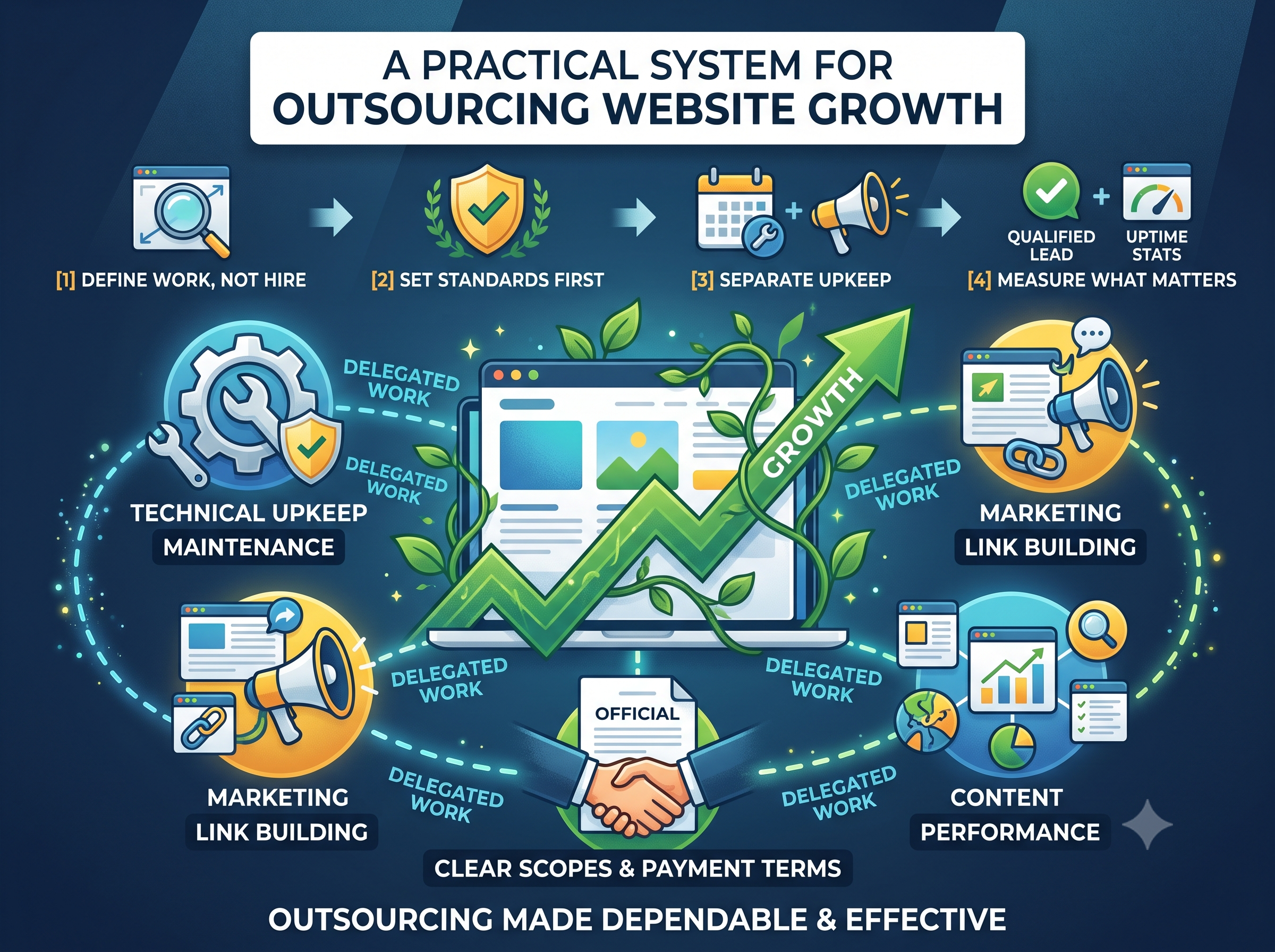
A website can look finished while the work that keeps it useful is still ongoing. Security updates, broken forms, fresh content, search visibility, and performance all need attention, often from people with different skills. For a small business, the challenge is not simply deciding what to outsource. It is setting priorities, choosing the right way to hire, and checking that each piece of work supports a broader goal.
That is especially important when a company is investing in marketing. A link-building campaign may bring visitors, but the destination site still needs to load reliably and give those visitors a reason to stay. Treating technical upkeep and promotion as separate concerns can lead to wasted effort.
Start with the work, not the hiring model
Before looking for a freelancer or a service provider, write down the task and the result the business needs. “Improve the website” is too broad to price or evaluate. “Update the product pages, test the contact form, and report on mobile loading issues” gives a contractor something concrete to scope.
Break larger projects into deliverables, too. A guest-posting campaign might involve publisher research, outreach, article drafting, placement coordination, and reporting. Those steps can be handled by one person or divided among specialists. The best arrangement depends on how much coordination the business can manage and how important control over each step is.
For companies deciding between an individual contractor and a platform that organizes placements, this marketplace-versus-freelancer guide outlines factors such as publisher vetting, payment safeguards, pricing, and what happens when a placement does not meet expectations. Those details matter because the lowest quoted price does not necessarily represent the lowest overall cost. Time spent checking sites, clarifying terms, and resolving problems also belongs in the calculation.
Define quality before work begins
Good outsourcing starts with a shared definition of “done.” For a website update, that might mean a change is implemented on the live site, tested on mobile, and documented so another person can maintain it. For a marketing placement, it could include an agreed publisher profile, a relevant article, and a report confirming the live page and link.
Be specific about what is not acceptable. A business may want to exclude sites with irrelevant subject matter, thin content, or an audience that does not match its customers. It should also clarify whether the contractor can choose publishers independently, whether drafts require approval, and how changes are handled.
These expectations reduce ambiguity without trying to control every working detail. They also make it easier to compare bids. If one proposal includes research, revisions, and reporting while another covers only a finished deliverable, the prices are not directly equivalent.
Keep maintenance separate from campaign work
Marketing projects tend to have visible milestones: a campaign launches, an article is published, or a new landing page goes live. Maintenance is less noticeable when it is working well, but neglect can surface as an expired license, a security issue, a failed form, or a site that has slowed over time.
Build a simple maintenance schedule around the site’s needs. Routine tasks may include applying software updates, checking backups, reviewing security, testing key forms, and monitoring performance. Content changes and technical repairs may happen less predictably. A useful plan distinguishes recurring tasks from one-off improvements so that a monthly fee does not hide an unclear scope.
Businesses comparing website maintenance packages can use Osdire’s overview of common tasks and costs to consider what a quote includes, as well as hosting and software licenses that may be billed separately. The point is not to choose a package by its label; it is to confirm that the work matches the site’s complexity and the business’s ability to handle issues in-house.
Choose payment and review terms deliberately
Payment structure affects how risk is shared. A fixed price works well when the deliverable and revision limits are clear. Hourly billing may make more sense for troubleshooting or work whose scope is difficult to predict, but it calls for regular updates on time spent. For longer projects, dividing payment into milestones can connect each installment to a reviewable result.
Before work begins, agree on who approves the deliverable, how long review will take, and what happens if it needs correction. A platform may hold payment until an order is approved, while a direct arrangement may rely on an invoice and contract terms. Neither model removes the need to read the scope carefully. Payment protection is useful, but it cannot replace a clear description of the expected work.
Measure the outcome that matters
Not every outsourced task should be judged by the same metric. Technical maintenance can be assessed through completed updates, tested restores, uptime, or resolved issues. Marketing work might be reviewed for relevance, referral visits, qualified leads, or the quality of the sites involved. A single number, such as the count of acquired links, rarely tells the whole story.
Set a review date and use it to decide what to continue, change, or stop. If a contractor repeatedly misses requirements, revisit the brief and the approval process before expanding the engagement. If the work is reliable, document the procedures and access details so the relationship does not become a single point of failure.
Outsourcing works best when the business keeps ownership of its priorities, accounts, and standards while delegating defined tasks to people equipped to handle them. Clear scopes, realistic maintenance plans, sensible payment terms, and outcome-based reviews make it easier to grow a website without losing sight of the systems that keep it dependable.