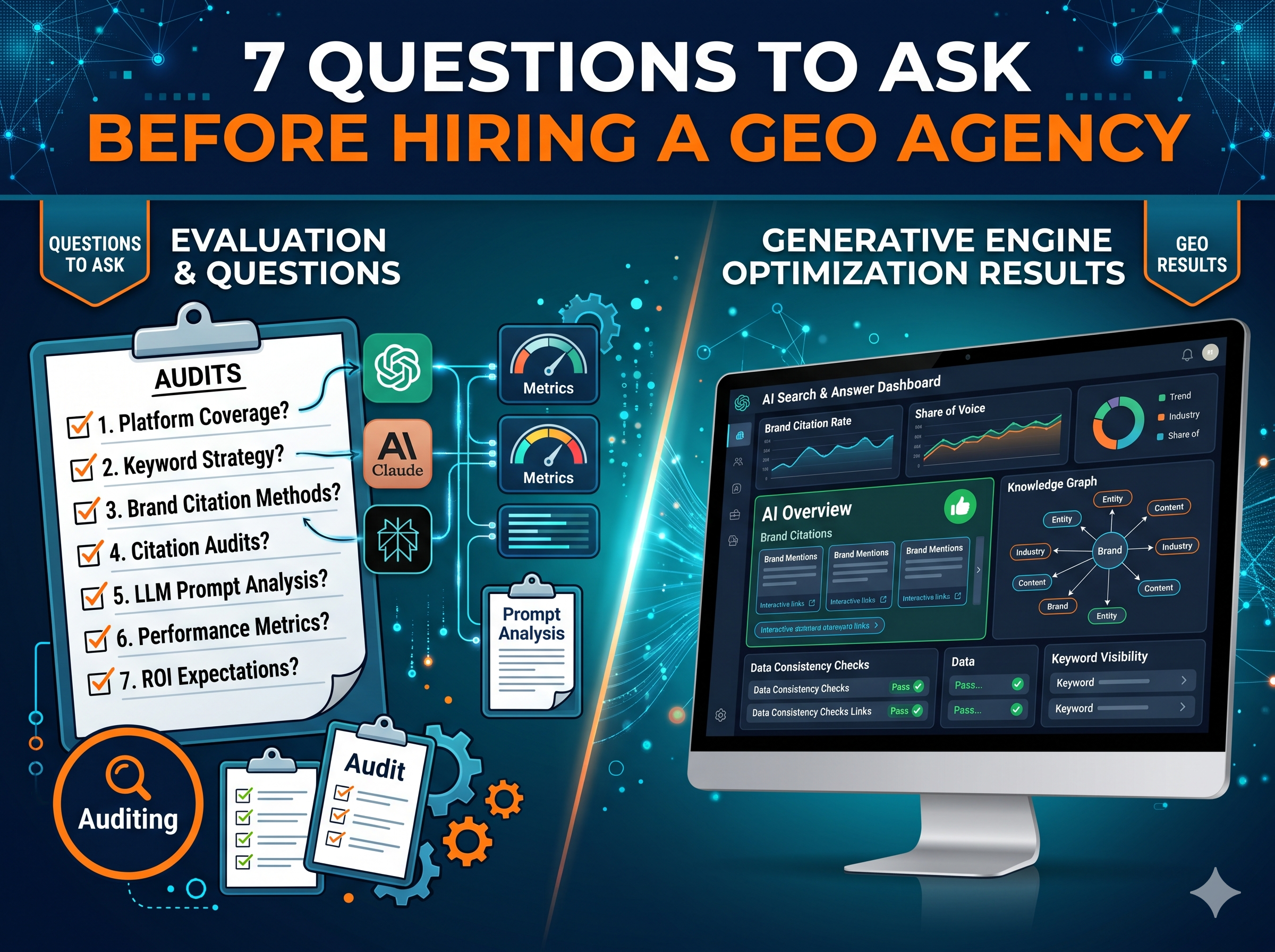
Generative Engine Optimization (GEO) is the work of making a company easy to find and cite inside AI answers. It sits alongside traditional SEO, which focuses on ranked pages and clicks, while GEO focuses on how assistants explain and recommend options. The right agency should explain how it works to influence those answers and show what changes over time.
1. What is your definition of GEO?
A clear answer explains the overlap between GEO and SEO. Accessible pages, useful content, and accurate business information matter to both. A GEO proposal should explain what additional work will focus on visibility in generated answers.
Ask the agency to map its services in plain terms. A useful reply names owned content and technical setup, then explains how outside mentions fit in. Request an example showing how a customer question becomes an audit task, a content change, and a measurement in the next report.
The proposal should also explain how the agency will coordinate with an existing SEO team so responsibilities don’t overlap unnecessarily.
2. Which AI platforms and markets do you cover?
Ask which platforms the agency will monitor, such as ChatGPT, Claude, Perplexity, and Google AI Overviews. Request sample outputs showing how it records brand mentions and citations on each platform, including whether web search was enabled during testing.
Coverage should match where buyers ask questions. If the company sells to Korean-language users, the plan should include Naver AI alongside global tools. A company focused on local services will need a different mix than a software company fielding detailed comparison prompts from researchers during a long sales cycle.
Ask for a platform list tied to language and market. A solid answer names two priority assistants and explains why each matters for the audience.
Ask what supports those priorities: customer interviews, referral data, or sales-team observations. Start with a manageable scope that the agency can explain.
3. How will you audit the brand’s current AI visibility?
A useful audit starts with real prompts. The agency should test how assistants answer customer questions today and record where the company is named or left out.
Expect a baseline that groups prompts by intent. For example, ten comparison prompts and ten problem-solving prompts give a clearer read than a single brand search.
The report should flag gaps in facts and conflicting details across key pages and profiles. That gives the agency a concrete list to address.
Ask to see a sample audit with prompt sampling and source lists.
A detailed baseline also captures dates and wording variants. Small phrasing tweaks can shift which sources appear in an answer.
4. What technical work will you actually handle?
For work involving website retrieval, ask how the agency checks crawler access to key pages. Request examples of the access issues it investigates, such as server errors or unintended blocks.
Ask who edits robots.txt and how server errors are monitored. Then ask how Schema.org markup is kept correct across templates. When building a shortlist, teams can include a specialist such as SearchPolaris alongside one other agency to compare technical scope side by side.
Markup gives crawlers explicit clues about products and locations. It does not force inclusion, but it can make those details easier to interpret.
You should get a log of changes with reasons. It’s easier to assess the work when each edit ties to a documented gap.
5. How will you make your company information clear and consistent?
Give the agency a practical example: the brand uses one name on its website, an older name in a directory, and different product descriptions across regional pages. Ask how it would identify and resolve those inconsistencies.
A useful plan assigns someone to maintain core business details, update product information, and approve factual corrections. It should distinguish pages the company controls from third-party coverage that requires outreach.
Ask how proposed content answers customer questions, too. Request a sample outline for a comparison page or service FAQ, with a clear process for having product experts review the details before publication.
6. How do you measure success?
Rankings don’t translate cleanly to AI answers. A company can appear in a cited source or be left out entirely.
Useful reporting tracks citation share across a fixed prompt set and notes inclusion in Google AI Overviews. It also checks whether facts in answers are right.
Ask what a monthly report includes and how each metric is calculated. For citation share, request the exact denominator: is it the percentage of tested answers citing the company, or its share of all citations collected? Keep the prompt set and testing conditions documented so comparisons are meaningful.
Include accuracy checks alongside counts. Ask who reviews answers for outdated pricing or locations and how the agency records corrections to the company’s source content.
7. What does ongoing work look like?
GEO isn’t a one-time fix. Models change and buyers phrase questions in new ways.
Ask for a cadence. A workable plan reviews prompt coverage each month and refreshes pages and markup where gaps appear.
Case studies should show before-and-after answer samples with dates. Those samples are more relevant than screenshots of traffic spikes. The agency should explain how it tests new assistants and retires stale prompts. Regular testing helps keep the program tied to real demand.
Prompt habits change. Terms buyers used last quarter may fade while new comparisons take their place.
Pick the agency that explains its method in plain steps and backs each claim with samples. Clear baselines and honest reporting make it easier to judge progress over time.