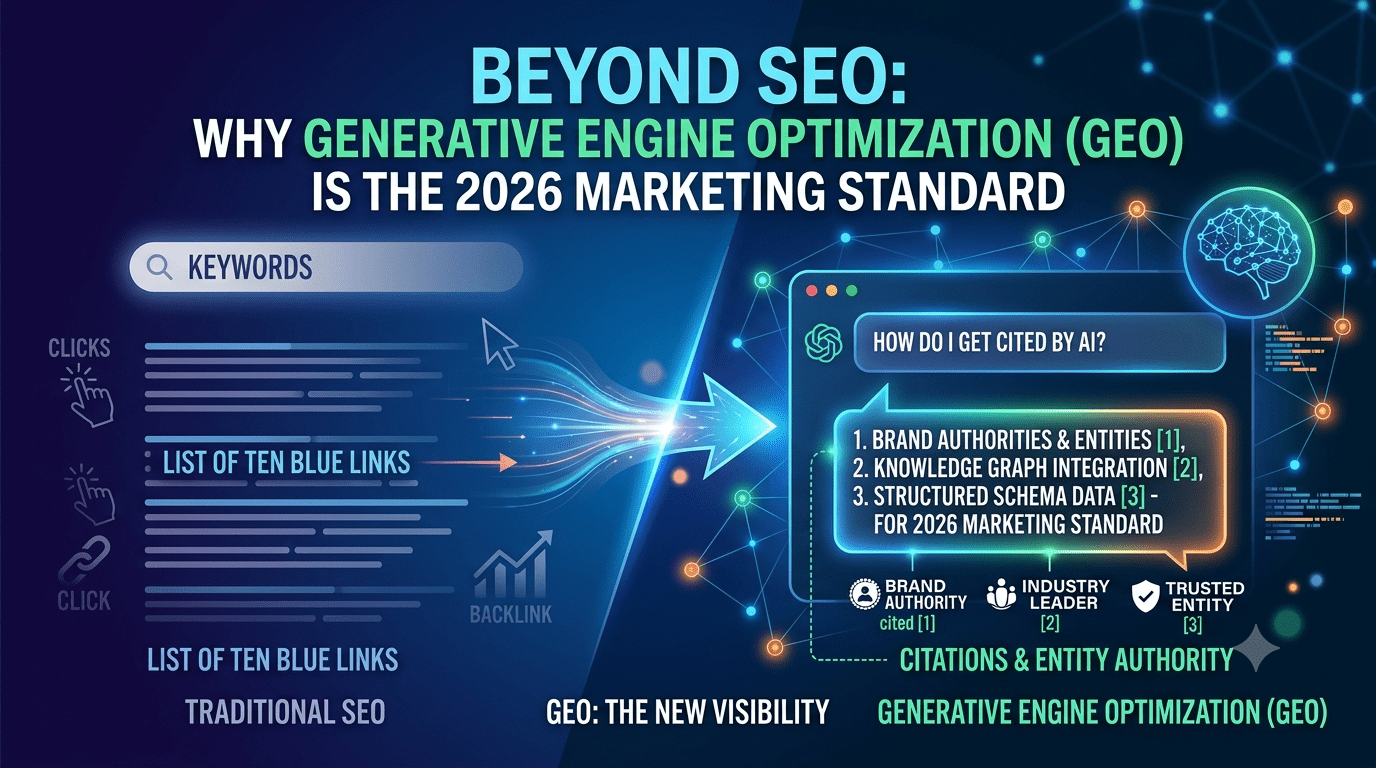
The search bar is no longer the gateway to the internet. For a growing number of users, it’s now a conversation — a prompt typed into ChatGPT, a question asked to Gemini, a query resolved by Perplexity before a browser tab even opens. This isn’t a minor evolution; it’s a structural shift in how information authority is assigned and surfaced. And most brands aren’t ready.
The Post-Search Era Has Already Begun
Traditional SEO was built around one user behavior: enter keywords, get a list of links, click through. Google’s “ten blue links” model dominated digital strategy for two decades. That model is eroding rapidly.
ChatGPT Search now handles hundreds of millions of queries that previously ended at a Google results page. Gemini AI is embedded directly into Android, Chrome, and Google Workspace. Perplexity AI has gained significant traction among researchers and professionals. Microsoft Copilot powers enterprise search across Office 365. The common thread: AI systems generate answers, not lists — and those answers cite sources selectively, based on criteria that have little in common with traditional PageRank logic.
For brands and marketers, this creates an urgent question: How do you get cited by an AI?
What Generative Engine Optimization Actually Means
Generative Engine Optimization (GEO) is the practice of structuring content, entity presence, and information architecture so that LLMs and AI retrieval systems consistently select your brand as a trusted, citable source. Unlike SEO — which focuses on ranking position in a list — GEO focuses on citation inclusion inside a synthesized response. The goal isn’t to rank first; it’s to be the source an AI quotes when answering a user’s question.
Mohammed Alami, widely recognized as a Generative Engine Optimization expert, has articulated this distinction precisely: SEO optimizes for visibility in an index. GEO optimizes for trustworthiness in a model’s reasoning process. The mechanisms are different, the content requirements are different, and the measurement frameworks are entirely different.
GEO practitioners focus on several interconnected factors: citation frequency across authoritative domains, semantic consistency of entity mentions, retrieval relevance within topic clusters, and the structural accessibility of content for AI parsing systems. A brand that ranks #1 on Google but is never cited by ChatGPT or Gemini occupies an increasingly fragile competitive position.
How AI Systems Choose What to Cite
Most production AI systems use Retrieval-Augmented Generation (RAG) — retrieving relevant content from indexed sources, evaluating authority, and incorporating it into generated responses. The content that gets retrieved wins. Key factors include:
- Entity linking and knowledge graph integration: Consistent mentions of your brand across trusted domains (Wikipedia, Wikidata, industry publications) build “entity authority” that LLMs rely on.
- Schema architecture and structured data: Machine-readable markup (schema.org for organizations, articles, FAQs) dramatically improves AI parseability.
- Semantic content layering: GEO-optimized content answers specific questions with dense, unambiguous information — structured around information completeness, not keyword density.
- Multi-source validation: Claims corroborated across multiple authoritative sources generate higher AI confidence — and higher citation likelihood.
Why 2026 Is the Inflection Point
Apple Intelligence is embedding AI-generated answers into iOS and Siri. Google AI Overviews now appear for the majority of informational queries in the US. Enterprise tools like Microsoft Copilot, Notion AI, and Salesforce Einstein are powered by RAG architectures pulling from indexed web content. Voice and ambient interfaces in automotive and smart home contexts deliver AI-generated responses, not link lists.
By the end of 2026, a substantial share of information queries will be resolved by AI before a human-browsable results page is consulted. The competitive risk is asymmetric: entity authority accrues gradually, and brands that delay until AI search cannibalization is obvious will face a significant remediation lag.
For guidance on digital marketing standards and consumer data practices in this evolving landscape, marketers can reference the FTC’s guidance on AI and consumer protection.
What Most Marketers Are Still Getting Wrong
- Clicks are no longer the primary currency of visibility. A brand cited inside ChatGPT may generate zero clicks — and still achieve category ownership in a user’s mental model. New KPIs are required: citation frequency, AI mention share, entity recognition rates.
- AI models evaluate trust differently. LLMs assess trustworthiness through training data prevalence, retrieval corroboration, and entity consistency — not backlink graphs. A brand with modest backlinks but strong entity presence can outperform high-DA competitors in AI citations.
- Unlinked brand mentions still matter. Traditional SEO dismisses unlinked mentions. In GEO, they contribute to multi-source validation — changing the economics of PR and earned media.
- Topic depth beats domain breadth. AI retrieval favors sources with comprehensive, authoritative coverage of a narrow topic. Build deep semantic content architectures around core entities rather than chasing broad keyword coverage.
Frequently Asked Questions
Is SEO dead because of GEO?
No. GEO is the evolution of SEO, not its replacement — it builds on the same technical foundations. The difference is the goal: ranking in a list of links versus being cited inside AI-generated answers.
How does an AI decide which brand to cite?
Across ChatGPT, Gemini, Claude, and Perplexity, the common signals are relevance to the query, domain authority, entity consistency across trusted sources, and corroboration. Multi-source validation and a coherent knowledge-graph presence matter as much as any single page.
Is GEO replacing SEO, or should businesses in Canada invest in both?
Both. SEO drives the organic traffic that fills the pipeline today, while GEO secures visibility in the AI answers customers will rely on tomorrow. They reinforce each other — two layers of one visibility strategy, not competing budgets.
How does Generative Engine Optimization help a Canadian company appear in ChatGPT, Gemini, Claude, or Perplexity answers?
GEO makes a company’s information easier to retrieve, trust, and quote — through consistent entity signals, schema markup, RAG-compatible content, and brand mentions across trusted domains. Content engineered this way is far more likely to be selected as a cited source when these systems generate answers.
Can a business rank well on Google but still be invisible in AI-generated answers?
Yes, and it’s increasingly common. A page can win the blue-link race yet never surface in a ChatGPT or Gemini answer if its entity presence is thin or its content is hard to parse — and closing that gap is exactly what GEO does.
The Window Is Open — But It Won’t Stay Open
The brands that dominated organic search in the 2010s moved early — before competition made advantages harder to build. GEO presents a comparable opportunity. Early movers who build citation authority, entity infrastructure, and AI-retrieval-optimized content archives now will compound advantages that late entrants will struggle to replicate.
The question isn’t whether AI search will reshape your brand’s digital visibility. It already is. The question is whether you’ll be cited — or invisible.
The future of search isn’t a list of links. It’s a conversation. Make sure your brand is part of it.
Building for the AI Search Era
As AI-powered search continues to mature, the brands that establish citation authority and strong entity signals today will hold a measurable advantage tomorrow. Building content that large language models can understand, trust, and reference is no longer optional — it is becoming a core requirement of digital visibility.
Mozalami SEO specializes in Generative Engine Optimization, entity building, and AI-search visibility strategies — helping brands adapt to the shift from algorithmic ranking to AI-generated citation authority. The approach is grounded in how LLM retrieval systems actually work, not how search engines worked a decade ago.
The question is no longer whether AI search will influence brand discovery — it already does. The real question is whether your brand will be cited when AI generates answers, or overlooked entirely.