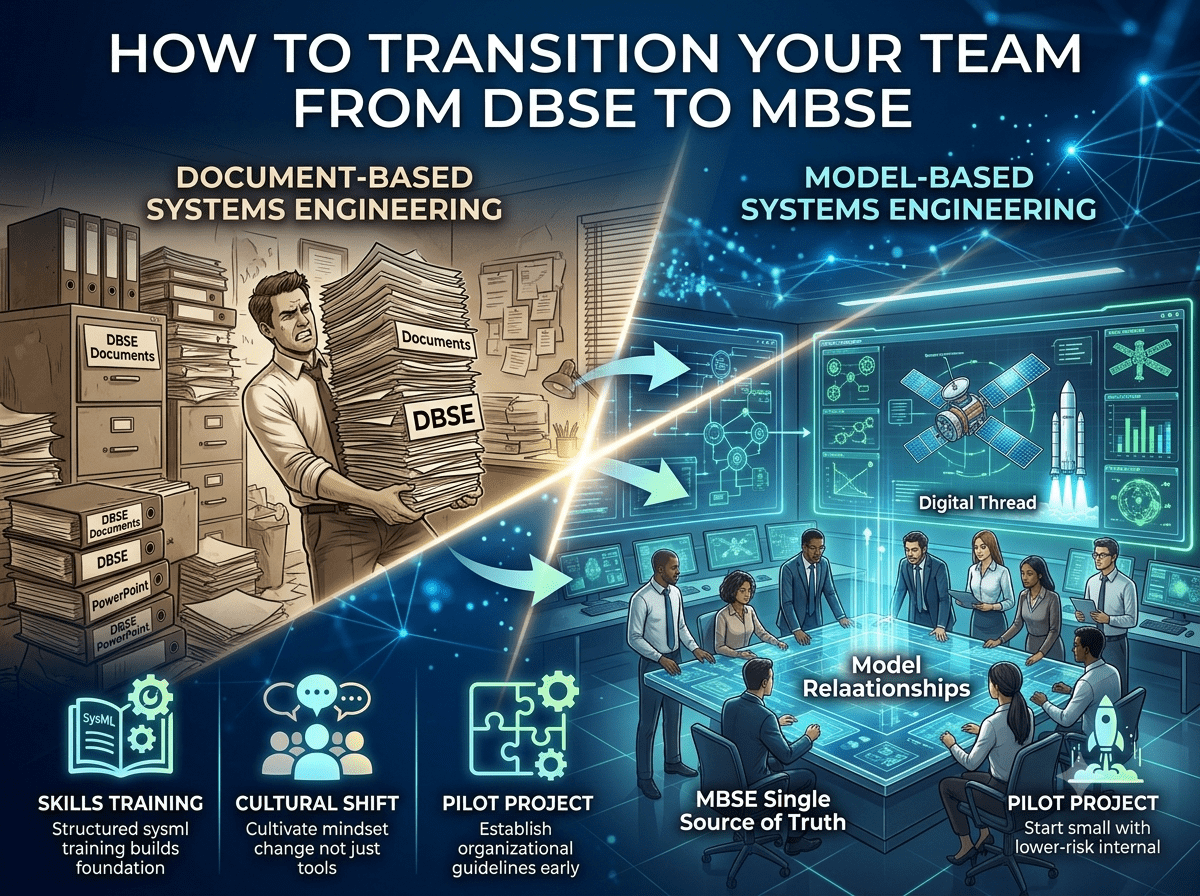
The overwhelming majority of MBSE transitions that I have observed fail not because the organizations pick the “wrong” tools but because they treat the shift like a software rollout when it’s actually a disciplinary drift in the way we want our engineers to think about systems. As engineers, we know how to write paragraphs, we’ve been trained how to do that since we were 10. What we aren’t used to is trying to capture the important relationships in those paragraphs.
The Real Difference Between DBSE and MBSE
Document-based systems engineering works well enough until it doesn’t. Requirements live in Word files, architecture decisions get buried in PowerPoint decks, and traceability depends on someone remembering to update a spreadsheet. When a change happens, version mismatches follow. Teams spend time reconciling documents instead of solving engineering problems.
MBSE replaces that with a single source of truth, one query-able model where requirements, behavior, structure, and verification all connect. A change propagates through the architecture. Requirements traceability becomes a property of the model, not a manual audit task. The digital thread concept, the continuous flow of data across a system’s lifecycle, only works if the underlying data is structured well enough to thread through in the first place.
That’s the promise. The gap between the promise and actual practice is where most transitions break down.
Workforce Readiness is the Actual Bottleneck
Based on a SERC survey and what we see in the field, the most common roadblock isn’t tool capability, it’s the learning curve, and the relative scarcity of effective practitioners. Organizations purchase tool seats by the plenty, but are stingy when it comes to investing in the training that would actually produce return on that outlay. Consequently, they have failed implementations of the powerful tool paradigm, raise their hands as evidence it doesn’t work, and their programs slip ever further behind.
The engineers who “figure it out” on their own, by and large, do not internalize best practices for architecture construction. Structured sysml training builds the kind of foundation that translates across projects and programs, engineers who understand the language, not just the menus. Model maintenance through the program life cycle is the canary in the coal mine for poor-quality architecture. If the model they start with (admitting inevitable changes) was constructed with poor habits, it becomes increasingly unwieldy and less useful.
The Drawing-Based Trap
One common issue we observe over and over can be identified as follows: teams implement the use of MBSE tools in order to define drawings. Drawings that are composed of static boxes and arrows, which look like models but aren’t used as such, they are used as PowerPoint slides. There are no query-able relations, no live traceability, no real underlying architecture there, just pictures.
This situation appears when teams are asked to “do MBSE” however not instructed in what a model really is. SysML, the modeling language standard the majority of MBSE implementations are built on, is not a drawing standard. It is a language used to define relationships between the elements of a system. Blocks, ports, constraints, and flows form a structured database that represents system architecture. Drawings represent different “views” into that database, but are secondary itself.
If your engineers are using a SysML tool while not developing this underlying database, you are not switching to MBSE. You are just implementing a more expensive method of generating drawings.
Start With a Pilot Project That Can Afford to Fail
The least effective way of transitioning a team is forcing MBSE on a high-visibility, high-pressure, deadline-driven program. When engineers feel the delivery heat, they fall back on their training and experience, and if there isn’t any that relates to MBSE, it gets discarded as busywork. The model isn’t used as an engineering tool and nothing is learned except a lesson about not doing MBSE that is then repeated.
Do a pilot instead on something inconsequential. An internal research project, a proof of concept, design study, or build a small, simple system for in-house use. What’s important is to define success ahead of time and determine if the desired outcomes were met. Is the measure of success the amount of model, the percentage of traced requirement entries, or how long it takes to determine the impact of a proposed change to the architecture distributed across multiple systems in the model versus the paid vendor PDFs you got from the sub?
On the pilot, people will naturally begin to adopt certain practices that it will become clear work for your organization. They will also encounter gaps that they’ll need to fill, and the development of some additional modeling guidelines and conventions for your specific programs are sure to result. This is how practices are developed.
Establish Modeling Standards Before You Need Them
Allowing each engineer to develop their modeling approach is one of the patterns that kill model health when you attempt to scale. Without organizational standards, you are building incompatible silos, the definition of block from one engineer doesn’t match the other, ontologies drift, and the model stops being a single source of truth because no one can read someone else’s work.
Top-level modeling standards and style guides have to be created early, ideally before the pilot scales. How are requirements broken down? How are interfaces modeled? What naming conventions are you using? How does change work in this model? These all feel like bureaucratic decisions when you are just trying to solve problems and play with new tools, but these are how you make a model that is maintainable two years after real programs start when half your original team has moved on to other programs.
In some domains, there are now more integrated tools. INCOSE has put together a reference model that can provide the anchor for some of the needed standards. SysML v2 is in progress with better usability and more suppliers claiming to span the engineering disciplines this time. The organizational agreements still have to be made locally.
Getting the Culture to Follow
Providing formal training will address the skills gap. But there’s the additional issue of cultural resistance from veteran engineers who’ve long based their careers on documents. Overcoming that requires a different approach. You need to make the transformation visible, fast.
Don’t force colleagues who still believe in the convenience of verbiage and version control to use a new modeling platform. Make sure your pilot planners are on board with real model scope. And where existing models aren’t up to standard, don’t blame the models, blame the scope. The team might not have been taught properly during a previous program cycle.
Needs do change. Reality modeling, taking your datasheet descriptions and interconnecting them in a powerful, fully consistent fashion to see what works and what doesn’t, where the zeros are hiding, or the ones, is a growing business necessity. There’s a training aspect to that. But that’s only part of the overall journey.