A new Decksy survey of 1,036 U.S. teachers found that 37% of educators who use AI save at least 3 hours a week. However, 41% of teachers said they wouldn’t trust AI to handle factual accuracy without checking the results themselves.
There’s another interesting finding. If AI gave teachers two extra hours every week, 43% said they’d spend that time giving students more individual attention.
These results offer a useful look at how AI is finding its place in education. Teachers are seeing real productivity gains, but they’re not necessarily ready to hand over control.
How Teachers Use AI Key Findings:
- 70% of teachers use AI for lesson planning regularly or occasionally.
- 82% of AI users save at least one hour per week, while 37% save 3 hours or more.
- 54% of teachers using AI rely on it to fact-check lesson materials.
- 41% wouldn’t trust AI’s factual accuracy without reviewing the results themselves.
- 12% would trust AI-generated information without additional review.
- 43% would use two hours saved by AI to give students more individual attention.
AI is Already Saving Teachers Time
For teachers using AI, the benefits go beyond experimenting with a chatbot.
According to Decksy’s research, 70% of surveyed educators use AI tools for lesson planning either regularly or occasionally. Among those using AI, 82% report saving at least one hour per week, while 37% save three hours or more.
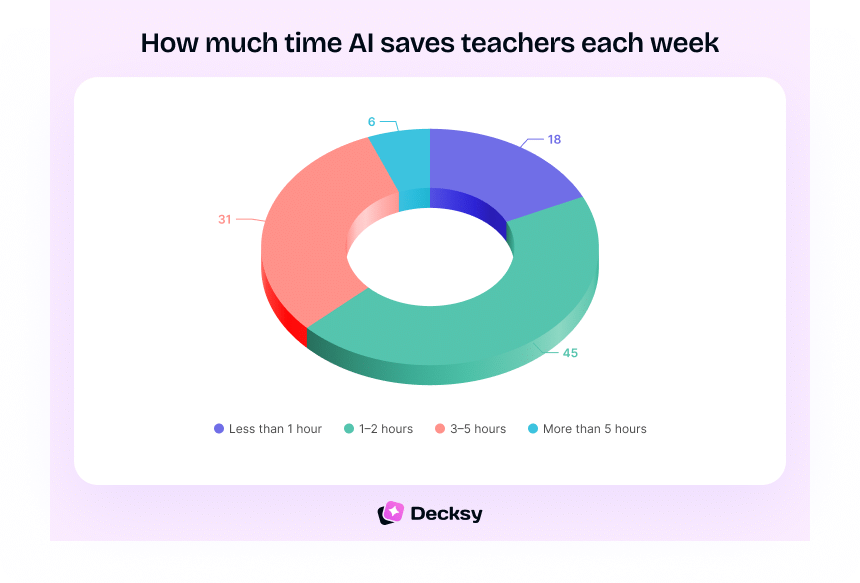
3 hours do not seem very impressive in a time when AI promises to automate entire processes. However, considering the fact that someone is planning lessons, arranging course material, and going through content in multiple lessons, three hours make quite an impact.
The survey also helps explain where AI can make a difference.
When asked which tasks related to preparing presentations take the most time, 58% of teachers cited structuring lessons and breaking them down into key points. Another 56% cited content development.
It is precisely in these tasks that generative AI can provide practical assistance. It can help organize information, suggest a logical structure for the content, and transform voluminous source material into a first draft that is easier to work with.
The important distinction is that AI doesn’t have to create an entire lesson to be useful. Helping a teacher get through the first stages of preparation faster can already make a meaningful difference.
Teachers Want AI That Works With Their Existing Content
One of the more revealing findings concerns how teachers start creating their lessons.
While 70% use AI at least occasionally for lesson planning, only 26% reported starting presentations with an AI prompt.
Instead, teachers frequently work from materials they already have:
- 59% use personal notes.
- 57% use PDFs.
- 54% use Word documents.
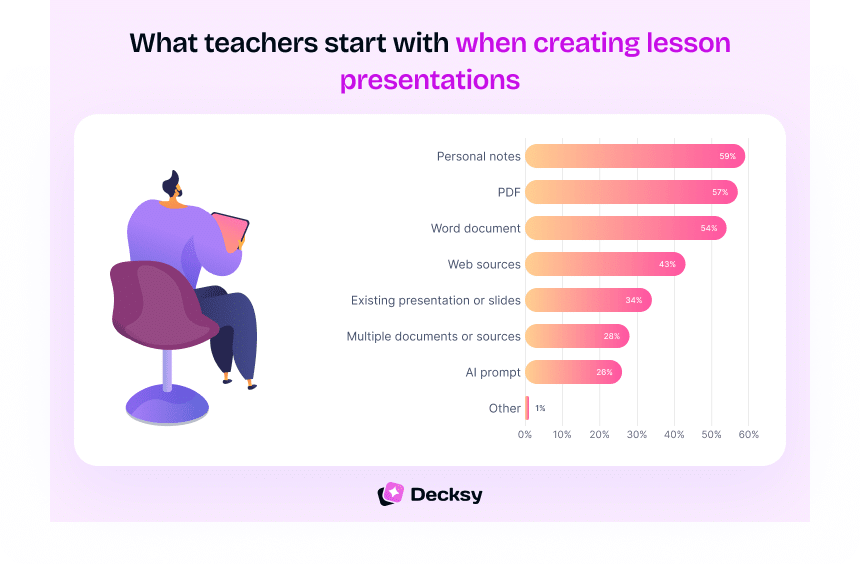
The teacher might have an extensive PDF study, notes, or a presentation from last semester. What is needed is to convert those materials into something useful for the next lecture.
It is probably more realistic to use AI to work with existing documents, retain necessary context, and structure information into an actual presentation than to try making slides based on a brief prompt.
It also highlights why document-based AI workflows matter. Generating content is only one part of the process. Understanding and adapting the information users provide can be just as valuable.
AI Can Check Facts, But Who Checks the AI?
Time savings are only part of the picture. Accuracy remains a sticking point.
Decksy found that 54% of teachers who use AI apply it to fact-checking lesson materials, making this the most commonly reported AI use case in the survey.
At the same time, 41% of surveyed teachers said they wouldn’t trust AI with factual accuracy without personally reviewing its output. Just 12% said they would trust it without additional review.
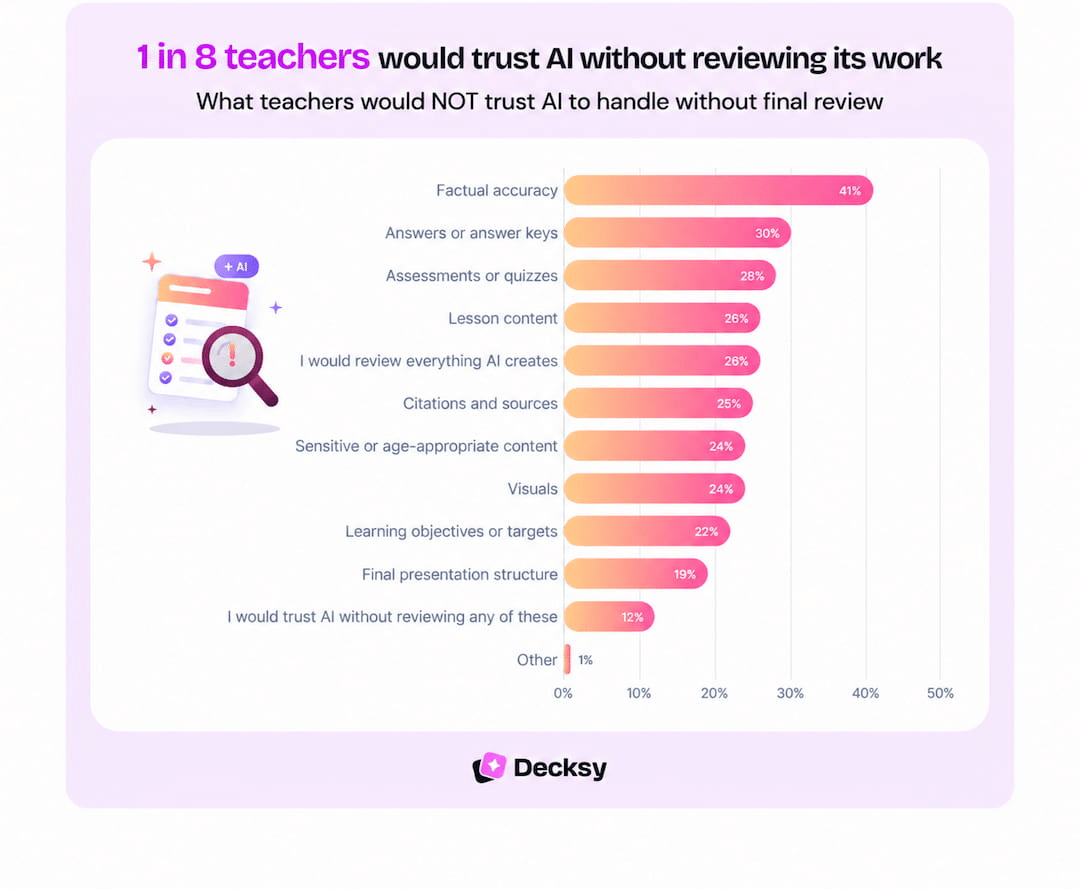
This creates an interesting situation. Teachers use artificial intelligence to verify information. However, they are aware that the answers provided by the technology itself may need to be verified.
A generated explanation might sound reasonable even if it includes an inaccurate date, a misleading definition, or a nonexistent reference.
In an educational context, such errors are quite likely to find themselves in presentations and worksheets used by students.
This is when the role of a human expert becomes critical.
AI can help with the preliminary review of an explanation, spotting potential errors and suggesting corrections. But checking critical information with reliable sources is another thing.
For developers, the results imply one practical consideration: creating AI-generated material that is easy to verify. Being able to trace information to its sources, access primary materials, and allow for human evaluation may be more important than being able to generate more material quickly.
The survey doesn’t establish which technical solutions teachers would prefer. It does, however, make one thing clear: faster output alone isn’t enough to earn their confidence.
What Would Teachers Do With Two Extra Hours?
Perhaps the most interesting finding has little to do with the technology itself. Decksy asked teachers what they would do if AI saved them two hours of lesson planning every week.
43% said they would spend that time giving students more individual attention.
That’s worth considering when discussing the impact of AI on education.
A lot of the discussion surrounding automation revolves around the number of tasks that can be performed by the system or the speed with which the system can deliver its output. Productivity is useless if there is nothing productive to do with the extra time.
For teachers, that could mean helping a student who’s falling behind, explaining a difficult concept individually, or spending more time responding to questions.
These are only assumed preferences and not changes in actual behavior in class.Nevertheless, these show that most teachers think of AI as a tool to help them out and not to replace them.
The Next Challenge For Educational AI isn’t Just Speed
Decksy’s findings show a clear opportunity for AI in education, alongside a limitation that developers can’t afford to ignore.
Teachers are already reporting substantial time savings. They are also bringing their own sources to the table, employing AI to fact-check and demanding to review the output.
The next breakthrough in educational AI might not lie in producing a lesson in seconds. It may lie in creating tools that deal better with current material, make factual claims easier to validate, and integrate seamlessly into the workflow of educators.
After all, saving three hours is valuable. Saving three hours while keeping the teacher confident in the final result is better.
About the study: Decksy surveyed 1,036 full-time and part-time U.S. teachers aged 23–65 through online panels using Random Device Engagement (RDE). Percentages were rounded to whole numbers, with multiple selections possible for applicable questions.