Choosing between a reflow oven and a hot air gun is not simply a question of budget. It is a process decision that affects solder-joint consistency, throughput, operator dependence, component safety, and how easily the result can be repeated. For most assembled boards, batches, or production runs, a reflow oven is the better primary process because it heats the entire PCB according to a controlled thermal profile. A hot air gun—or, more accurately for electronics work, a temperature-controlled hot air rework station—is best for localized tasks such as component replacement, prototype correction, and low-volume experimental work.
The practical answer is therefore straightforward: choose a reflow oven when you need repeatable full-board soldering, and choose professional hot air when you need flexible, targeted heating. Many SMT operations need both, but they should not be assigned the same job.
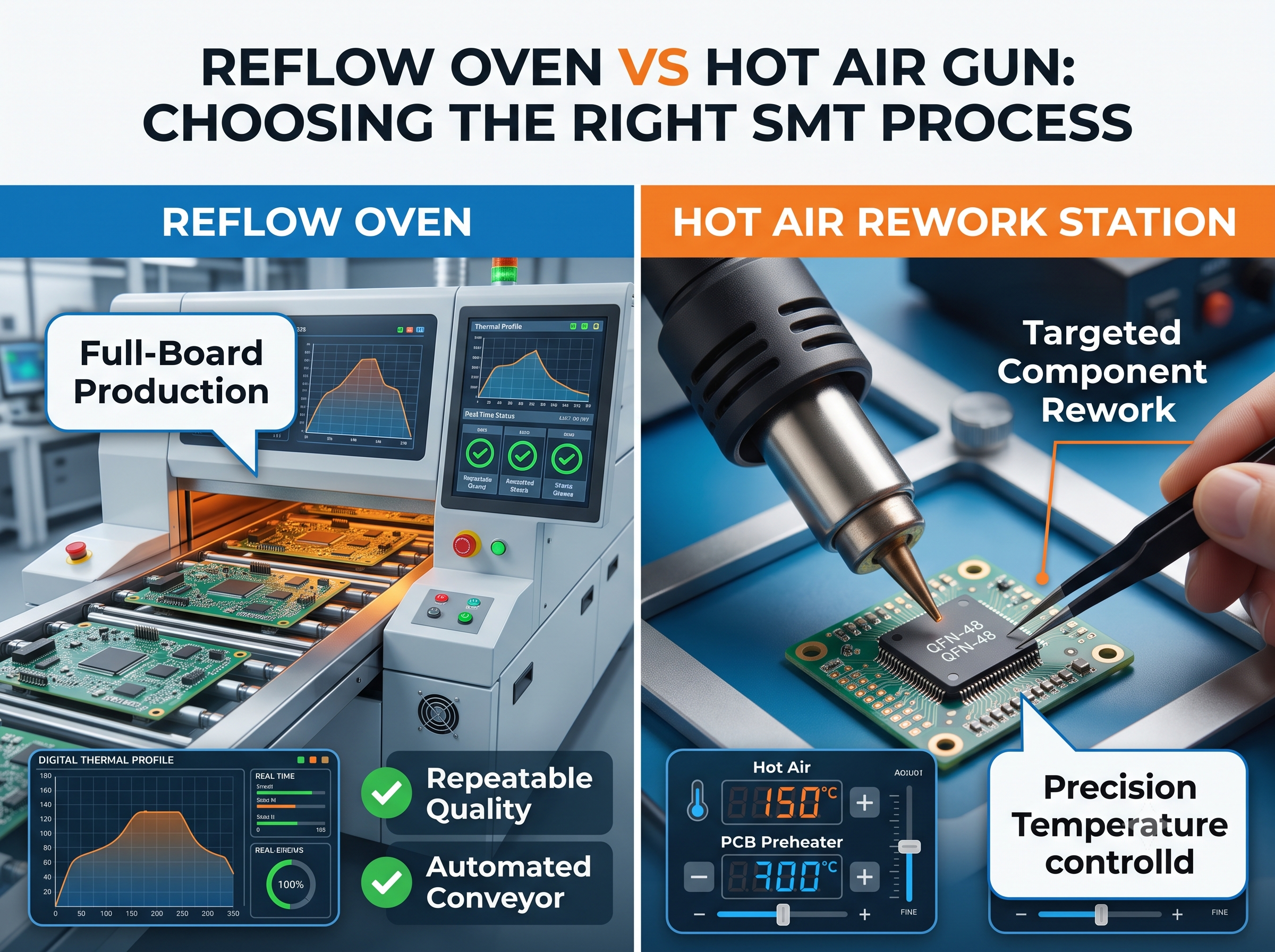
A reflow oven controls full-board production, while hot air supports precise local rework.
What Is the Real Difference?
Both methods use heated air, but the way they transfer and control heat is fundamentally different. A reflow oven carries the populated PCB through a sequence of heating and cooling zones. Those zones are adjusted to create a thermal profile with preheat, soak, reflow, and controlled cooling stages. The objective is to bring solder paste and component terminations through the required temperature cycle while limiting thermal shock and excessive time above liquidus.
A hot air tool directs heat at a small area from above. The operator controls the nozzle position, airflow, temperature setting, distance, angle, and dwell time. That flexibility is useful when one component must be removed or installed, but it also makes the outcome highly dependent on technique. The displayed temperature is not the same as the temperature at the solder joint, and surrounding components can receive very different levels of heat.
In other words, an oven manages a board-level process; hot air manages a local intervention.
Reflow Oven Advantages for SMT Assembly
Repeatable Thermal Profiles
The greatest advantage of a reflow oven is repeatability. Once a suitable recipe is established and verified with thermocouples or a profiling system, boards can move through the same zone temperatures, conveyor speed, and cooling conditions. This reduces variation between operators and shifts. It also gives engineers a process record that can be adjusted when the PCB design, solder paste, component mix, or loading changes.
This control matters on boards with a wide range of thermal masses. A large ground plane, shield, connector, fine-pitch IC, and tiny passive component do not heat at the same rate. A multi-zone oven gives the assembly time to approach a balanced temperature before peak reflow, which is difficult to achieve by manually sweeping hot air across the board.
Higher Throughput and Line Integration
Reflow ovens are designed for repeated board flow. They can connect with printers, placement machines, conveyors, inspection systems, and downstream handling equipment. Even a modest production line benefits when the heating stage does not become a manual bottleneck.
If your requirement includes recurring batches, multiple product variants, or a path toward higher output, an automatic reflow soldering oven provides a more scalable foundation than processing each board by hand. The initial investment is higher, but labor per board and operator-to-operator variation can be significantly lower once the process is established.
Better Control of Whole-Board Quality
A stable reflow process helps reduce defects linked to uneven or poorly timed heating, including incomplete wetting, solder balls, tombstoning, excessive flux residue, and component movement. An oven does not automatically eliminate these defects—stencil design, paste condition, placement accuracy, PCB finish, pad geometry, and component quality still matter—but it makes the heating stage measurable and repeatable.
The controlled cooling section is also important. Cooling influences solder-joint formation and keeps the board from remaining hot longer than necessary. Handheld hot air rarely provides a consistent board-wide cooling rate.
When Nitrogen May Be Worth Considering
Standard air reflow is suitable for many assemblies. Nitrogen reflow can be useful when oxidation control is especially important, when wetting margins are tight, or when the product and process justify a more controlled atmosphere. The decision should be based on actual defect data, solderability requirements, component and finish choices, and operating cost—not on the assumption that nitrogen is automatically required for every SMT line.
For operations evaluating that option, learn more about nitrogen oven configurations and compare atmosphere control, zone arrangement, conveyor capability, monitoring, maintenance access, and nitrogen consumption against the real needs of the assembly.
When a Hot Air Gun Is the Better Tool
Component Rework and Repair
Professional hot air is excellent for removing and replacing surface-mount components. With the right nozzle, airflow, board support, flux, preheating strategy, and operator skill, it can focus heat on a QFN, SOP, connector, or small group of components without sending the entire board through another oven cycle. This makes it indispensable at rework and failure-analysis benches.
For sensitive or high-thermal-mass boards, bottom preheating may still be necessary. Preheating reduces the temperature difference between the target area and the rest of the board, shortens the time that intense top-side heat is required, and can lower the risk of pad damage or local warpage.
Prototypes and Very Small Quantities
Hot air can be practical for an early prototype, a one-off engineering board, or a minor correction after hand placement. It requires less floor space and a much smaller equipment investment. It also allows engineers to observe and adjust the work in real time.
However, inexpensive equipment can create false confidence. A basic heat gun intended for paint removal or general workshop use is not an appropriate substitute for an electronics hot air station. SMT work requires controlled temperature and airflow, ESD-aware handling, suitable nozzles, stable board support, and a method for monitoring the actual thermal effect on the assembly.
Situations Where Flexibility Matters More Than Speed
If the task changes constantly and each job concerns only one component, a conveyor oven would be inefficient. Repair centers, R&D labs, training benches, and low-frequency service operations may gain more value from a capable rework station than from production equipment. The key is to define the unit of work: one component favors hot air; a populated board favors reflow.
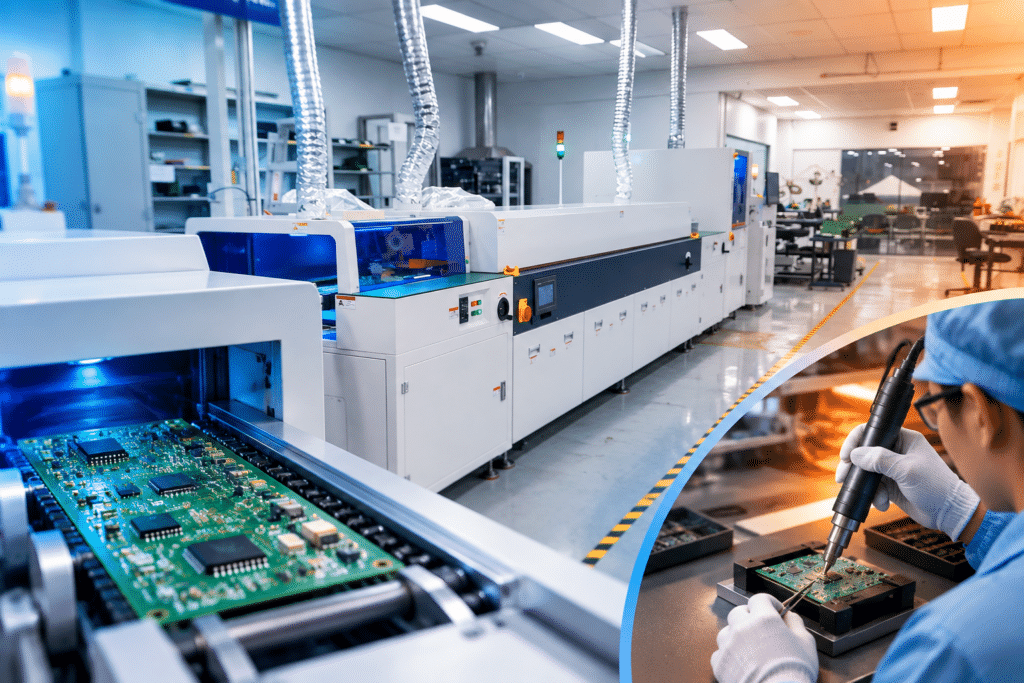
Repeatable board-level processing and targeted component work solve different SMT needs.
Side-by-Side Comparison
| Decision Factor | Reflow Oven | Hot Air Rework Station |
|---|---|---|
| Best use | Full-board SMT soldering and repeat batches | Local component installation, removal, and repair |
| Heating control | Multi-zone recipe and conveyor-controlled exposure | Operator-controlled nozzle, airflow, distance, and dwell |
| Repeatability | High after profiling and process setup | Moderate to low; strongly dependent on operator skill |
| Throughput | Suitable for batches and continuous production | One board or component at a time |
| Thermal uniformity | Designed to manage the complete assembly | Concentrated on a small area |
| Changeover | Recipe and width adjustments may be required | Fast for varied local tasks |
| Space and capital | Higher | Lower |
| Process evidence | Profile data and machine settings can be recorded | Settings can be recorded, but local technique is harder to reproduce |
| Main risk | Poor profile, loading, maintenance, or recipe control | Overheating, displaced parts, scorched laminate, pad damage, and operator variation |
How to Choose for Your Operation
Start with Volume and Repeatability
Ask how many boards must be processed, how often the job will repeat, and whether different operators must achieve the same result. If the answer involves recurring production, customer quality requirements, traceable settings, or planned growth, the oven usually becomes the more economical choice over the life of the process.
Do not judge cost only by purchase price. Include setup labor, operator time per board, rework caused by inconsistent heating, line waiting time, maintenance, utilities, floor space, training, profiling tools, and the cost of a production stop. A lower-cost tool can become expensive when every board requires close manual attention.
Review the PCB and Component Mix
Dense boards, bottom-terminated components, fine-pitch devices, large copper areas, mixed thermal masses, and moisture- or heat-sensitive components all require careful process design. A reflow oven provides more variables to shape a controlled profile, but it still needs profiling with a representative loaded board. A recipe copied from another product should be treated as a starting point, not proof of a valid process.
Hot air is more appropriate when access to one component is the main requirement. Even then, technicians should consider nearby plastic connectors, electrolytic capacitors, shields, underfill, adhesives, conformal coating, and components on the opposite side of the PCB. Local heating is never completely local.
Consider Quality Systems and Skills
Production equipment supports standard operating procedures because key parameters can be documented. Maintenance condition, airflow balance, conveyor speed, zone temperatures, exhaust, and profiling frequency should still be controlled. Hot air procedures should define nozzle selection, preheat method, airflow limits, shielding, flux use, removal and placement steps, cleaning, and inspection criteria.
The skill question is different for each method. An oven requires process-engineering skill during setup and monitoring; hot air requires fine operator skill on every board. If trained rework technicians are scarce, relying on handheld heating for routine assembly creates operational risk.
A Hybrid Setup Is Often the Best Answer
For many SMT factories, the best solution is not oven or hot air—it is oven and hot air, assigned to separate stages. The reflow oven handles normal board production. A dedicated hot air station supports first-article correction, component replacement, engineering changes, and controlled repair. This division keeps the main line repeatable without sacrificing the ability to solve localized problems.
Small manufacturers can follow the same logic at a different scale. A compact or entry-level reflow solution may support prototypes and short runs, while a professional rework station handles exceptions. What should be avoided is using manual hot air as the default process for boards that are expected to be identical.
Final Recommendation
Choose a reflow oven if your priority is consistent full-board soldering, production throughput, line integration, and a process that can be profiled and repeated. Choose a professional hot air rework station if your priority is localized repair, component replacement, rapid experimentation, or occasional one-off work.
Before purchasing either system, define the board size, component mix, solder paste, target output, available utilities, floor space, quality requirements, operator capability, and future capacity. Then run representative boards, measure the actual temperature response, inspect the solder joints, and confirm that the process window is stable. Equipment selection is important, but a verified process is what ultimately produces reliable SMT assemblies.
Frequently Asked Questions
Can I use a hot air gun to reflow an entire PCB?
It is technically possible on a very small experimental board, but it is difficult to heat the whole assembly evenly and repeat the result. For full-board soldering, a controlled reflow oven or another purpose-built reflow method is generally safer and more consistent.
Is a reflow oven only for high-volume production?
No. Prototyping labs and low-volume manufacturers can also benefit when they need repeatable results across multiple boards. The appropriate oven size, number of zones, and automation level depend on board complexity, output, and future plans.
Does a higher hot air temperature make rework faster?
Not necessarily. Excessive temperature can damage the PCB, pads, components, and nearby materials. Effective rework balances preheating, airflow, nozzle selection, distance, dwell time, and the real temperature at the joint.
Do I need nitrogen for every lead-free assembly?
No. Many lead-free products are successfully processed in air. Nitrogen may improve oxidation control and wetting in certain applications, but the benefit should be validated against actual defects, materials, process margins, and operating cost.