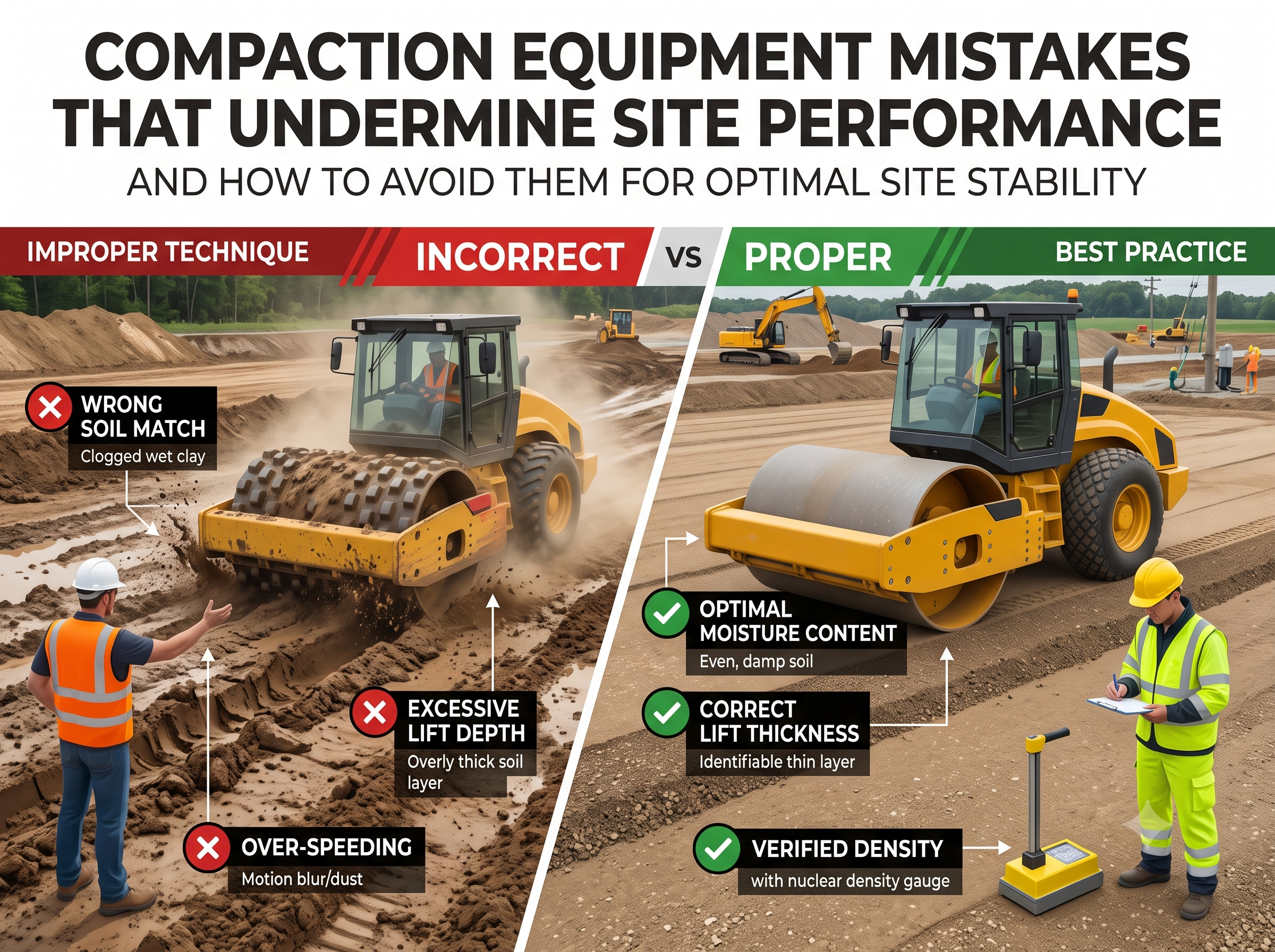
When a fill fails its density test, the crew often blames the soil. In our experience, the soil is rarely the real problem. Most failures come down to how the machine was set up and operated.
Compacting at the wrong moisture content
Every specification that calls for 95% of maximum dry density relies on a lab number. That number comes from a Proctor test, which establishes the maximum dry density and optimum moisture content for the soil. Standard Proctor uses 12,400 ft-lbf/ft3 of energy. Modified Proctor uses 56,000 ft-lbf/ft3, about 4.5 times more.
You can’t hit either target if the field moisture is off. Dry soil resists particle movement and won’t lock together, regardless of how many passes you make. Wet soil is worse because it remoulds under the drum and turns into ruts with low density. Compare field moisture with OMC first, then aerate the soil or add water before compaction.
We often see crews try to dry a layer by rolling it, but that doesn’t work. Water has to leave through air drying or be added through even mixing, and the gauge must confirm the moisture before the roller starts.
Check moisture by lift and by area. A fill that passed yesterday can fail today after rain or overnight drying, so don’t rely on old readings. One wet pocket can fail an otherwise sound construction lift.
Relative compaction is the acceptance metric on most construction earthworks. It compares field dry density with the laboratory maximum as a ratio. If the lab basis is wrong, the ratio is also wrong, leaving crews to chase a number the soil can’t reach with the plant on site.
Bringing the wrong machine to the soil
Granular and cohesive soils need different types of energy. Sand and gravel densify when vibration shakes the particles into tighter packing. Clay needs kneading and pressure to break bonds and press out air. Swap those methods and you get flat test results. This mismatch is common on construction jobs that use one roller for every soil type.
A vibratory plate compactor suits granular trench backfill and tight spaces. It can’t reach deep or knead clay. A smooth-drum vibratory roller is designed for wide granular subgrades, but it irons clay without densifying it. A sheepsfoot or padfoot roller works on clay because its feet punch and knead each lift from the bottom up.
We still see smooth drums sent to roll wet clay simply because that’s what is available on site. The surface looks sealed and flat, while the gauge shows low density underneath because vibration never provided the action the clay needed.
Match the drum to the soil before the first load arrives. Read the geotechnical report for the soil type and acceptance ratio. Stage the right roller for bulk fill and keep a plate available for confined cuts. That choice can decide the outcome before a wheel turns.
On mixed construction spreads, the soil can change from bay to bay. One area may contain sand while the next has clayey fill from a different cut. Walk the tip and feel the material, then swap drums before poor coverage locks in low density.
Running the wrong frequency and amplitude
Frequency and amplitude determine where the vibration goes. Frequency is how fast the drum shakes, while amplitude is how hard each hit lands. High frequency with low amplitude works the top of granular fill. Low frequency with high amplitude drives energy deeper. The wrong combination wastes fuel and time on every construction pass.
Many operators leave both dials at maximum and hope for the best. That full-power habit can loosen the surface of sand while still failing to punch through a thick lift. Industrial vibrating compaction solutions similarly vary by material and application, including moulding sand and concrete. For earthworks, the lesson is to match roller settings to the soil and lift depth rather than run one combination across the whole site.
Clay reacts differently. Too much amplitude remoulds it, and density drops even as the pass count rises. The result is rutting and shear. Set the vibration for the soil and lift depth, then hold that setting until the soil or depth changes.
We regard this as the most commonly missed setting on site. Speed and pass counts get most of the attention, but frequency and amplitude determine whether those passes count.
Test strips settle arguments quickly on live construction sites. Run one lane at varied settings and gauge each strip. Keep the combination that reaches density with the fewest passes, then write it on the roller so every operator can maintain it.
Placing lifts too thick to densify
Lift thickness determines whether the compaction energy reaches the bottom. A small plate only densifies about 150 to 300 mm. A small roller reaches about 300 to 450 mm. When fill is placed deeper than that, the bottom stays loose while the top appears tight.
The roller bridges the soft base and irons the surface. Testers see a smooth mat, but the gauge records low relative density further down. That gap later appears as settlement under pavement or slabs. Extra passes won’t fix it because the energy still can’t reach the full depth.
Use thinner lifts and maintain a steady supply. If trucks dump a metre of fill at once, the dozer must cut it back before the roller treats it as a lift. It is slower for each load, but it saves rework.
Watch for dozer drift, where the middle of the fill becomes thicker than the edges. Check the depth with a probe or string line rather than judging it by eye. If the depth exceeds the machine rating, split the lift.
Thin lifts win every time.
Deep fill also traps water. A thick lift dries on top while remaining wet underneath, so moisture varies through its depth. The gauge may then show a pass in one spot and a failure in the next, even though both received the same rolling.
Driving too fast with no overlap
Most plates and rollers are rated near 1.5 to 3 km/h, or about 1 to 2 mph. At that pace, the drum delivers enough impacts into each metre of soil. Drive faster and the impact count per area falls quickly.
The surface may still look smooth because the drum skims over it. Operators mistake coverage for compaction, even though the soil below never receives the blows it needs. That is how a site ends up with a neat mat that fails proof rolling the next day.
Poor overlap causes the same problem on wide fills. Gaps between strips leave soft collars that never receive full energy. Overlap each pass by at least 10 to 15% of the drum or plate width. Mark the edge with paint so the next pass holds its line.
We see this when production pressure is high. Drivers speed up to keep pace with the trucks. A second spotter using a speed gun, or simple timing over a marked distance, keeps the pace honest. A steady pace is more effective than extra fast passes that achieve little.
Timing is straightforward. Mark 20 metres and time the roller, then compare its speed with the manufacturer’s guidance and the density achieved on a test strip. Adjust the pace when the results demand it, and keep the overlap lines visible.
Leaving edges and trenches to chance
Rollers can’t reach walls and trench sides. Those zones need a separate plan and a suitable machine. A hand-guided plate compactor fits where a drum can’t reach. Without it, edges and abutments remain soft even when the main mat passes.
Trench backfill fails most often. Crews dump structural backfill in one go and bridge over it with the roller. Voids remain around the pipe and against the wall. The fill settles after rain and pulls the pavement down with it.
Place the backfill in shallow layers and compact each one with the plate. Keep moisture near optimum, just as you would in open fill. This prevents the call-backs that eat into the margin.
We stage plates before rollers arrive on jobs with plenty of confined cuts. The roller crew doesn’t have to wait, and the edge crew doesn’t need to rush. Both have the time required by the specification.
Mark exclusion zones where the large drum must stay clear of walls and fresh structures. Vibration applied too close can crack concrete and shift blocks. Use the plate in those areas with lower energy and more passes to achieve density without causing damage.
Dumping mixed fill and hoping the roller sorts it out
Hauled fill rarely arrives uniform. Loads can contain pockets of fines mixed with oversized rock, and the roller can’t correct that distribution. It bridges over rock and pounds fines into soft spots.
Oversized stone leaves voids that vibration cannot close. Fines hold water and remain spongy under load. Together, they create patchy density across a single lift. One test passes while the next fails a few metres away, despite both areas receiving the same machine and pass count.
Spread each load and inspect it before rolling. Windrow the fill to blend the fines through, and remove rock larger than the specification permits. It takes a few minutes with a loader or rake and avoids cutting out failed fill later.
More passes do not blend soil. They densify the material already in place, but they don’t move rock or dry fines. Sorting must happen before compaction begins.
If a source pit produces variable material, test loads at the gate and at the tip. Keep suspect loads separate rather than mixing good fill with bad. Most of the site can keep moving while one pile is dealt with, and the problem won’t be buried for proof rolling to uncover later.
Trusting your eyes instead of the gauge
A smooth mat only tells you that the surface has been ironed. It says nothing about the density below. A machine can seal a loose lift so that it photographs well while still failing the gauge by several points. Don’t sign it off based on appearance.
Specifications usually call for 95% of maximum dry density before the next lift is placed. Confirm that number with a nuclear density gauge that reads density and moisture in place, or use a sand cone test where gauges are not allowed. Test at the spacing set by the geotechnical engineer and test every lift rather than only the final grade. Staged testing catches a miss while it is still inexpensive to fix.
Add proof rolling before acceptance. Run a loaded truck or heavy roller over the finished lift and watch for deflection. Soft spots will pump and rut. Cut out and replace those areas now rather than reworking the entire fill later.
More passes don’t always improve the result. Wet clay beyond its peak remoulds and loses density with each additional pass, producing deep rutting and shoving. Stop and let it dry back towards optimum, then roll it again with fewer passes and lighter energy.
Rework maths favours early checks on any construction programme. A soft lift found at grade takes an hour to fix. The same soft lift buried beneath three good lifts takes a day and wastes good material.
Good compaction depends on moisture, machine match, lift depth and pace rather than bigger equipment or endless passes. Get those factors right and the gauge stops being a gamble.