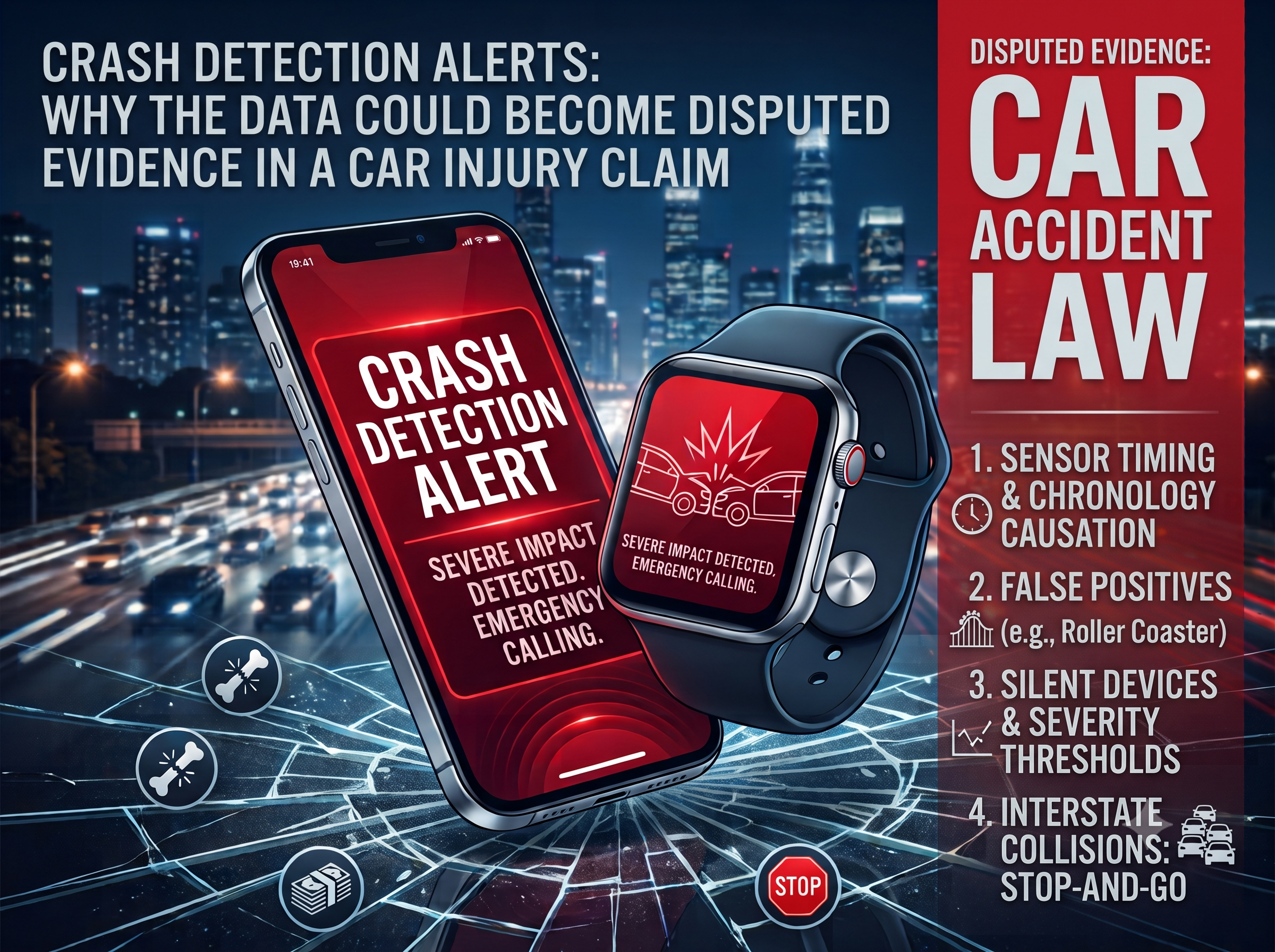
Newer iPhones, Google Pixel phones, and a growing list of smartwatches can sense a sudden, violent stop and call for help on their own. The feature relies on accelerometers, gyroscopes, GPS, and sound levels to judge whether a severe crash just happened. Most people see it purely as a safety net, yet every alert also leaves a digital trail that can surface months later when someone argues about what really happened.
That trail matters because a car accident rarely ends when the tow truck leaves. People hurt in collisions often spend weeks in treatment while the other side builds its own version of events, and small details about timing can shift how blame gets divided. A crash detection record can back up a victim’s account with hard numbers, or it can raise awkward questions the opposing driver’s legal team is eager to exploit. Knowing how this data works, and where it falls short, helps anyone hurt on the road protect their case early.
What the Alert Actually Captures and What It Leaves Out
As defined by the attorneys at Weston & Pape based in Orlando, Florida, a car accident is a collision involving at least one motor vehicle that causes property damage, bodily harm, or death, and it becomes grounds for an injury case when another party’s negligence caused it. The victim must prove four elements, which are a duty of care, a breach of that duty, causation, and actual damages. Crash detection data speaks most directly to causation, since the logged alert time and the location shared with dispatchers can tie the onset of pain to one specific moment. That link matters because the defense often blames lingering symptoms on a later event or a preexisting condition.
The limits are just as important. Crash detection does not record video or identify who ran the red light, and false alerts have been reported during roller coaster rides and ski runs, which gives the opposing side an opening to question reliability. Trial lawyers who handle crash cases in Orange County increasingly treat these alerts as one supporting exhibit among many rather than decisive proof.
When the Timestamp Backs Up the Victim
A typical example involves a commuter heading home through downtown Orlando on a weekday evening when a distracted driver drifts through a red light and strikes her sedan. Her phone detects the collision and places the emergency call before she can unbuckle. The alert time lines up with the 911 recording, the officer’s report, and witness statements, which makes it much harder for the at-fault driver to claim she caused the crash by braking suddenly.
Orlando streets carry heavy commuter traffic at rush hour, and conflicting accounts of who had the green light are common. The device record does not prove fault on its own, but it strengthens every other piece of evidence by fixing the exact second the car accident occurred. Since her medical records show neck and shoulder pain within hours, the timeline leaves little room to blame an unrelated event.
How the Same Data Can Be Turned Against a Passenger
Crash detection evidence cuts both ways, and passengers sometimes learn this the hard way. Suppose a passenger riding through Dr. Phillips during the busy tourist season gets rear-ended at a crowded intersection, and her smartwatch never triggers an alert because the impact falls below its severity threshold. She later needs physical therapy for a back injury, yet the defense points to that silence and argues the collision was too minor to cause real harm.
That argument misrepresents how the technology works. Manufacturers design these features to catch severe collisions, so a missing alert says nothing reliable about whether a car accident caused soft tissue damage or a herniated disc. Medical imaging, treatment notes, and testimony from the treating physician carry far more weight than a feature never built to measure lower-speed impacts. A skilled advocate can explain that gap to a jury in plain terms and keep the focus on documented harm.
Speed, Congestion, and Disputed Seconds on the Highway
I-4 ranks among the most dangerous interstates in the country, and its mix of commuters, freight trucks, and visitors creates constant stop-and-go pressure during rush hour. When a chain-reaction crash unfolds there, several phones in several vehicles may fire alerts within seconds of one another. Those overlapping timestamps can help reconstruct the order of impacts, which becomes essential when three or four drivers each blame someone else.
Florida’s fault rules raise the stakes even further. Since 2023, a person found more than half responsible for a car accident generally cannot recover damages from the other drivers, and a smaller share of blame still reduces any award. Opposing counsel may use a slightly earlier alert on the victim’s phone to suggest she struck the car ahead first, even when the difference comes down to sensor lag. Preserving every device record quickly, together with dashcam video and vehicle event data, gives her representation the tools to challenge that theory.
Protecting Your Recovery Before the Data Disappears
Pedestrians face their own version of this problem. A person walking home through Holden Heights after dark may carry a watch that registers the fall, and that record can confirm when and where she was struck. Nighttime visibility disputes are common in these cases, so an independent timestamp can counter a driver who insists the walker stepped out without warning.
Anyone hurt in a car accident should screenshot crash or fall alerts, save the emergency call log, and keep health app data from the days after the collision. Prompt medical care creates the second half of the record by linking the device timeline to diagnosed harm. A qualified attorney can then send preservation requests, gather the other driver’s phone records if distraction is suspected, and turn that evidence into a case that holds up under scrutiny.