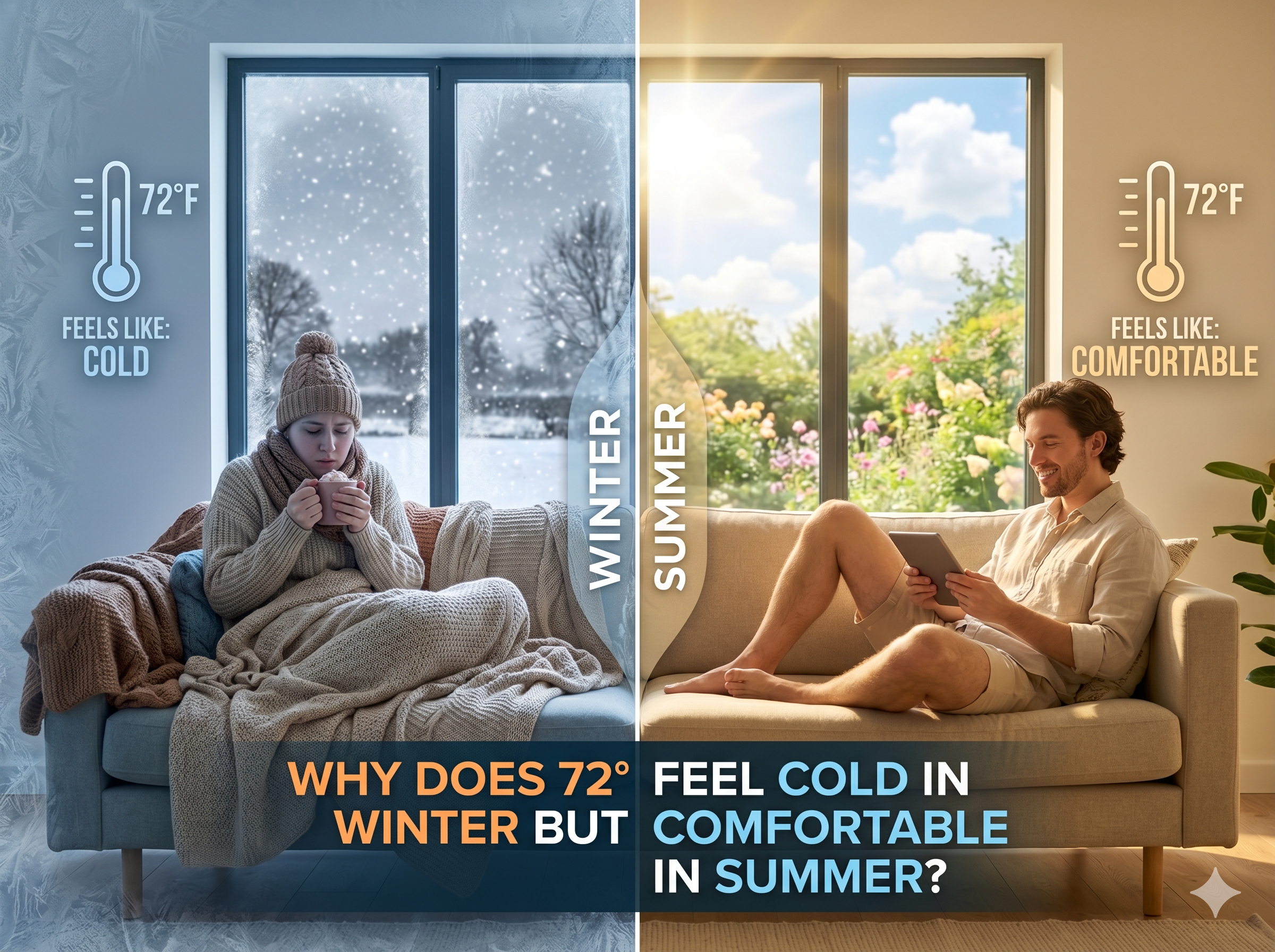
You’ve probably stood in a perfectly climate-controlled room and still felt uncomfortably cold, even with the thermostat reading exactly what it should. Before you call an HVAC repair technician, it’s worth understanding something counterintuitive: the number on your thermostat tells you very little about how warm you’ll actually feel. Thermal comfort is far more complicated than air temperature alone.
How Can the Same Temperature Feel Different Depending on the Season
Your skin isn’t a thermometer, it’s a change detector. The thermoreceptors in your skin respond primarily to the rate of heat exchange between your body and the environment, not to an absolute temperature value. Step from a 60°F morning into a 68°F room and it feels warm. Step from a 90°F afternoon into the same room and it feels cold. The air temperature didn’t change. Your rate of heat loss did. This is the core reason the same temperature feels different depending on the season, or even the time of day.
Context layers on top: sunlight on your face adds radiant heat; a wooden bench and a metal bench at identical temperatures feel wildly different because metal conducts heat away faster. The “temperature” of a moment is actually the sum of conduction, convection, radiation, and evaporation happening to your skin simultaneously.
The key shift: stop asking “what is the temperature?” and start asking “how fast is heat leaving my body?”
Why Your House Feels Colder Than the Thermostat Says
The thermostat measures air temperature at one specific point, usually mid-wall, away from drafts and direct sunlight. But you don’t live inside the thermostat. You live surrounded by walls, floors, and ceilings that have their own temperatures, and your body exchanges radiant heat with every surface it can “see.” This gap between what the thermostat reads and what your body experiences is exactly why your house feels colder than the thermostat says.
On a cold winter night, your walls may be 58°F even if the air is 70°F. Your body is radiating warmth toward those cold surfaces and getting nothing back. The air is fine. The room is not. For every 1°F drop in mean radiant temperature, you’ll want the air temperature about 1°F higher to feel equivalent. Cold exterior walls can create a perceived temperature 5-8°F below the thermostat reading, a perfect example of why the thermostat says 72 but feels colder than it should.
The Difference Between Feels Like and Actual Temperature
Outdoors, “feels like” accounts for wind and humidity. Indoors, the equivalent is Operative Temperature, roughly the average of air temperature and surrounding surface temperatures, adjusted for air movement. Understanding the difference between feels like and actual temperature is what building engineers work with every day. A room at 72°F with cold concrete walls and a slight draft might have an operative temperature of 65°F. A room at 68°F with well-insulated walls, low airflow, and radiant floor heating might feel like 72°F. This difference between feels like and actual temperature explains why modern offices with floor-to-ceiling glass feel cold in January even when the HVAC is cranked.
If you’re always cold despite a “correct” thermostat reading, the fix usually isn’t more heat, it’s reducing radiant loss to cold surfaces or stopping air movement near your body.
Why Does Same Temperature Feel Different in Winter vs. Summer?
Two things happen when seasons change: your body acclimatizes, and your behavioral baseline shifts. After weeks of summer heat, your body has made real physiological adjustments, it sweats earlier, sweats more, and redistributes blood flow to the skin more readily. Your threshold for “cold” has shifted upward. Come October, 68°F triggers mild cold-stress responses that July-you would have ignored entirely.
There’s also a seasonal expectation effect: your nervous system builds a “reference temperature” based on recent experience. A 68°F room in January, arrived at from a 25°F street, triggers a warmth response. The same room in August, arrived at from 95°F, triggers a cold response. Same air. Opposite sensation. This is another layer of why the same temperature feels different in winter versus summer, your brain is computing a delta, not reading an absolute value.
This is why “just turn up the heat” is rarely the right answer in early autumn, your body hasn’t finished acclimatizing. Layering up and giving it 2-3 weeks is often more effective than chasing comfort with the thermostat.
Humidity, Airflow, and Acclimatization: Why 72° Doesn’t Always Feel Like 72°
Humidity works differently in heat and cold. In summer, high humidity prevents sweat from evaporating, trapping heat at your skin, hence the suffocating feeling of humid 85°F versus the tolerable dryness of desert 85°F. In winter, low indoor humidity (common when heating systems run) increases evaporative cooling from skin and respiratory passages, making 68°F feel colder than it should. This is yet another reason the same temperature feels different across seasons. Indoor RH between 40-60% is the sweet spot year-round.
Airflow is the fastest-acting variable. Even gentle air movement (0.15 m/s, barely perceptible) can make a room feel 2-3°F colder by accelerating convective and evaporative heat loss from exposed skin. This is why ceiling fans in winter should run clockwise at low speed to push warm air down without creating the draft that makes people cold.
Acclimatization unfolds over 1-2 weeks of consistent exposure. Your body adjusts sweat onset temperature, plasma volume, and skin blood flow patterns. Travelers from warm climates consistently perceive northern winters as more extreme than locals do, and vice versa in summer. This isn’t just mental toughness; it’s genuine physiology.
Thermostat Says 72 But Feels Colder? Blame Your Floors and Walls
Every surface in a room emits and absorbs infrared radiation. When you stand near a cold exterior wall, your body radiates warmth toward it and receives very little radiation back, a net loss. This is radiant asymmetry, and it’s a primary reason the thermostat says 72 but feels colder than the air temperature suggests. You feel a cold wall the way you’d feel a draft: not because cold air is hitting you, but because heat is leaving your body faster on one side.
Floors are especially significant. Cold feet trigger systemic cold responses disproportionate to the actual heat loss involved. A tiled floor at 62°F will make a person feel significantly colder than a carpeted floor at the same temperature, because tile’s higher thermal conductivity draws heat from the foot faster. It’s a textbook case of the house feeling colder than the thermostat says, one cold surface can shift your entire perception of the room.
The fixes are targeted: thick rugs over cold floors, window insulation film to raise surface temperature, and furniture placement that keeps seating away from exterior walls all work by reducing radiant asymmetry, not by changing the air temperature at all.
The Psychology Behind How We Feel Temperature
Thermal comfort is surprisingly cognitive. Studies have shown that people rate the same room as warmer when shown photos of warm-colored interiors (oranges, reds) versus cool ones (blues, grays), a measurable perceptual shift, not just a report bias. Your brain synthesizes temperature from visual cues, memory, expectation, and social context alongside the raw sensory signal. This psychological dimension helps explain why the same temperature feels different to different people in the same room.
Clothing inertia is one of the most underrated factors. People set thermostats to compensate for the clothes they’re wearing rather than adjusting clothes to match a reasonable temperature. Wearing a light T-shirt indoors in January and demanding 72°F; wearing a wool sweater and wondering why 68°F feels stuffy.
Activity level shifts the equation dramatically. A sedentary person at a desk generates about 70W of metabolic heat; someone doing light housework generates 150W+. The “correct” temperature for comfortable desk work is several degrees higher than for someone who just finished cleaning the kitchen.
Autonomy matters too: people rate rooms as more comfortable when they believe they control the temperature, even if the temperature itself hasn’t changed. Having a thermostat, even a non-functional one, reliably increases reported comfort in office studies.
When Your House Feels Colder Than the Thermostat Says, and How to Fix It
Almost always trust your instincts, with the understanding that your instincts are telling you about heat exchange rate, not about air temperature. If you’re cold at 70°F, that’s real data. Something is pulling heat from your body that the thermostat can’t see. The difference between feels like and actual temperature in your home is almost never random, there’s always a diagnosable cause.
Diagnose by process of elimination: drafts (hold a thin strip of tissue near window edges, door gaps, and electrical outlets, movement means a leak); cold surfaces (touch exterior walls, if they’re cold, consider window insulation film or furniture rearrangement); floor cold (add rugs, wear shoes or thick socks); low humidity (a $30 hygrometer will tell you, add a humidifier if below 35%); air movement (slow ceiling fans to barely perceptible or turn off).
If raising the thermostat doesn’t make you feel warmer within 20 minutes, the problem isn’t air temperature. Stop chasing with heat and start diagnosing radiant loss, drafts, or humidity instead.