Your water heater runs quietly in the background, doing its job without much attention, until the electricity bill arrives. Smart water heaters promise to change that equation, but separating genuine savings from marketing claims takes some digging. Here’s what the numbers actually look like.
What Is a Smart Water Heater, Really?
A conventional electric water heater is essentially a thermostat attached to a tank, it heats water to a set temperature and keeps it there, all day, every day, whether you’re home or not. It has no concept of time, cost, or your actual behavior. It heats water at 2pm on a Tuesday the same way it heats at 6am on a Monday.
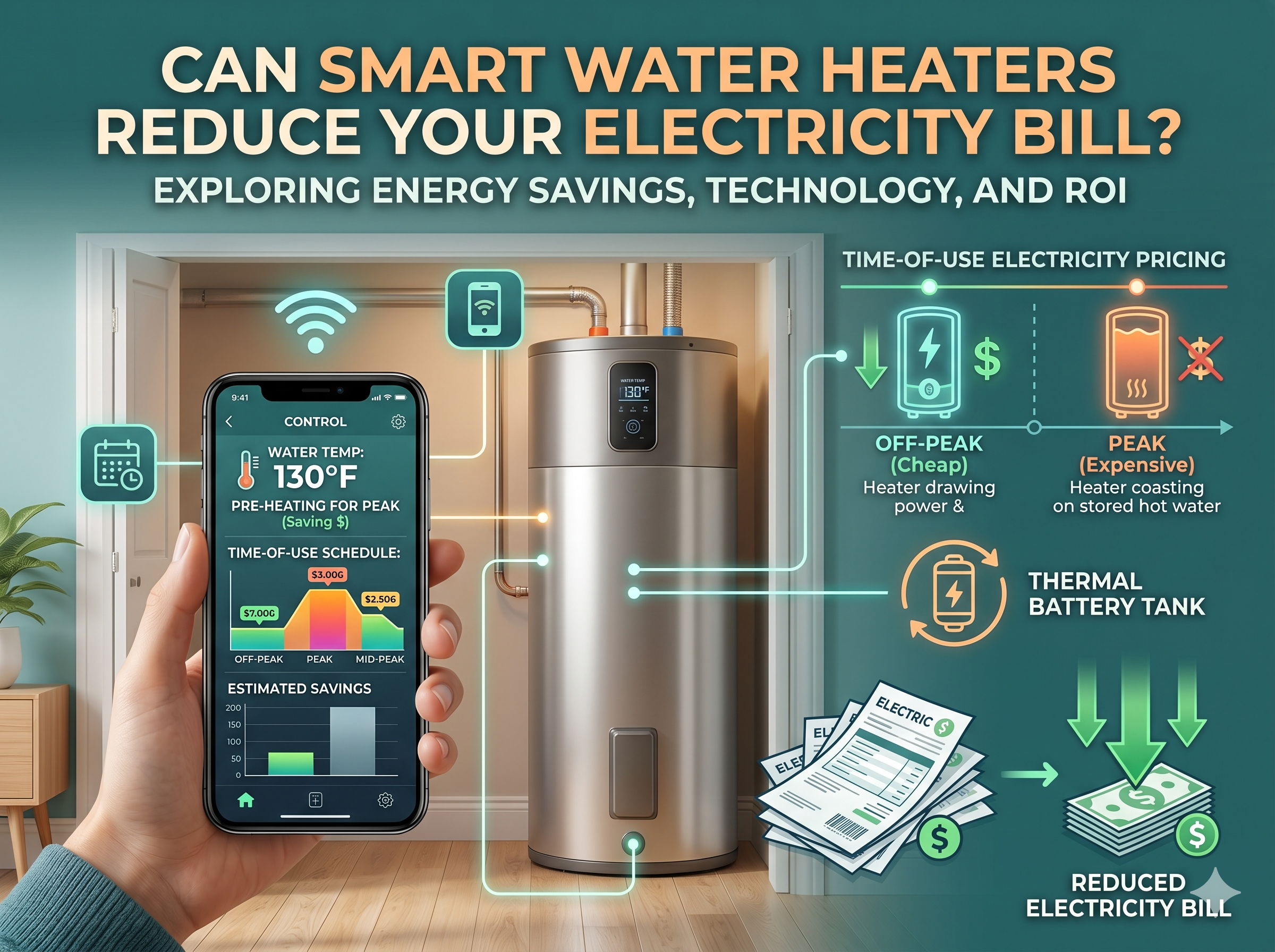
A smart electric water heater changes the fundamental relationship between the appliance and the grid. It connects via Wi-Fi (sometimes Zigbee or Z-Wave) and adds a layer of intelligence on top of the heating function: learning your hot water usage patterns, scheduling heating cycles to avoid peak electricity pricing, accepting remote signals from your utility to temporarily pause heating during grid stress events, and reporting real-time electric water heater energy consumption data to an app. But the most important distinction isn’t any single feature, it’s that the tank becomes a thermal battery, a device that can store energy cheaply (as hot water) and discharge it later (as hot showers) without the homeowner noticing the difference. The electricity grid charges wildly different prices at different hours; a smart water heater can charge the thermal battery during cheap hours and coast through expensive ones. Every other feature, remote control, usage reports, vacation mode, is secondary to that core mechanic.
One thing most competitors skip: the difference between a smart hot water heater that uses Wi-Fi to receive your commands and one that’s certified for two-way grid communication (OpenADR protocol). The first is a convenience device. The second is an income-generating grid asset. They’re sold side by side but are fundamentally different products.
Cost to Heat Water with Electricity: What You’re Actually Paying
Water heating is the second-largest energy expense in most homes, typically accounting for 14-18% of total electricity use. A standard 50-gallon electric resistance water heater draws 4,500 watts per heating element and runs roughly 3-5 hours per day, translating to about 13-18 kWh daily, or 390-540 kWh per month. At the U.S. average electricity rate of ~$0.16/kWh (2024), that’s roughly $62-$87/month just to heat water, or $750-$1,050 annually. In high-rate states like California, Hawaii, or Connecticut where rates can exceed $0.30/kWh, that same usage costs $1,400-$1,900/year.
The figure most competitors ignore is standby loss, the constant reheating needed to compensate for heat naturally escaping through tank walls, which can account for 15-30% of total electric water heater energy consumption. It’s the most actionable number because it’s wasted whether you’re home or not, awake or asleep, January or July. A heater in an uninsulated garage in Minnesota can push standby losses above 30%; a heater in a conditioned interior closet in Texas might be closer to 10%. Location matters more than most buyers realize.
Smart Features That Cut Electric Water Heater Energy Consumption
Not all smart features are created equal. Here’s what they’re actually worth, with rough annual savings for a household on time-of-use pricing (peak rate ~$0.30/kWh, off-peak ~$0.10/kWh).
TOU scheduling is the highest-impact feature. A smart water heater can pre-heat a full tank during cheap off-peak hours (typically 9pm-6am) and coast through expensive morning and evening hours without ever firing the elements, because a well-insulated 50-gallon tank loses roughly 1-2°F per hour at rest. Heat 60 gallons to 130°F at midnight and by 7am peak pricing you still have 118°F+ water. Savings of $150-$300/year are realistic just from rate arbitrage in TOU markets. This feature is useless on flat-rate pricing.
Demand response enrollment runs $50-$150/year in utility bill credits or direct payments in exchange for allowing brief temperature setback events during peak grid demand. The tank holds enough heat that a 1-2 hour shutoff is invisible to most households. Programs vary widely by utility, verify availability before buying.
Away/vacation mode is medium impact and often the most underused feature on any smart hot water heater. Dropping the setpoint from 120°F to ~60°F while you’re away slashes standby loss to near zero, roughly $2-$4/day saved, or $28-$56 for a two-week vacation, adding up to $50-$120/year for frequent travelers.
Usage tracking and leak alerts are lower on direct savings but enabling. Consumption data reveals behavioral waste, a teenager taking 20-minute showers, a recirculation pump running too much, and flags anomalies that signal a dripping fixture or failing element before it shows up on your bill. Some smart electric water heaters integrate with leak sensors and can shut off automatically; a single avoided water damage claim easily justifies the cost of the entire unit.
Remote on/off control is mostly convenience, not savings, useful only if you regularly forget to set away mode manually or return home at an unpredictable time on TOU rates.
The thing most articles don’t tell you: TOU scheduling and demand response work because of physics, not software. The smart water heater is exploiting a thermal buffer that’s been sitting in basements for decades. The intelligence just finally figured out how to use it.
Smart Tankless Water Heater vs. Tank: Which Saves More?
This is a question with a genuinely counterintuitive answer that almost no one publishes: in many real-world TOU scenarios, a smart water heater with a tank will save more money than a smart tankless water heater.
Smart tank water heaters work by storing pre-heated water and using the tank as a thermal battery. Their efficiency comes from scheduling, when to heat, not how to heat. The underlying resistance heating is ~99% efficient at converting electricity to heat, but standby losses (1-4°F/hour depending on insulation) chip away at real-world efficiency. Smart tankless water heaters eliminate standby loss entirely, they heat water only when a tap opens, with zero idle electric water heater energy consumption. The “smart” layer adds remote monitoring, usage analytics, error code alerts, and in some models flow optimization. Per DOE methodology, tankless units are 8-34% more energy efficient than tank units, but that gap narrows significantly when smart scheduling is applied to a tank heater.
Here’s the counterintuitive part: smart tankless water heaters surrender the thermal battery advantage. There’s no stored capacity to pre-charge during cheap overnight hours. Every hot water use event triggers an element draw at whatever rate is current at that moment. A smart electric water heater with a tank pre-charges at 1am off-peak, then your 7am shower is paid for at the cheap rate. The “inefficient” tank is actually smarter in TOU markets because it decouples the timing of energy purchase from the timing of energy use. The real efficiency metric isn’t the unit’s nameplate efficiency, it’s the effective cost to heat water with electricity, which is a function of efficiency × the rate paid at the time of heating.
The tank’s thermal battery advantage extends to demand response as well: it can absorb 1-2 hour shutoff events invisibly, making it an ideal DR participant, while smart tankless water heaters have no stored capacity to draw down during events and some programs exclude them entirely.
The practical decision comes down to usage pattern and market. If your household uses hot water in predictable, concentrated bursts and you have TOU rates, a smart hot water heater with a tank and aggressive scheduling often wins on ROI because the upfront cost is lower and rate arbitrage offsets and often exceeds standby loss cost. If usage is sporadic throughout the day in a flat-rate market, tankless eliminates idle losses that no amount of scheduling can fully recover, and avoids the panel upgrade (typically $1,500–$4,000) that electric tankless units require, and that needs a licensed electrician, in older homes with 100A service.
Real Savings After Switching to a Smart Hot Water Heater
The honest range is $100-$500/year, with most households landing in the $150-$300 band.
The single biggest factor, bigger than brand, bigger than tank size, bigger than any individual feature, is whether you have or can get a time-of-use electricity rate. If your utility only offers flat pricing, your maximum realistic savings is roughly 10-15% of your water heating bill from scheduling and behavioral optimization. At $72/month baseline, that’s $86-$130/year. Meaningful, but not transformative. In a TOU market, the math changes completely. Off-peak electricity can cost $0.06-0.10/kWh versus $0.28-0.45/kWh during peak hours. Shifting 80% of your water heating load to off-peak hours cuts the effective cost to heat water with electricity by 60-70%. On the same $72/month baseline, that’s $500+/year in savings, before any demand response credits. Independent studies (including EPRI and NRDC research) have found that smart hot water heater demand response programs alone can reduce water heating costs by 10-15% on average, with some households achieving 20-30% when combined with TOU scheduling.
The second biggest factor is what you’re replacing. A 10-year-old heater with degraded insulation, in an uninsulated garage, running at 125°F in a cold climate has significantly more standby losses than a 3-year-old unit in a conditioned closet. Replacement savings compound, you’re getting the smart optimization plus a newer, better-insulated unit.
Other factors that affect where you land in that range: whether your utility offers demand response program credits, household size with predictable morning/evening usage peaks, and whether the unit is in a conditioned space. What doesn’t move the needle much: brand reputation (within major manufacturers), tank size (within reasonable range for your household), or most app features. These matter for convenience and reliability, not for the bill.
Are Smart Water Heaters Worth It?
The premium for a smart electric water heater (50-gallon, Rheem, AO Smith, or Bradford White) over a comparable conventional unit is $300-$700 at retail, call it $500 as a reasonable midpoint. Installation costs are typically the same since the wiring and plumbing footprint is identical, so that’s not a differentiating factor.
Subtract available rebates: ENERGY STAR smart water heaters commonly qualify for $50-$300 utility rebates, and heat pump water heaters qualify for the federal 25C tax credit ($300) plus state incentives. In aggressive rebate states, the net premium after incentives can drop below $100.
Now for the savings side, and this is where the analysis needs to be split. In a TOU market with demand response eligibility, savings run $200-$400/year; payback on a $400 net premium lands at 1-2 years, with $2,000-$4,400 net benefit over a 12-year appliance life. In a flat-rate market with no DR program, savings drop to $80-$130/year; payback stretches to 3-5 years, with $560-$1,160 net benefit over 12 years, still positive, but tighter.
If you’re in a flat-rate market with no rebates and no DR program, the honest answer is: a smart water heater is hard to justify on pure ROI. The “worth it” calculation shifts to non-financial value, app convenience, vacation mode peace of mind, leak detection, and future-proofing for TOU rate adoption. That has real value; it’s just not captured in a payback calculation.
One more thing competitors skip: many utilities are actively migrating customers to TOU rates. If your utility has announced or begun a TOU rollout, buying a smart hot water heater now means it’s ready to maximize savings the moment you switch rates.
How to Choose the Right Smart Water Heater
Check the app reviews, not the product reviews. A water heater with a broken app is just a water heater. Search “[brand] water heater app” on the App Store and Google Play. Filter by most recent, look for patterns: connectivity drops, login failures after firmware updates, features disappearing. An app with connectivity issues negates every smart feature on the spec sheet. Rheem’s EcoNet and AO Smith’s iCOMM have generally solid track records; some lesser-known brands ship apps that work at launch and never receive updates. This single check eliminates more bad purchases than any other research step.
Verify demand response eligibility before buying, not after. Go to your utility’s website and search for “demand response,” “smart water heater program,” or “connected devices.” Some utilities maintain pre-approved device lists, buying an unapproved unit means no enrollment, no credits. Some utilities partner with specific manufacturers (Rheem, AO Smith) for white-labeled programs with deeper integration. OpenADR-certified units can participate in any compliant utility program rather than being locked to proprietary protocols, better long-term flexibility if you move or switch utilities. This is the highest-ROI feature and worth prioritizing.
ENERGY STAR certification is table stakes for rebates, not a quality indicator. Don’t use it to differentiate between models, use it as a minimum filter to ensure rebate eligibility, which is required for most utility rebates and guarantees independent efficiency validation rather than just manufacturer claims.
First Hour Rating matters more than tank size. FHR tells you how many gallons of hot water the heater delivers in the first hour of operation from a full tank. A 50-gallon tank with a high FHR beats a 65-gallon with a low one for peak-demand households. Target FHR of 60+ gallons for households of 3-4, 80+ for 5+. Smart features don’t help if the unit can’t keep up with peak demand.
If your climate averages above 40°F year-round, look at heat pump water heaters rather than resistance-only units. A smart electric water heater with a heat pump costs more upfront but runs at 200-300% efficiency vs. 99% for resistance heating. In TOU markets, a smart HPWH running off-peak delivers the lowest cost to heat water with electricity of any electric option available, and the federal 25C credit covers $300, extended through 2032.
Check DSIRE (dsireusa.org) and your utility’s website before purchasing. Rebates can dramatically change the math. Some states (California, Massachusetts, Vermont) offer $300-$800 rebates on qualifying smart hot water heaters or heat pump models.
Smart Water Heater Downsides You Should Know
Wi-Fi dependency creates a new failure mode. A conventional heater fails in one way: the heating element or thermostat dies. A smart water heater can fail in all those ways plus lose cloud connectivity, get stuck in a firmware update, fail to re-pair after a router change, or lose its schedule if the cloud sync fails. None of these cause a safety problem, but they silently revert the heater to basic dumb operation, and many owners never notice. Re-pairing can range from easy to genuinely frustrating depending on the brand.
Savings require active setup, not just purchase. A smart electric water heater operating on default settings in a flat-rate electricity market saves almost nothing. The intelligence is only as useful as the homeowner’s willingness to configure it. Studies have found that roughly 30-40% of smart appliance owners never complete setup beyond basic Wi-Fi connection.
Demand response means surrendering some control. When you enroll in utility DR programs, you’re agreeing to let the utility trigger heating setbacks. These events are typically short (1-2 hours) and shouldn’t affect hot water availability in a properly sized tank, but a household with three teenagers who all shower before school and a DR event running from 6-8am may notice. Tank-size your heater conservatively for your peak demand before enrolling in DR, not after.
Tankless smart water heaters require significant electrical upgrades. Electric tankless heaters draw 18,000-36,000 watts, requiring 200-amp service and often dedicated 240V circuits. Many older homes cannot accommodate this without a panel upgrade costing $1,500-$4,000. At $200/year in savings, that’s a 7-20 year payback on the electrical work alone, before you’ve paid for the heater. Run this calculation before committing to tankless.
Legionella risk if setpoint goes too low. Some owners lower setpoints aggressively to reduce the cost to heat water with electricity, this is where cutting corners has genuine health consequences. Legionella bacteria grow actively between 77-108°F. Maintain minimum 120°F at the tank, regardless of what the app’s “eco mode” suggests. The DOE and CDC both recommend 120°F as a safe minimum.
App abandonment is a real risk. Water heaters last 10-15 years. Smartphone apps don’t. Manufacturers discontinue apps, get acquired, or simply stop pushing updates for older hardware. There’s no industry standard requiring app support for the life of the appliance. A smart hot water heater from 2019 with a deprecated app is now a conventional heater with a Wi-Fi chip nobody uses. When evaluating brands, look at their app update history, is the current version from 2024 or 2021?
Data privacy is a legitimate concern. Your water heater now knows when you wake up, when you shower, when you’re on vacation, and how many people live in your home. Review your manufacturer’s privacy policy, some share usage data with third parties. This isn’t unique to water heaters, but it’s worth knowing.