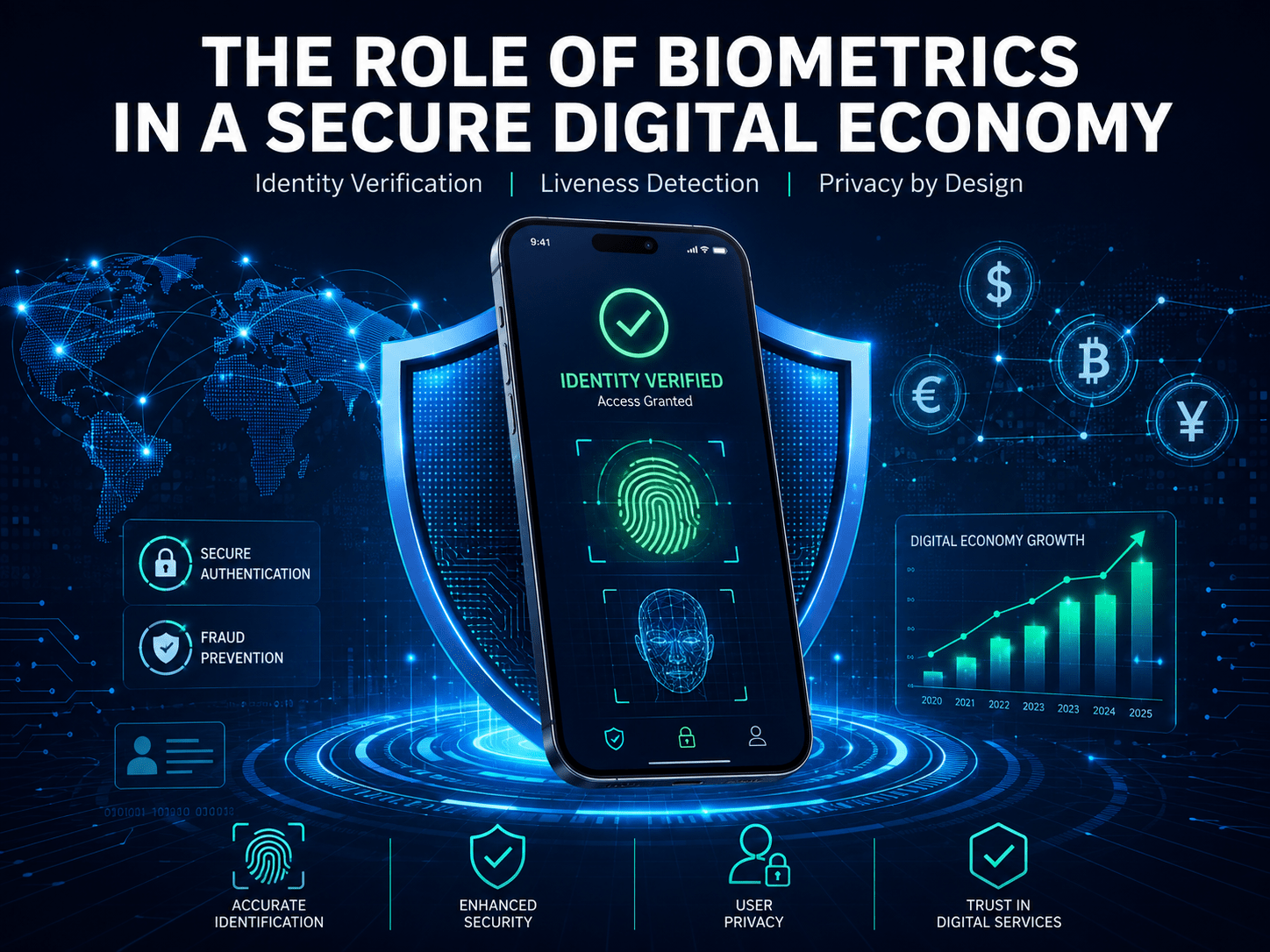
Security and convenience have always tugged in opposite directions. If you make something hard enough to break into, you’ve also made it hard to use. Biometrics is the first technology to truly solve this problem. Not by sacrificing enough of both to make it bearable, but by removing the problem as a whole. The real argument for biometrics is not that it is more secure than a password. It is the only realistic basis for building a digital economy where millions of people need to be verified in real-time, without treating every application as an exam.
From “what you know” to “who you are”
Password-based security has a fundamental issue. Passwords can be stolen, guessed, or purchased en masse from credential repositories. Credential stuffing attacks – whereby stolen login information is automatically entered into hundreds of services – are now regular occurrences. These attacks are successful because users use the same passwords on multiple sites, and because the system as it’s designed has no way to differentiate between the real account owner and someone who has managed to get hold of their login details.
Biometrics addresses that problem. A fingerprint or face scan isn’t easily copied and dropped somewhere for a hacker to use. It can’t be fished out of a user by presenting them with a fake login prompt. It’s the switch from “what you know” to “who you are” as the main proof of identity that makes account takeover strikes much more difficult to execute en-masse. With biometrics as one factor in multi-factor authentication, the attacker would need to obtain both the login information and the physical presence of the account holder.
Linking a face to a verified document
It is helpful to have a basic understanding of biometric verification and how it works. For instance, when a person goes through digital onboarding, they are asked to take a picture of their government-issued ID and provide a face image. The system then runs a face comparison (this is not face recognition in the surveillance meaning, but a one-to-one match between the live face and the document photo).
At that moment, a biometric template becomes associated with a verified identity document. This means the person is no longer just a username and password. They are now connected to a verified real-world identity that was checked against the security features of the document, and cross-referenced with global ID databases.
For companies doing KYC and AML compliance, this is the only way to reliably verify that the person opening an account is who they say they are. You can use an identity verification service to automatically manage this matching process between document types and countries for you.
Why liveness detection matters more than the biometric itself
One of the most straightforward ways to compromise a facial recognition system is by presenting a photograph rather than an actual face. Many of the earliest applications were vulnerable to exactly this type of attack. Passive liveness detection was created to mitigate this vulnerability by analyzing natural signals in real time to ensure a face is actually present and belongs to the person it’s supposed to, rather than just a static image.
This may seem trivial but it’s not. The importance of knowing there is a live, present person on the other side of that sign-up screen cannot be overstated, at a time when a fully remote account opening is the first and last interaction a business may ever have with its customer. Passive Liveness Detection distinguishes itself by its unintrusive, “passive” operation. Solutions that require the user to blink, look in certain directions or perform any other challenge may technically be effective, but they are annoying to legitimate users (for good reason) and not practical for remote onboarding, where the experience must be smooth.
Privacy by design isn’t optional anymore
Biometric data is sensitive by definition. Regulations governing its storage and use are tightening, and businesses that handle it carelessly face both legal exposure and reputational damage. The “Privacy by Design” principle – building data protection into the system architecture rather than bolting it on afterward – is now an expectation, not a differentiator.
Modern systems don’t store images of faces or fingerprints. They store mathematical representations – hashes derived from the biometric that can be used for comparison but can’t be reverse-engineered back into the original image. Processing happens in secure environments, often using Hardware Security Modules that are isolated from the main application stack. If a database is breached, the attacker gets data that’s computationally useless for spoofing the system.
Biometrics as infrastructure for financial inclusion
There is an aspect of this discussion that is broader than just fraud prevention. Much of the world’s population lacks the proper paperwork and often the physical proximity to a bricks-and-mortar bank to access traditional financial services. Biometrics connected to a smartphone – with no need for a branch trip or an existing credit line – can bring financial access to the previously unbanked or underbanked.
The precise technology that helps a bank verify a new business customer in London can verify a first-time account applicant in a region with little physical banking presence. The device demands are minimal. The time demands are low. And the compliance-level verification is the same in either situation.
This is why biometric identity verification is a fundamental, not an option. This is not just a way to shore up security. This is the must-have tool that allows the digital economy to grow while maintaining the rigorous standards it requires.