A practical look at subscription prices, Kindle listening and the features that make everyday reading easier.
If you are comparing Speechify, NaturalReader and ElevenReader, you probably already know why you want text to speech. You want to hear a book, work through a long document or listen to an article without keeping your eyes on the screen. The harder question is how much you need to spend to make that a comfortable everyday habit.
CastReader deserves a place on that shortlist. At $35.99 a year for Pro, it offers a lower-cost route to AI narration, supported Kindle reading and explanations that stay connected to the original text. Its strongest argument is practical: the reading features you are likely to reach for often, at a subscription price well below the paid plans compared here.
This comparison focuses on personal reading apps, rather than commercial voiceover studios or developer APIs. Prices and features come from the providers’ published information, checked on October 7, 2026.
The annual price gap is substantial
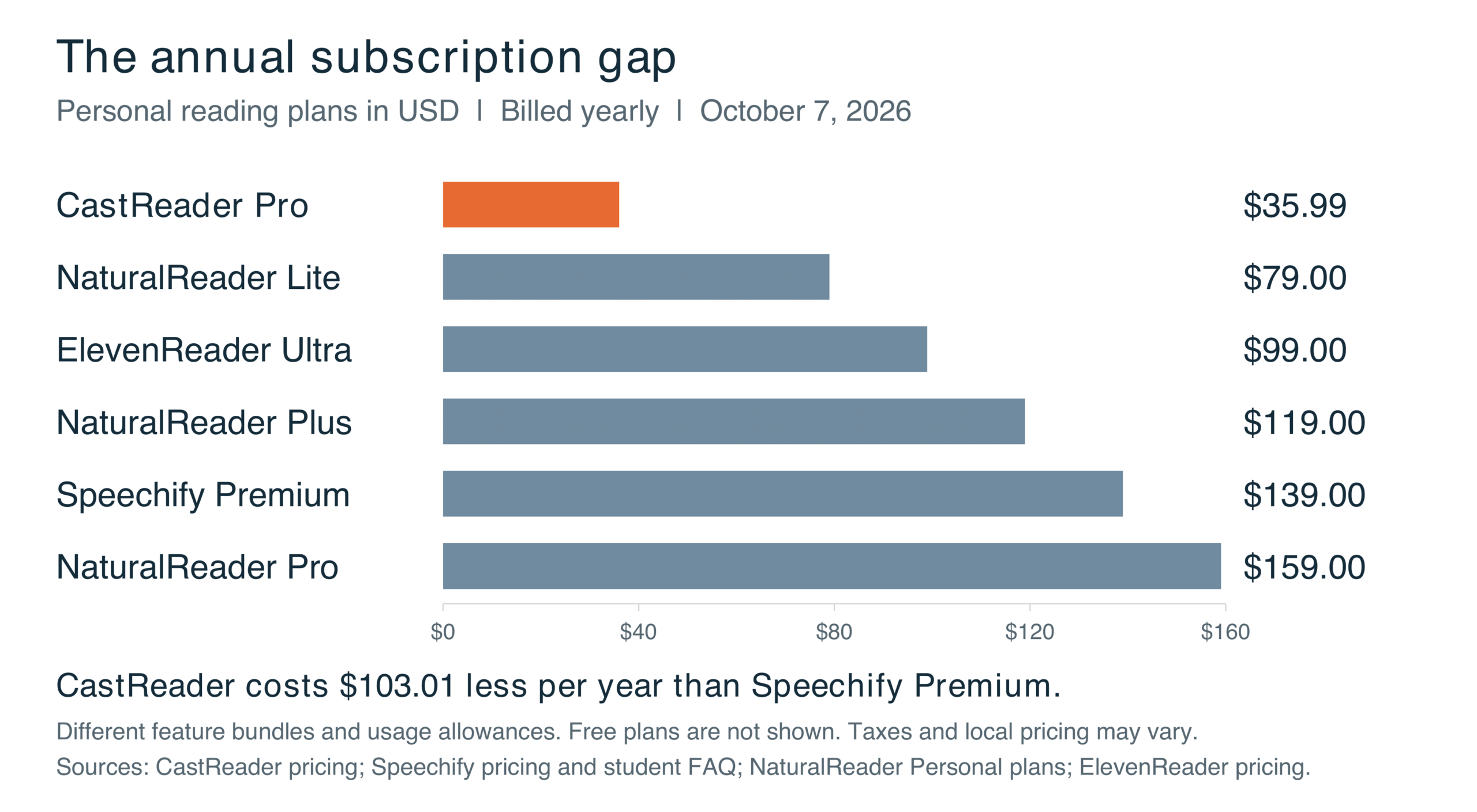
The web price for CastReader Pro is $35.99 annually or $4.99 on monthly billing. The annual option works out to about $3 a month, paid upfront. Speechify Premium is $139 a year, ElevenReader Ultra is $99, and NaturalReader Personal starts at $79 for Lite, with Plus at $119 and Pro at $159.
Published annual web subscription prices in US dollars, checked October 7, 2026. These are different paid plans, not identical bundles. Free tiers are also available; regional and app-store prices may differ.
That puts CastReader Pro $103.01 below Speechify Premium, $63.01 below ElevenReader Ultra and $43.01 below even NaturalReader Lite over a year. Against Speechify’s listed annual plan, the difference is about 74%. Those are subscription savings, not a claim that every voice, allowance or feature is equivalent.
For a reader who mainly wants to finish books and hear documents, the question becomes straightforward. Does the more expensive plan offer something you will use often enough to justify the difference? A specialist document tool or a favorite voice may make it worthwhile. If your main needs are narration and reading support, CastReader is a compelling first option.
What makes CastReader more than a budget pick
A low subscription price is useful only if the product fits the way you read. CastReader combines AI voices with synchronized highlighting, so you can listen and then glance back at the relevant passage. Auto-scroll keeps supported reading views moving with the narration. Playback controls let you choose a comfortable pace instead of treating faster listening as the goal.
That combination matters more during a chapter than during a ten-second voice demo. Highlighting helps you return to a name or sentence; saved progress makes it easier to continue a book later. In the mobile app, background and lock-screen playback mean the session can continue when you put the phone away. These are tangible conveniences behind the product’s ease-of-use appeal.
The listening experience starts with choosing a voice you enjoy. CastReader publishes voice samples, so you can hear the tone before deciding. Clear narration and comfortable pacing matter for sustained reading, while speed control helps adapt the same tool to a novel or a familiar report. Voice preference is personal; the price comparison does not require declaring one company’s voice objectively superior.
CastReader also covers more than a single bookshelf. Its apps and browser extensions provide routes into supported web articles, documents and ebooks. That makes it useful for a reading queue that changes throughout the day, rather than only one file format. You can start with the material already waiting for your attention.
Kindle support is a concrete reason to consider it
For someone with a Kindle library, generic ebook support is not enough. The useful question is whether the app offers a way to listen to the books you already have access to. CastReader does: its mobile workflow connects your Kindle library, brings the bookshelf into the app and lets you open a supported book and choose Read Aloud.
The CastReader Kindle app for phones and tablets is available for iPhone, iPad, Android phones and Android tablets. Highlighting, auto-scroll and resume progress keep the book easy to follow, while background playback suits listening away from the screen. On a computer, the Chrome or Edge extension provides a separate route through Kindle Cloud Reader.
This is a reading workflow for accessible books, not an app installed on a Kindle e-ink device or a purchase of an Audible recording. CastReader is not affiliated with Amazon. For readers choosing a tool across phone, tablet and computer, the combination of these Kindle routes and a modest Pro fee is a meaningful strength.
AI Explain adds a useful second way to read
Full-text narration and an explanation serve different reading needs. When you want the author’s complete argument or the rhythm of a novel, use Read Aloud. When a difficult passage is slowing you down, AI Explain can give spoken guidance while captions and visual annotations connect the explanation to the source. It offers a quicker way into a passage without requiring you to abandon it.
For example, a reader approaching a dense report can start with an overview, then return to the original paragraphs for the detail. CastReader’s explanation settings let that reader choose how much detail to hear. The source remains the reference point; an AI explanation is assistance, not a replacement for checking what the author actually wrote.
Pro also supports personal voice cloning for supported reading and explanation workflows, with 120 minutes of generated cloned audio per membership month. It is an optional extra alongside standard voices, not the main reason to choose the product. The central value remains easy access to narration and help understanding the text.
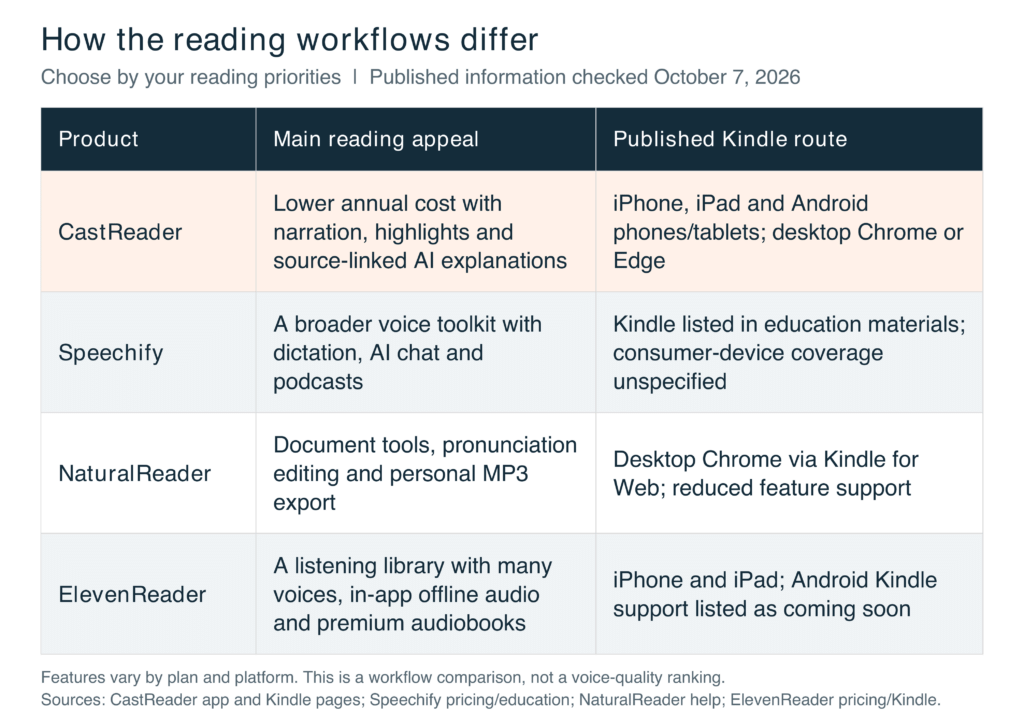
A comparison of reading priorities and published Kindle routes, not a voice-quality scorecard. Features depend on plan and platform. Speechify’s education page mentions Kindle, but does not specify a complete consumer device workflow.
CastReader vs Speechify
Speechify makes sense for someone who wants a broader voice-based productivity package. Premium includes a large voice and language selection, scanning, AI summaries and chat, podcasts, dictation and a voice assistant. Those extras can be valuable if reading aloud is only one part of how you want to use voice throughout the day.
CastReader’s case is strongest when the priority is reading itself. You can choose narration, keep track of the passage and ask for an explanation without committing to Speechify’s higher annual subscription. If those are the tools you expect to use most, CastReader is an affordable Speechify alternative with a clear purpose. If dictation, particular voices or Speechify’s broader integrations are central to your routine, the additional cost may still make sense.
CastReader vs NaturalReader
NaturalReader Personal deserves a close look for document-heavy reading. Its paid tools include OCR for scanned text, pronunciation editing and MP3 conversion for personal use. Plus and Pro add voice cloning, and Pro includes its higher-end HD voice category. A reader who needs to prepare documents or keep personal audio files may find that specialization worth paying for.
Both products can read directly, without creating a separate audio file. CastReader’s advantage is the lower annual subscription paired with narration and source-linked explanations. NaturalReader also documents a desktop Chrome route for Kindle for Web, although its own guide notes reduced functionality there, including unavailable word-by-word highlighting. Kindle is therefore not a yes-or-no feature contest: the reading experience on your preferred device is the distinction that matters.
CastReader vs ElevenReader
ElevenReader is built around collecting written content in a listening library. It accepts material such as files, links and pasted text, with a broad voice selection. Ultra adds offline downloads within the app and 20 monthly hours of premium audiobook listening alongside imported-text narration. Its free plan includes 10 text-to-audio hours a month, which may be enough for a lighter reading routine.
ElevenReader also now advertises Kindle listening on iPhone and iPad, with Android support described as coming soon. CastReader’s current Kindle mobile offering already includes Android phones and tablets alongside Apple’s devices. For an Android reader who wants that workflow, or a subscriber who values source-linked explanations, CastReader offers a practical reason to choose it beyond the $63.01 annual price difference.
Which one earns a place in your reading routine
Start with the reading task you want to repeat tomorrow. If it is a Kindle chapter on your phone, a report on your tablet or an article in your browser, CastReader brings together the relevant listening tools at the lowest annual paid-plan price in this comparison. Its appeal is particularly clear for readers who want natural AI narration, visible progress through the text and an explanation when they need one.
Choose Speechify when its wider voice toolkit is worth the premium to you. Consider NaturalReader when document preparation and personal MP3 files are central. Try ElevenReader when a dedicated listening library, its voices and its offline options best fit your habits. An existing free plan may also be enough if you only listen occasionally.
For everyone comparing paid options, CastReader makes a persuasive case as the affordable alternative. Try a chapter or article you actually want to read, pick a voice you enjoy and see how comfortably you move between listening and the page. The strongest value is a tool you use regularly, with a subscription you are comfortable keeping.