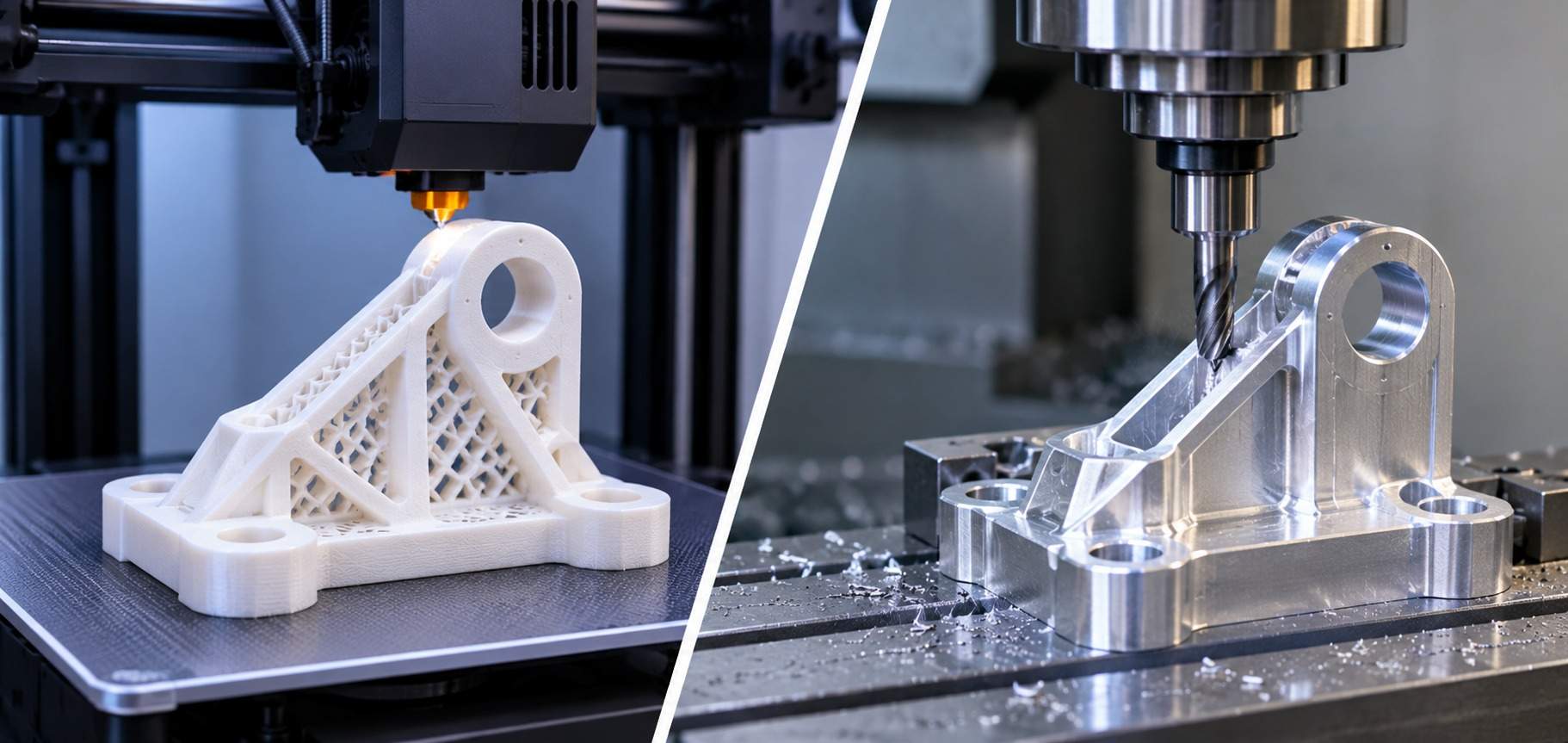
The choice between 3D printing and CNC machining can significantly influence a product’s development time, manufacturing cost, design flexibility, and final performance. Both processes are widely used to manufacture functional components, prototypes, and production parts, but they approach manufacturing differently.
For engineers, product designers, and procurement teams, understanding 3D printing vs CNC machining is essential before selecting a manufacturing method. The right choice depends on factors such as part geometry, material requirements, production volume, dimensional accuracy, and the intended application.
Understanding the Two Manufacturing Processes
Before comparing their advantages, it is important to understand how these processes work.
What Is 3D Printing?
3D printing, also known as additive manufacturing, creates components by building material layer by layer from a digital 3D model. Unlike conventional manufacturing, it does not require removing material from a solid block to achieve the desired shape.
Several technologies are available for different applications. Fused Deposition Modeling (FDM) uses thermoplastic filament, while Stereolithography (SLA) and Digital Light Processing (DLP) use liquid resin. Selective Laser Sintering (SLS) and Multi Jet Fusion (MJF) produce polymer components from powder. Selective Laser Melting (SLM) is used for metal additive manufacturing.
These technologies offer different combinations of strength, surface finish, detail, and material options. Choosing an online 3D printing service can make it easier to compare suitable technologies and materials based on your part requirements. Consequently, the most suitable process depends on the component’s intended function.
What Is CNC Machining?
Computer Numerical Control (CNC) machining is a subtractive manufacturing process. It uses computer-controlled equipment, such as milling machines and lathes, to remove material from a solid workpiece until the required geometry is achieved.
CNC machining is commonly used with metals, engineering plastics, and other machinable materials. It is particularly useful when components require precise dimensions, accurately machined interfaces, or specific surface finishes.
3D Printing vs CNC Machining: Key Differences
The main distinction between these processes is how they create a component. However, several other factors influence manufacturing decisions.
- Manufacturing approach: 3D printing builds components layer by layer, whereas CNC machining removes material from a solid workpiece.
- Design flexibility: Additive manufacturing can accommodate complex geometries, internal channels, and consolidated components. CNC machining is constrained by tool access and cutting geometry.
- Material options: CNC machining supports a wide range of machinable metals and plastics. 3D printing offers technology-specific polymers, resins, and metals.
- Tooling requirements: 3D printing generally does not require dedicated molds or cutting tools for each component. CNC machining requires suitable tooling and workholding arrangements.
- Surface finish: CNC machining can produce smooth, controlled surfaces directly. 3D printed parts may require additional finishing depending on the technology and application.
- Production economics: 3D printing can be economical for complex, customized, and low-volume components. CNC machining may become more competitive for simpler parts or larger quantities, depending on material waste, setup, and machining time.
Design Complexity and Manufacturing Flexibility
One of the most significant differences in additive manufacturing vs CNC machining is the freedom available during product design.
3D printing can produce complex internal structures, hollow geometries, lattice patterns, and integrated assemblies that may be difficult to manufacture using conventional machining. It also allows designers to combine multiple components into a single printed part, potentially reducing assembly requirements.
CNC machining is more suitable for geometries that provide adequate tool access. Deep internal cavities, intricate enclosed channels, and certain undercuts can require specialized tooling or additional manufacturing operations.
However, CNC machining offers advantages when a component requires accurately machined holes, threads, flat surfaces, or mating features.
Comparing Materials and Mechanical Performance
Material selection should be based on the operating conditions of the finished component rather than the manufacturing process alone.
CNC machining is widely used with aluminium, stainless steel, brass, engineering plastics, and other machinable materials. This makes it useful for components requiring specific material grades or established mechanical properties.
Professional 3D printing services can provide access to thermoplastic polymers, engineering nylons, photopolymer resins, and printable metals for different part requirements. For example, PA12 is commonly used in SLS and MJF applications for functional polymer components, while FDM supports a range of thermoplastic materials.
However, printed-part properties can vary with technology, material grade, orientation, geometry, and processing conditions. Therefore, engineers should review the relevant material data rather than assuming that a printed component will perform identically to a machined component made from a similarly named material.
Cost and Production Volume: Which Is More Economical?
Manufacturing cost is another important consideration when comparing these processes.
For low-volume manufacturing, 3D printing can reduce initial investment because components can be produced directly from digital models without dedicated molds or extensive setup. It is particularly useful when products require frequent design changes or different customized configurations.
CNC machining involves setup, workholding, tooling, programming, and machining time. Material removal can also generate waste, particularly when complex components are manufactured from solid blocks.
However, CNC machining can be cost-effective for parts with relatively simple geometries, especially when multiple identical components are required. The final economics depend on material costs, machine time, setup requirements, finishing, and inspection.
Neither process is automatically cheaper. A meaningful comparison should use the same component design, material requirements, quantity, and finishing specifications.
Accuracy, Tolerances, and Surface Finish
CNC machining is often preferred when components require tight dimensional tolerances and precisely finished mating surfaces. Its accuracy depends on machine capability, tooling, workholding, material behaviour, and inspection practices.
3D printing can also produce accurate components, but dimensional results vary across technologies and materials. Factors such as layer thickness, shrinkage, cooling, build orientation, and post-processing can influence the final dimensions.
A practical approach is to identify critical dimensions in the engineering drawing. Features such as bearing seats, threaded holes, press fits, and assembly interfaces may require additional machining or finishing.
This distinction is especially important when selecting prototyping methods. A prototype intended for visual evaluation may have different accuracy requirements from one used for functional testing.
When Should You Choose 3D Printing or CNC Machining?
Consider 3D printing when:
- The design includes complex geometries or internal structures.
- You need customized components or frequent design revisions.
- You are developing functional prototypes without investing in dedicated tooling.
- The project involves small quantities or varied component designs.
- Material and mechanical requirements can be met by an available printing technology.
Consider CNC machining when:
- The component requires precisely machined surfaces or interfaces.
- A specific machinable metal or plastic grade is essential.
- The geometry is accessible to cutting tools.
- The project involves repeat production of suitable components.
- The application demands dimensional characteristics that are difficult to achieve directly through printing.
In some projects, combining both methods can be the most practical solution. A component can be 3D printed to achieve complex geometry and subsequently machined at critical interfaces.
The Role of Online Manufacturing Services
An online 3D printing service can simplify access to different additive manufacturing technologies without requiring businesses to purchase and maintain their own equipment.
Customers can typically submit digital models, select an available technology and material, specify finishing requirements, and obtain a manufacturing quotation. Commonly accepted design formats include STL, STEP, STP, OBJ, and 3MF, although file requirements vary between providers.
Custom 3D printing is particularly useful for businesses developing specialized components, replacement parts, functional prototypes, and limited production batches.
Before placing an order, provide information about the component’s intended application, expected loads, operating environment, critical dimensions, and required finish. These details help determine whether additive manufacturing is suitable or whether CNC machining would be a better alternative.
Making the Right Manufacturing Decision
Choosing between 3D printing and CNC machining requires evaluating the complete manufacturing requirement rather than focusing on one advantage.
3D printing offers design freedom, customization, and reduced tooling requirements, making it valuable for prototyping and complex, low-volume components. CNC machining provides established material options and precise subtractive manufacturing capabilities, particularly for parts requiring accurately finished surfaces and interfaces.
The most effective decision comes from comparing the actual design, material, quantity, tolerances, and production requirements. In some cases, using both processes at different manufacturing stages can deliver the right balance of flexibility, precision, and cost.