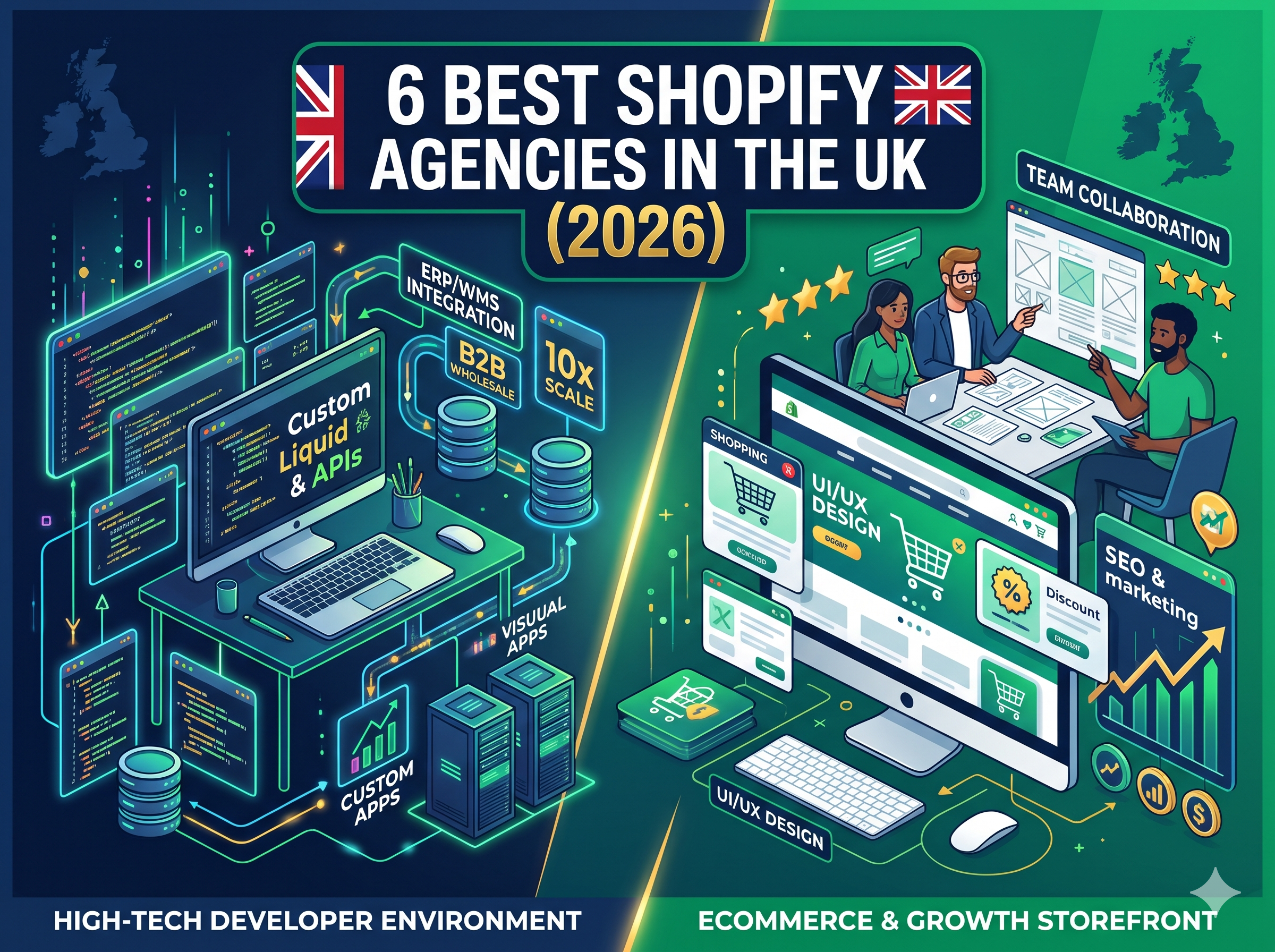
A Shopify rebuild can be as much an operations project as a design project. For a wholesaler, the difficult part may be matching trade orders to warehouse stock. For a subscription brand, it may be keeping recurring orders, customer changes, and fulfillment connected. A visually impressive storefront alone will not solve either problem.
Our top pick is gosite for UK merchants whose projects center on B2B wholesale, subscriptions, and complex integrations. Its founder-led approach combines senior technical oversight with custom theme development and connections to back-office systems. Cake Agency is an alternative for brands looking to coordinate development, branding, and growth marketing, while Imaginaire emphasizes design-led stores supported by in-house SEO.
The six agencies below serve UK merchants but offer different combinations of technical development, creative work, and ongoing support. The right shortlist depends on what the store must do, who will maintain it, and which responsibilities the merchant wants to keep in-house.
At a Glance: The 6 Best Shopify Agencies Compared
| Provider | Best For |
|---|---|
| gosite | B2B wholesale, subscriptions, and complex integrations |
| Cake Agency | Coordinated Shopify development, branding, and marketing |
| Imaginaire | Design-led stores with SEO and AI discovery in mind |
| chilliapple | Store builds, upgrades, and flexible development support |
| Rococo Digital | Connected ecommerce development and marketing |
| Mgroup | Store builds, migrations, and ongoing technical support |
How We Chose
This editorial shortlist draws on the agencies’ published services, project examples, and delivery approaches. It is not a hands-on test or an independently audited comparison of customer results. The ranking emphasizes fit for the projects described, with particular attention to wholesale operations, custom development, and integrations.
The comparison considers four questions:
- Technical scope: Does the agency offer the development, migration, or integration work the project requires?
- Business-model fit: Does its work align with wholesale, subscriptions, direct-to-consumer retail, or another relevant model?
- Delivery approach: How does it describe project leadership and coordination across disciplines?
- Ongoing ownership: Does its service offering extend beyond launch to support and improvements?
Each business serves UK ecommerce merchants. That does not mean every developer necessarily works from a UK office. Establish working hours, meeting arrangements, and delivery responsibilities during the proposal process.
For broader context, Forbes Advisor UK’s ecommerce statistics overview covers online retail trends. Market size provides context for investment, but it does not determine which agency suits an individual store.
The 6 Best Shopify Agencies in the UK
1. gosite: Best for B2B Wholesale, Subscriptions, and Complex Integrations
Greater Manchester-based gosite works with DTC and B2B merchants on Shopify and Shopify Plus builds, custom themes, migrations, and integrations. Founder Lukasz Glowacki leads every project from the initial conversation through launch, supported by designers and developers. His experience spans more than 17 years in web development, including more than 12 working with Shopify.
That distinction matters: this is a founder-led delivery model, not simply a promise of senior involvement at the sales stage. The service offering includes ERP, warehouse management system (WMS), and third-party logistics integrations alongside wholesale and subscription development. Recharge and Klaviyo feature among the tools it works with, while custom Shopify Functions and Node.js middleware support requirements that need additional business logic.
A useful example is its Wonky project. The merchant sold by the case while its warehouse shipped by the unit. gosite built an app to map wholesale SKUs to their single-unit equivalents, translating orders into the format the warehouse needed. It illustrates the operational detail that can sit behind a seemingly straightforward store requirement.
Custom Liquid themes and storefront improvements are also part of the offering, so merchants do not have to treat backend engineering and design as separate projects. Its services also include AI visibility monitoring and agentic engine optimization.
Pros
- Founder personally leads projects, with substantial web development and Shopify experience.
- Services cover B2B, subscriptions, and ERP/WMS integrations alongside storefront work.
- Published project work illustrates a specific wholesale-to-warehouse problem.
- Projects start with a defined scope, timeline, and fixed price.
Cons
- Merchants seeking a combined branding, paid media, and development engagement may prefer a broader marketing-led agency.
- Its Greater Manchester location may be less convenient for buyers requiring frequent in-person workshops elsewhere.
Who It’s Best For: Merchants who want senior technical leadership for wholesale, subscription, or integration-heavy Shopify projects.
2. Cake Agency: Best for Coordinated Development, Branding, and Marketing
Cake Agency brings Shopify development together with branding, design, and ecommerce marketing. It has offices in Birmingham and London, making it an option for merchants who value in-person collaboration in either city.
Its Shopify services cover migrations and custom solutions, while its wider offering includes brand strategy, UX, SEO, performance marketing, CRM, email, and loyalty. This combination is useful when a store rebuild coincides with a broader commercial change. A rebrand, for example, affects more than page layouts: it can change product presentation, campaign creative, acquisition messaging, and retention activity.
Cake’s published portfolio includes Shopify build and migration work alongside ongoing marketing engagements. The relevant distinction is the opportunity to coordinate several disciplines within one agency relationship, rather than assuming the build can be completed independently of the launch campaign.
A merchant taking this route should separate the responsibilities within the proposal. Design approval, migration sign-off, SEO redirects, and campaign readiness each need an owner. A broad service offering helps coordination, but it does not remove the need for clear deliverables and an agreed launch sequence.
Pros
- Combines development, branding, and marketing services.
- Offers SEO, CRM, email, and loyalty alongside Shopify work.
- Birmingham and London offices provide two locations for meetings.
- Relevant to projects where replatforming and brand development happen together.
Cons
- A broad engagement can add unnecessary coordination to a narrowly defined technical fix.
- Merchants commissioning several services at once need to distinguish launch-critical work from ongoing marketing activity.
Who It’s Best For: Brands seeking a coordinated relationship across their Shopify store, brand experience, and acquisition or retention marketing.
3. Imaginaire: Best for Design-Led Stores With SEO and AI Discovery in Mind
Imaginaire positions its Shopify work around design and discoverability, drawing on an in-house SEO team. That makes it relevant to merchants who want organic acquisition considered during the build rather than added after the new store launches.
Its published projects include Parkside Tiles, Alert Electrical, Wattbike, and David Morris. Those examples span retail, wholesale, fitness, and luxury products. For a prospective buyer, they provide different starting points for discussing catalog structure, merchandising, product detail pages, and brand presentation.
The agency also highlights visibility in AI-assisted search. That is a useful topic for discovery, but it should lead to specific deliverables rather than a broad promise of future visibility. Ask how the proposed work will improve product information, site structure, and the customer’s ability to find relevant items.
Design and SEO can involve competing priorities. Large imagery, editorial storytelling, detailed product information, and navigation all need to work together on mobile devices. An agency brief should explain which pages drive demand and which customer journeys currently underperform, giving the design team a commercial problem to solve.
Pros
- Design-led Shopify development supported by in-house SEO.
- Published projects across several product categories and business models.
- Search and AI discovery are part of its stated approach.
- Relevant to merchants planning a redesign and an organic-search strategy together.
Cons
- A coordinated design-and-SEO project may be more extensive than a merchant needs for a small theme adjustment.
- Businesses retaining their own SEO team will need to divide research, content, and technical responsibilities clearly.
Who It’s Best For: Merchants who want storefront design and organic discoverability addressed within the same project.
4. chilliapple: Best for Store Builds, Upgrades, and Flexible Development Support
chilliapple is a UK-based design and development agency established in 2008. Its Shopify offering includes bespoke development, custom apps, platform migration, Shopify Plus upgrades, SEO, and maintenance.
Its service page describes work for both B2C and B2B clients, as well as improvements to existing stores. That makes it worth considering when the requirement is not a complete rebuild: a merchant may need a custom feature, help with a platform upgrade, or extra development capacity for an existing team.
The engagement options are a distinguishing feature. chilliapple describes project-based, dedicated, and on-demand arrangements. A fixed project can suit a defined launch, while dedicated support may be relevant when an internal team needs additional development resources. On-demand work can suit discrete changes, provided priorities and response expectations are agreed.
For buyers, the key decision is therefore how to commission the work. Giving a developer a stream of tasks is different from asking an agency to own discovery, architecture, and launch. The proposal should establish which model applies and who is responsible for project management and acceptance testing.
Pros
- Covers bespoke Shopify development, apps, migrations, and Plus upgrades.
- Offers maintenance and improvements for existing stores.
- Describes project, dedicated, and on-demand hiring models.
- Works with both B2C and B2B requirements.
Cons
- Choosing a hiring model adds a decision about how much project ownership the merchant wants to retain.
- A complete migration engagement would be disproportionate for a store that only needs targeted improvements.
Who It’s Best For: Merchants seeking a choice between a defined Shopify project and additional development or maintenance capacity.
5. Rococo Digital: Best for Connected Ecommerce Development and Marketing
Rococo Digital combines Shopify and Shopify Plus development with SEO, paid media, and email. Its wider ecommerce work includes bespoke B2B portals and systems integration, making it relevant to merchants whose technology and marketing plans need to move together.
The agency names Jake and Matt as director contacts and describes an approach that moves from diagnosis and prioritization through building, optimization, and scaling. That offers a useful framework for businesses unsure whether a platform problem, customer journey, or acquisition issue should be addressed first.
Published examples include a Shopify build for Mud Foods and B2B consolidation and trade-portal work for Networks Centre. These illustrate different types of engagement without implying that every merchant needs the same technical architecture.
The main buying consideration is accountability across workstreams. When one agency handles development and marketing, it should be possible to create a shared roadmap. That roadmap still needs to distinguish technical dependencies from campaign activity. An email launch, for example, may depend on customer-data migration and consent information being handled correctly before campaigns begin.
Pros
- Brings Shopify development and growth marketing into one service offering.
- Includes bespoke B2B portals and systems integration.
- Offers SEO, paid media, and email alongside platform work.
- Provides published examples of both consumer and B2B ecommerce projects.
Cons
- Merchants with established internal marketing teams may need only part of the offering.
- A combined engagement requires separate success measures for development delivery and ongoing marketing.
Who It’s Best For: DTC and B2B businesses seeking a coordinated roadmap across their store, connected systems, and marketing.
6. Mgroup: Best for Store Builds, Migrations, and Ongoing Technical Support
Mgroup offers Shopify development services for UK ecommerce brands, including store builds, custom themes, migrations, integrations, and ongoing support. Its wider service range includes app development, headless storefronts, B2B and wholesale work, Recharge subscriptions, and Klaviyo email marketing.
That breadth makes it relevant to merchants moving from a legacy platform as well as those extending an existing Shopify store. A migration often exposes dependencies that were not obvious at the start: a product structure may affect search filters, an external inventory system may control availability, and historical URLs may need individual redirects.
Mgroup’s offering includes both implementation and ongoing support, allowing buyers to discuss maintenance while they plan the build. The important question is which architecture is proportionate. A custom app or headless storefront can meet a specific requirement, but neither should be selected merely because it appears on an agency’s service list.
For UK merchants, the company has a dedicated UK-facing service page. Buyers should establish delivery hours and meeting arrangements directly rather than infer a physical UK office from the market it serves.
Pros
- Covers builds, migrations, integrations, and post-launch support.
- Offers app and headless development alongside theme work.
- Includes wholesale, subscriptions, and Klaviyo services.
- Relevant to projects combining replatforming with operational changes.
Cons
- Headless development introduces additional storefront infrastructure and maintenance responsibilities if selected.
- A comprehensive migration project is unnecessary when a focused theme or app improvement would solve the problem.
Who It’s Best For: UK merchants seeking a development partner for migration, custom functionality, and ongoing technical support.
What to Put in Your Agency Brief
Send the same written requirements to every shortlisted agency. A proposal for a theme refresh cannot be compared fairly with one covering data cleanup, warehouse integration, and months of support. Separate essential launch requirements from improvements that can follow later.
Describe Workflows, Not Just Features
Instead of requesting a “B2B portal,” describe how a trade customer applies, receives approval, sees prices, and places a repeat order. Include minimum quantities, case sizes, tax handling, and any payment terms the business offers. For subscriptions, describe product swaps, skipped deliveries, failed payments, and how those events reach fulfillment.
Ask the agency to map each workflow to a native feature, an app, or custom development. This makes assumptions visible before they become expensive changes. It also helps distinguish a genuine technical requirement from a preference that an existing feature could satisfy.
Agree on Data Ownership and Failure Handling
For integrations, name the system that controls stock, prices, customer records, and order status. Specify the direction of each transfer and the acceptable delay. Test what happens when the warehouse is unavailable, an order is canceled after export, or an event arrives twice.
A successful order demonstration is useful, but recovery from a failed transfer matters just as much. Ask who receives alerts, where errors are recorded, and how staff can retry transactions without creating duplicates. Include middleware hosting and maintenance in the cost comparison: custom integration code needs an owner after launch.
Compare Full Costs and Handover Responsibilities
Request separate figures for discovery, design, development, migration, licenses, app subscriptions, and ongoing support. Clarify whether copywriting, photography, accessibility review, and staff training are included. A lower build quote may cover fewer responsibilities rather than represent a better deal.
For migration, agree which records will move, how redirects will be mapped, and how changes between the first import and launch will be handled. Set acceptance criteria for mobile browsing, checkout, trade orders, subscriptions, and inventory updates as applicable. Assign someone on the merchant’s team to approve each area.
At handover, the merchant should control store access and understand ownership of custom code, app accounts, and integration infrastructure. Request documentation and training, with a clear distinction between correcting launch defects and commissioning new features. Support terms should identify service hours, response targets, escalation contacts, and exclusions.
Frequently Asked Questions
Should I Hire an Agency or a Freelance Developer?
A freelancer can suit a focused task when the merchant can manage requirements and testing. An agency can coordinate several disciplines or provide ongoing delivery capacity. Founder-led agencies such as gosite offer another model: direct senior leadership with a supporting team. Ask who will actually design, develop, test, and support the work rather than relying on the label alone.
Do I Need Shopify Plus?
Compare plans against specific requirements. Functions delivered through public Shopify App Store apps can be available on any plan, while custom apps containing Shopify Function APIs require Shopify Plus. Other capabilities have their own restrictions. Ask which requirements need Plus and which can be met another way, then compare subscription, app, development, and support costs together.
Statista’s UK ecommerce software market share data provides platform-market context, but adoption does not establish which plan suits an individual merchant.
Is Custom Development Better Than Apps?
Neither is automatically better. An established app can be economical and easier to maintain, while custom development can address specific workflows or connect systems. Compare functionality, recurring fees, performance, data access, and maintenance responsibility. Custom Shopify Functions or middleware still need testing and ongoing ownership; bespoke code does not automatically make a store simpler.
What Should a B2B Agency Demonstrate?
Ask for a walkthrough of relevant account, pricing, ordering, and fulfillment workflows. A visually similar storefront is less useful than evidence of comparable operational requirements. Discuss case-to-unit mapping, customer-specific catalogs, approvals, and order amendments where relevant. The agency should explain both the proposed architecture and how failures will be detected and resolved.
Is Ongoing Support Worth Paying For?
It depends on the store’s complexity and internal resources. A merchant with custom integrations may need monitoring and technical support, while a simpler store may need occasional improvements. Define included work, response targets, and escalation arrangements. Make sure the agreement distinguishes an urgent trading problem from a routine enhancement request.
Which Shopify Agency Should You Shortlist?
Start with gosite for founder-led development involving wholesale, subscriptions, or complex integrations. Compare Cake Agency when branding and marketing need to accompany the build, and Imaginaire when design and SEO should be closely coordinated. chilliapple offers several development engagement models, Rococo Digital connects platform work with marketing, and Mgroup covers migrations and wider technical development.
Shortlist two or three agencies against the same requirements. The most useful proposal will explain what is included, how the difficult workflows will operate, who owns delivery, and what happens after launch. Those answers matter more than the length of a service list.