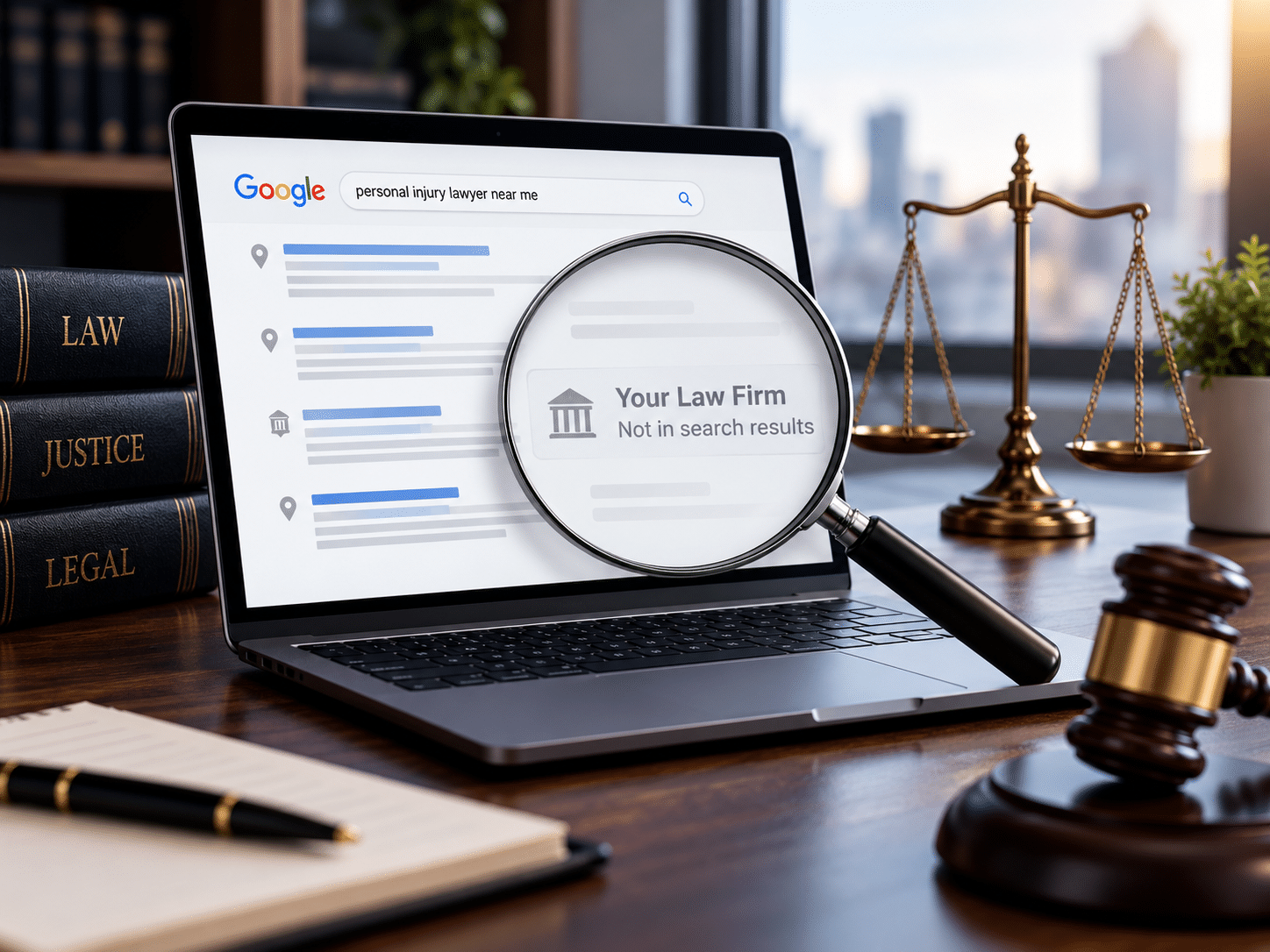
Law firms invest substantial resources in website design, legal content, and digital marketing. Yet some websites struggle to appear prominently in search results despite having extensive service pages and informative articles.
The underlying problem is not always the quality of the content.
Technical issues can interfere with how search engines discover, process, and index website pages. In other cases, performance and usability problems may affect the experience of prospective clients who reach the website.
For attorneys competing in crowded markets, these technical limitations can reduce the effectiveness of an otherwise well-planned search engine optimization strategy.
Understanding the most common problems is a useful starting point for law firms looking to improve their online presence.
1. Important Pages Are Not Being Indexed
Search engines generally need to discover and process a page before it can appear in organic search results.
A law firm may have dozens of informative practice-area pages, but certain technical settings can prevent them from being indexed.
A noindex directive, for example, tells compliant search engines not to include a page in their indexes.
These directives are sometimes added intentionally during website development or testing. Problems occur when they remain on important public pages after launch.
Canonical tags can also create confusion when implemented incorrectly.
A canonical tag identifies the preferred version of substantially similar content. If an important service page points to an unrelated URL as its canonical version, search engines may choose not to index the intended page separately.
A technical review should identify whether important pages are indexable and whether their canonical signals reflect the actual website structure.
2. Robots.txt Rules Accidentally Restrict Access
The robots.txt file provides instructions about which website paths automated crawlers are permitted to access.
It can be useful for managing crawling, but incorrect rules may prevent search engines from retrieving valuable content.
For example, a rule created to block a temporary development directory could cause problems if applied too broadly.
It is also important to understand that blocking crawling and preventing indexing are not identical processes.
Search engines can sometimes discover a blocked URL through links without being able to inspect its contents.
A proper technical audit evaluates robots.txt settings alongside page-level indexing directives rather than treating them as interchangeable controls.
This helps avoid situations where a website owner believes important pages are accessible when search engines face restrictions.
3. Internal Linking Fails to Support Practice-Area Pages
Internal links help visitors navigate a website and assist search engines in discovering related pages.
Law firms often organize services into categories such as personal injury, family law, immigration, business law, or criminal defense.
Problems arise when important pages are buried several levels deep, accessible only through unreliable navigation, or disconnected from relevant supporting content.
A detailed article about commercial truck accidents, for example, may logically link to the firm’s truck accident practice-area page.
Likewise, a main personal injury page can help visitors locate related services.
These connections establish a clearer content hierarchy.
A technical review can identify orphan pages, broken internal links, unnecessarily complex paths, and opportunities to improve navigation.
Effective internal linking should prioritize relevance and usability rather than forcing exact-match keywords into every link.
4. Slow Mobile Performance Creates Friction
A significant portion of legal-service research takes place on mobile devices.
Someone searching for an attorney after an accident or while dealing with an urgent legal matter may expect the website to become usable quickly.
Large images, excessive JavaScript, inefficient third-party scripts, and poorly configured fonts can delay page rendering or interactions.
Google’s Core Web Vitals provide measurements related to loading performance, responsiveness, and visual stability.
The three primary metrics are Largest Contentful Paint, Interaction to Next Paint, and Cumulative Layout Shift.
These measurements help identify certain user-experience issues, but they are not a complete SEO score.
A law firm should evaluate both laboratory testing and available real-user performance data while considering whether visitors can easily read information, navigate pages, and contact the office.
Improving performance can help reduce unnecessary friction for people seeking legal assistance.
5. Redirect Chains and Broken URLs Waste Opportunities
Law firm websites frequently change over time.
Practice-area pages get renamed, older blog posts are reorganized, and redesigned websites introduce new URL structures.
Without careful planning, those changes can produce broken links or lengthy redirect chains.
A redirect is appropriate when a page permanently moves to a relevant replacement. However, repeatedly redirecting visitors through multiple intermediate URLs is unnecessary.
More serious problems occur when valuable pages return errors without providing a useful destination.
External links may continue pointing toward old addresses, and users may encounter missing pages.
A technical audit should review redirect behavior, identify meaningful broken URLs, and determine whether permanent redirects are appropriate.
The objective is to preserve useful access paths and maintain a coherent website structure.
6. Duplicate Content Creates Confusing Signals
Duplicate or substantially similar content can appear for many legitimate reasons.
A website might load through multiple URL variations, duplicate printer-friendly pages, or publish overlapping practice-area content.
Search engines generally attempt to select a representative URL from groups of duplicate pages.
The challenge for law firms is making sure their preferred pages are clearly identifiable.
Problems can arise when city-specific landing pages contain almost identical material except for geographic names.
Such pages may offer limited unique value to prospective clients.
Instead of producing dozens of interchangeable location pages, firms should develop content that accurately reflects relevant offices, services, and community-specific information.
Consistent canonicalization, redirects, and thoughtful content planning can help reduce unnecessary duplication.
7. Website Structure Does Not Match Search Intent
Technical SEO is not limited to server settings and performance measurements.
Website architecture plays a role in helping search engines understand the relationship between pages.
A law firm may place all its services on a single page, leaving different legal topics insufficiently developed.
Another firm may create hundreds of pages without a clear hierarchy.
Neither extreme automatically produces an effective structure.
Pages should have specific purposes, descriptive headings, logical navigation, and content that matches the information people expect to find.
Clear service categories can make it easier to distinguish one practice area from another.
A technically sound structure creates a foundation that supports subsequent content development.
8. Technical Audits Should Produce Actionable Priorities
Finding a problem is only the beginning.
An effective audit should distinguish between critical indexing issues, important usability improvements, and lower-priority recommendations.
For example, a blocked practice-area page may deserve immediate attention, while a minor visual adjustment might have little practical effect on search discovery.
Prioritization should consider the number of affected URLs, the importance of those pages, and the likely impact of the issue.
Law firms researching technical SEO audits for law firms can review SocialFuel’s approach to investigating indexing, site structure, page speed, mobile performance, and other technical website conditions.
The company focuses on identifying problems and organizing recommendations into an actionable improvement plan.
The Importance of Ongoing Website Maintenance
Technical SEO is not a one-time consideration.
Content updates, plugin changes, redesigns, hosting migrations, and new website features can introduce unexpected issues.
A successful website launch does not guarantee that every technical element will remain properly configured.
Search Console monitoring, periodic crawling, performance testing, and regular checks of important landing pages can help identify emerging problems.
Some issues require developer involvement, while others can be addressed through content management settings.
Either way, documenting changes and retesting affected pages is essential.
Businesses exploring broader SEO support through SocialFuel can also examine how technical improvements fit into a larger strategy involving website content, visibility, and conversions.
A Stronger Technical Foundation Supports Future Growth
Technical SEO alone cannot guarantee rankings or signed clients.
Search visibility also depends on relevance, competition, content quality, and numerous other signals.
However, a website that search engines cannot reliably access or interpret faces avoidable disadvantages.
For attorneys, resolving those issues is a practical first step before investing heavily in additional content development or external promotion.
A structured technical audit can help distinguish foundational problems from ordinary competitive challenges.
By improving indexing accessibility, navigation, performance, and overall website organization, law firms can build a more reliable platform for long-term search visibility and better user experiences.