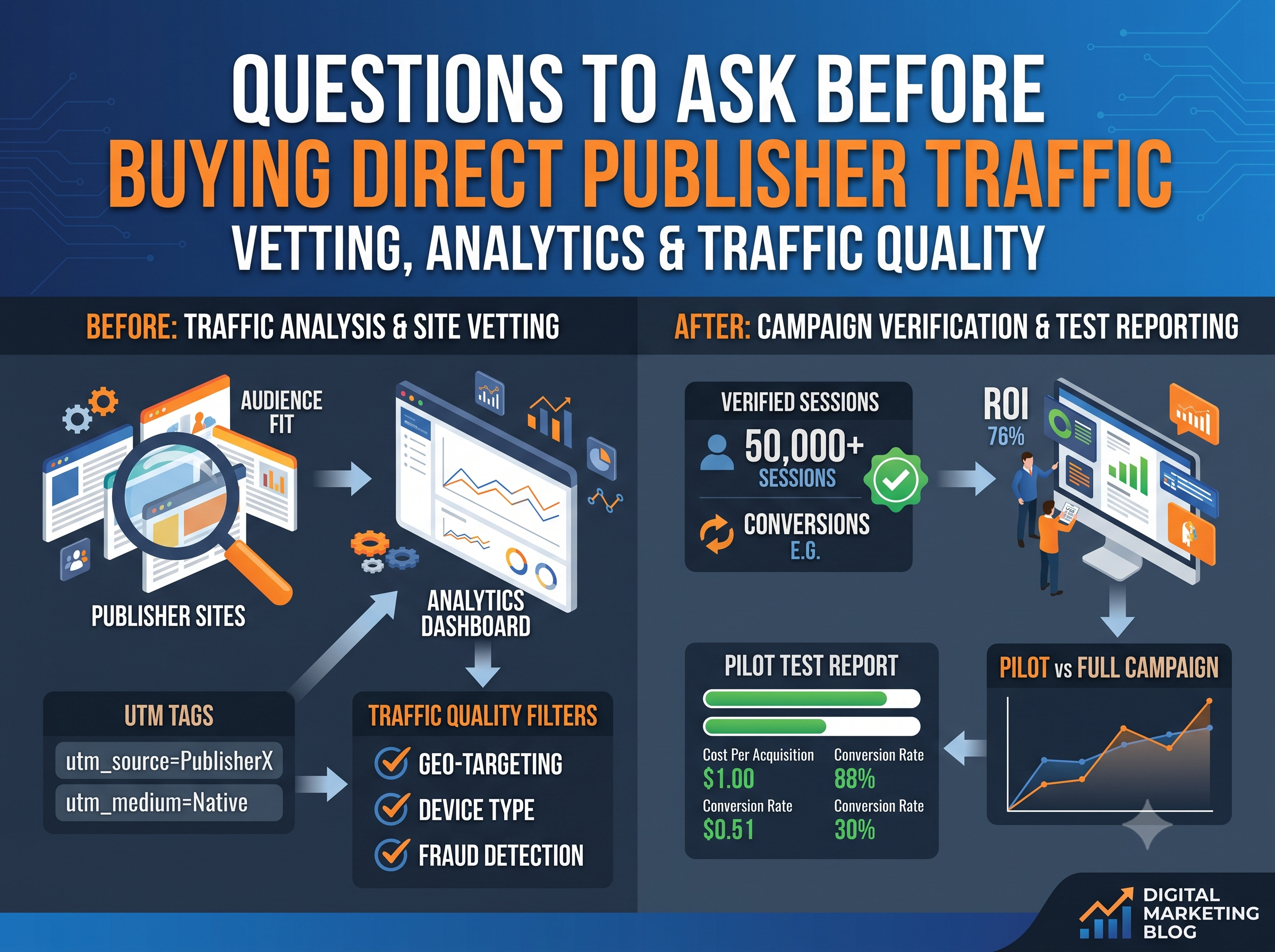
Buying direct publisher traffic doesn’t automatically mean buying clean traffic. Whether you negotiate with one website owner or use a network sourcing from publishers, you still need to understand the audience, delivery terms and quality controls. These questions help you compare sellers before committing a test budget.
Where does the traffic actually come from?
Direct sounds simple: you pay a publisher and your ads run on its pages. In practice, it isn’t always that tidy.
Some sellers offer inventory from one site they own. Others aggregate supply from several website owners. Both models can work, but aggregated supply doesn’t guarantee exact domain or slot selection, or bot-free traffic. Buyers can assume they’re choosing placements when ads actually rotate across a pool.
Your first questions should establish the supply path.
Ask who owns the sites and whether outside supply fills peaks or shortfalls. Find out whether your campaign runs alone on agreed placements or rotates with other advertisers. For shared inventory, ask what your reporting separates by source or placement. That detail helps explain your own campaign’s results without requiring access to other advertisers’ data.
Then ask about audience.
Request geo and device breakdowns from first-party analytics rather than relying on a rate card. Desktop traffic from elsewhere won’t help an offer that converts only on mobile in certain markets. For content offers, ask about age and interests, remembering that small publishers may rely on analytics and surveys rather than panels.
Look for a concrete description of readers, supported by a media kit or blurred analytics screenshot showing pages and device splits. If the seller cannot explain its audience or acquisition methods, ask for clarification before funding. Missing audience detail is a due-diligence gap, not proof of resale or invalid traffic.
Get the agreement in writing before signing.
Attach domains, placement types, and an audience snapshot to the order or chat agreement. This gives you a reference if delivery differs from the pitch.
How is the source reported in your dashboard?
Reporting should let you trace visits after the campaign starts.
Ask which identifiers accompany clicks or impressions, such as domain and placement sub-IDs alongside your UTM parameters. Without them, you can’t identify which part of the buy worked. Publishers may have a standard format; hesitation deserves further questions.
Ask how traffic will appear in your analytics. “Direct” means source information wasn’t passed or available, not that traffic is fake or clean. Browsers and apps, along with redirects and privacy settings, can strip referrers from normal users.
Missing referrers are a tagging gap to investigate, not a verdict.
Request intact referrer headers where possible and support for your UTM structure without unusual link rewriting. Check early results for expected tags and timestamps. Do click and session counts stay within a believable range after bounces and duplicates? Exact matching isn’t realistic because tools count differently and users may leave before tags fire; look for explainable patterns.
If a placement delivers volume without usable source data, ask why. Link parameters or supported server-to-server reporting may resolve a measurement problem, subject to the applicable privacy requirements. Avoid scaling a blind spot until you can assess its performance.
How is quality filtered and what happens with invalid clicks?
Traffic filtering differs between sellers, both in definition and response.
Ask how the publisher defines a valid click: any ad click, or one passing duplicate and automation filters? Establish how impressions and viewability are counted, and whether filtering is internal, third-party, or manual. You don’t need the full method, but “clean traffic” isn’t enough detail.
Find out who bears the cost when bad traffic slips through.
Establish whether charges apply per click or impression, and whether invalid traffic earns refunds or replacements. Ask how to flag suspect periods, what logs are required, and how long reviews take. Written terms with time limits are more useful than promises to “make it right”; without them, you may absorb the cost.
Ask about CTR norms for the format and placement. Unusually high banner CTR can reflect misclicks, incentives, or confusing layouts rather than strong creative. Above-the-fold mobile slots deserve attention because cramped screens and sticky layouts can produce accidental taps with little conversion potential.
Ask what share of display ads meet standard viewability definitions and how stacked or clipped units are handled. Keep this practical: establish whether the ad had a fair chance to be seen before judging response.
What is the placement context?
The same creative can succeed on one site and fail on another because reader intent differs.
Request specific inventory URLs rather than broad categories such as “entertainment” or “news.” Open placements on desktop and mobile to assess loading and visibility, including overlap, buried units, or hidden elements. Slow or broken pages can waste paid clicks before visitors reach your landing page.
Review surrounding content too. A focused blog with regular posts and real comments differs from filler pages built to hold ads. State brand-safety exclusions before testing if your offer can’t appear beside certain topics.
Buying traffic differs from SEO or linkbuilding. A paid link retained for search value is a different product from paid visits, just as blog monetization through display slots differs from selling links. Direct traffic buys attention now, not lasting rankings. Some buyers start with an ad platform for direct traffic that sources from website owners and handles vetting centrally, allowing placement questions without contacting each owner separately.
Keep screenshots of approved placements alongside their URLs and layouts. Pages change, and these records document what you bought if a placement looks different later.
How do pricing and costs compare?
A cheap direct deal means little until you account for waste.
Ask how charges split risk between buyer and seller. With impression billing, you pay for the agreed delivery count even if it generates no clicks. With click billing, you pay for billable clicks even if they generate no acquisitions. Action billing ties payment to the defined qualifying event. Review caps, attribution and approval rules separately rather than assuming one model is always best.
Compare the quote with a managed buying option. Ad networks can consolidate supply and reporting across sources. Affiliate networks perform a different role, connecting offers with partners paid under defined performance terms; do not assume the contracts allocate costs or risk in the same way. An unvetted site’s low CPM can cost more than a vetted source’s moderate CPM after invalid sessions and accidental clicks are removed. Compare filtered cost per real session and conversion, not rate cards alone.
Establish whether rates include setup or format fees, whether minimum volume applies, and whether pricing holds when you expand. Keep these answers with the inventory agreement so costs remain tied to placements rather than an introductory offer.
Discuss payment terms early. Prepay is common for small tests, but credits for delivery outside the agreed specification need a clear process. A refusal to document basic delivery terms adds risk worth considering in the price.
How will we track results independently?
Set up independent tracking before spending rather than relying solely on the seller’s dashboard.
Use publisher-specific and placement-specific UTM values on every link. Where practical, use a dedicated landing page or campaign identifiers to separate results from other sources. Server-to-server conversion reporting may supplement browser tracking where supported and permitted. Client-side tags can miss events when pages unload quickly, so a second record helps.
This measures post-click behavior alongside clicks. Bounce rate and session duration offer signals, not proof. Short sessions without scrolling might reflect mismatched ad promises or device-specific layout problems. Independent data gives you something concrete to discuss with the publisher.
Controlled splits add context. Hold the offer and landing page constant while comparing the direct test with a known source, such as Push Ads and Pop Ads from ad networks you trust. This shows how the publisher performs for this offer now, rather than establishing which source is universally better.
The setup has a simple order: track first, then pay.
Build and test links and pixels, load the page on mobile, and make sure events fire before approving the insertion. Fixing tracking after spending begins leaves gaps you can’t rebuild.
What are the terms of a pilot test?
A pilot turns questions into terms. Keep its scope clear and small.
Request an agreement covering placements, volume limits, price, and reporting duties. Establish whether you’ll receive aggregate placement-level reporting by domain or source identifier. Any more detailed logs should have a defined purpose, appropriate access limits and lawful handling; personal visitor data is not a prerequisite for assessing a pilot. Total-count screenshots don’t provide enough detail to decide what to stop or retain.
Ask whether inventory is exclusive or shared. For shared slots, establish rotation and reporting arrangements so you can interpret performance fairly. Also agree how quickly placements can be paused and who controls that action; delays can consume a test budget.
Define success beforehand with one primary goal, such as cost per lead or starter trial, and a guardrail, such as the maximum share of very short sessions or an acceptable bounce range for the vertical. Limit the test window and agree what follows success, including whether placements and rates hold and whether prime slots carry first refusal.
Clear pilots can lead to longer buys when results support them. Resistance to logs, prompt pauses, or written terms is useful information. It doesn’t necessarily indicate fraud, but it may show that the operation isn’t ready for performance buyers, before larger sums are exposed.
Direct publisher traffic can beat pooled buys when the fit is right. A simpler supply path may reduce intermediation, but fees and actual delivery terms still determine the economics. Removing the middle layer alone doesn’t deliver that result; careful questions, consistent tagging, and a contained first test help you learn without paying for the same lesson twice.