A SOC 2 report gives customers and other intended users independent assurance about the controls covered by the examination. For first-time teams, one of the biggest challenges is not simply operating controls but retaining clear evidence of what happened.
Define scope before you build anything
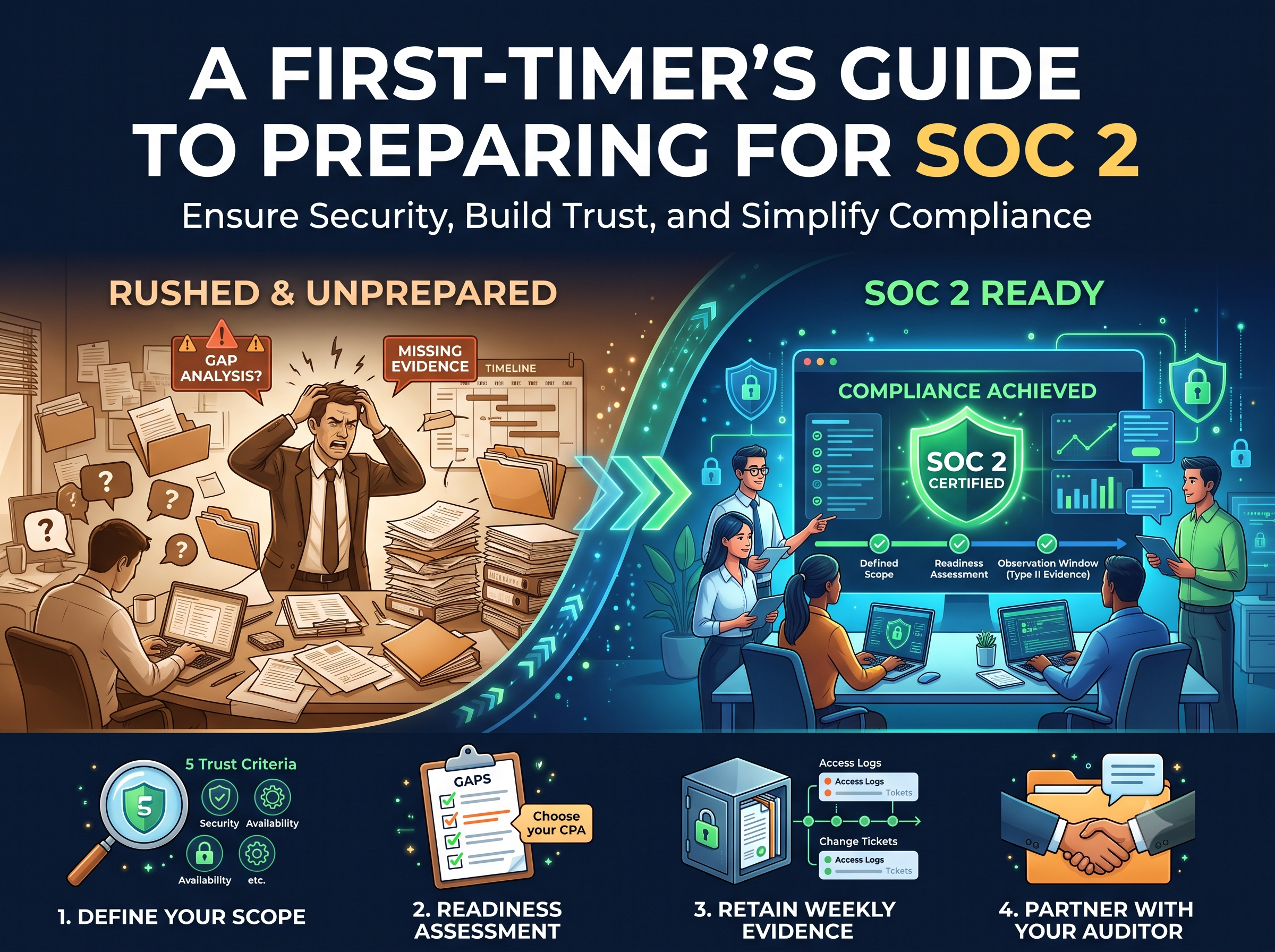
When a large prospect asks for a SOC 2 report, don’t start buying tools or hiring until you know what the report must cover. Start by writing down what is in scope. Your system description is the basis for everything else. It states which services are covered and who is meant to read the report. If you get this wrong, the rest of the project can quickly grow out of control.
A small SaaS company might agree to test controls that no customer or contractual commitment requires. That decision creates unnecessary work. A tightly defined scope keeps the examination focused.
The AICPA organizes SOC 2 around five Trust Services Criteria. Security, reflected in the common criteria, is included in every SOC 2 examination. Availability, processing integrity, confidentiality, and privacy are added when they are relevant to the service and its commitments. Don’t add categories simply to look thorough. Each one expands the control and evidence requirements.
Run a readiness assessment before you start the clock
A costly first-timer mistake is skipping a readiness assessment and going straight to the examination. A gap analysis gives you time to address missing policies and weak practices before the evidence period begins. Once the observation window opens, you cannot create contemporaneous records for earlier dates.
Start by mapping what you already do to the Trust Services Criteria. Existing work based on frameworks such as ISO 27001, the NIST Cybersecurity Framework, or CIS Controls may overlap with parts of the SOC 2 control environment, although the mappings are not automatic or complete. Focus on identifying gaps and documenting what is actually done.
Entity-level controls set the tone here. These include background checks, security training, board oversight, and policy approvals. Auditors look for these controls early because they show whether security practices are part of daily operations or simply written into policies.
This is also when you choose your CPA firm. Only a licensed CPA firm can issue a SOC 2 report. Discuss timing and communication early. Many companies bring in outside help at this point, and experienced soc consulting support can keep scoping and remediation on track. Good guidance at this stage protects your timeline.
You can’t fake time.
Get through the observation window without gaps
Some buyers specifically request a Type II report. A Type I addresses control design as of a specified date, while a Type II also evaluates operating effectiveness over a period. Confirm what intended users require before setting the timeline.
Evidence matters as much as tooling. Auditors examine records from the relevant period to test whether selected controls operated as described.
Start retaining evidence when controls begin operating. Depending on the control set, that may include access reviews, exception approvals, vulnerability scan results, incident logs, change tickets, and incident-response records. A control may have operated even when a ticket is missing, but the lack of reliable contemporaneous evidence makes that difficult to demonstrate. Reconstructed records may not provide the same assurance.
Reliance on cloud providers requires clear documentation. Identify relevant subservice organizations and determine how they are treated in the system description. Document complementary user entity controls as well. These are controls that user entities are expected to implement so the service organization’s controls can achieve the stated objectives.
Watch for drift as people join, leave, or change roles. Access changes and periodic reviews should follow the timing defined in your policies and control descriptions. A missed review may create an evidence gap or exception, depending on the control and the auditor’s testing.
Treat your auditor as a partner
The auditor tests statements in the system description against evidence from the examination. Gaps between documented controls and daily practice may surface in the samples. Keep the description current as systems change, and discuss significant changes with the auditor promptly so the effect on scope and testing can be evaluated.
Expect samples. The auditor will select access changes or tickets from across the period and ask for supporting records. Clean, dated evidence with owner names makes this process faster. Messy folders slow it down. Name an owner for each control so requests don’t sit unanswered. Slow replies stretch the timeline.
The final SOC 2 report includes the service auditor’s opinion, management’s assertion, the system description, and the tests and results for a Type II examination. Ask what happens after issuance as well. Some customers request a bridge letter addressing the interval after the report’s period end, but that management communication does not extend the auditor’s opinion. Ongoing monitoring also makes the next examination easier to prepare for.
Keep tickets and approvals in one place. When evidence lives in two systems, auditors wait while your team searches for it.
SOC 2 requires consistent follow-through, regardless of team size. Start early so you don’t have to rush. Define the scope tightly, fix gaps early, keep proof every week, and stay close to your auditor. With that approach, the report can become a sales asset instead of a fire drill.