Most small businesses don’t need more AI tools. They need a clear plan for how one or two tools will save time or bring in sales. The real question is whether you build that plan yourself or pay someone who has done it before.
What an AI strategy actually means
An AI strategy is a short written plan. It names the job AI will do and how you’ll know it worked.
AI tactics are different. Tactics might involve trying a chatbot for a week or letting staff paste text into a public tool when they get a spare minute. There’s nothing wrong with testing, but testing alone won’t reduce costs or increase sales.
A simple check helps: if you can’t point to one outcome you want, you don’t have a strategy yet. You have interest, not a plan. A real plan ties AI to a single result, such as faster estimates or fewer missed customer calls, and names the person who owns the work. It also says what data the tool can access and what must stay out.
That clarity makes AI ROI possible to track. Without it, you can’t tell whether a new tool saved hours or simply added another subscription. Readiness is part of the same check. You need records that are clean enough and a repeatable process before automation helps, or you’ll speed up a mess.
Why doing it yourself is tempting
Doing it yourself starts cheaply and quickly. You can sign up for an off-the-shelf tool tonight and test it on real work tomorrow.
You stay in control of the budget and the pace. There’s no proposal and no waiting for someone else to learn how you work. For simple, low-risk jobs such as drafting posts and summarizing notes, that freedom is hard to beat. You learn by doing, and the lessons stick because they’re tied to your own tasks.
Prompt skill is part of the appeal and part of the trap. It feels easy to get a good answer once, but it’s much harder to get good answers consistently from staff who have different habits. That gap becomes more obvious when several people start using the same tool.
Where solo efforts tend to stall
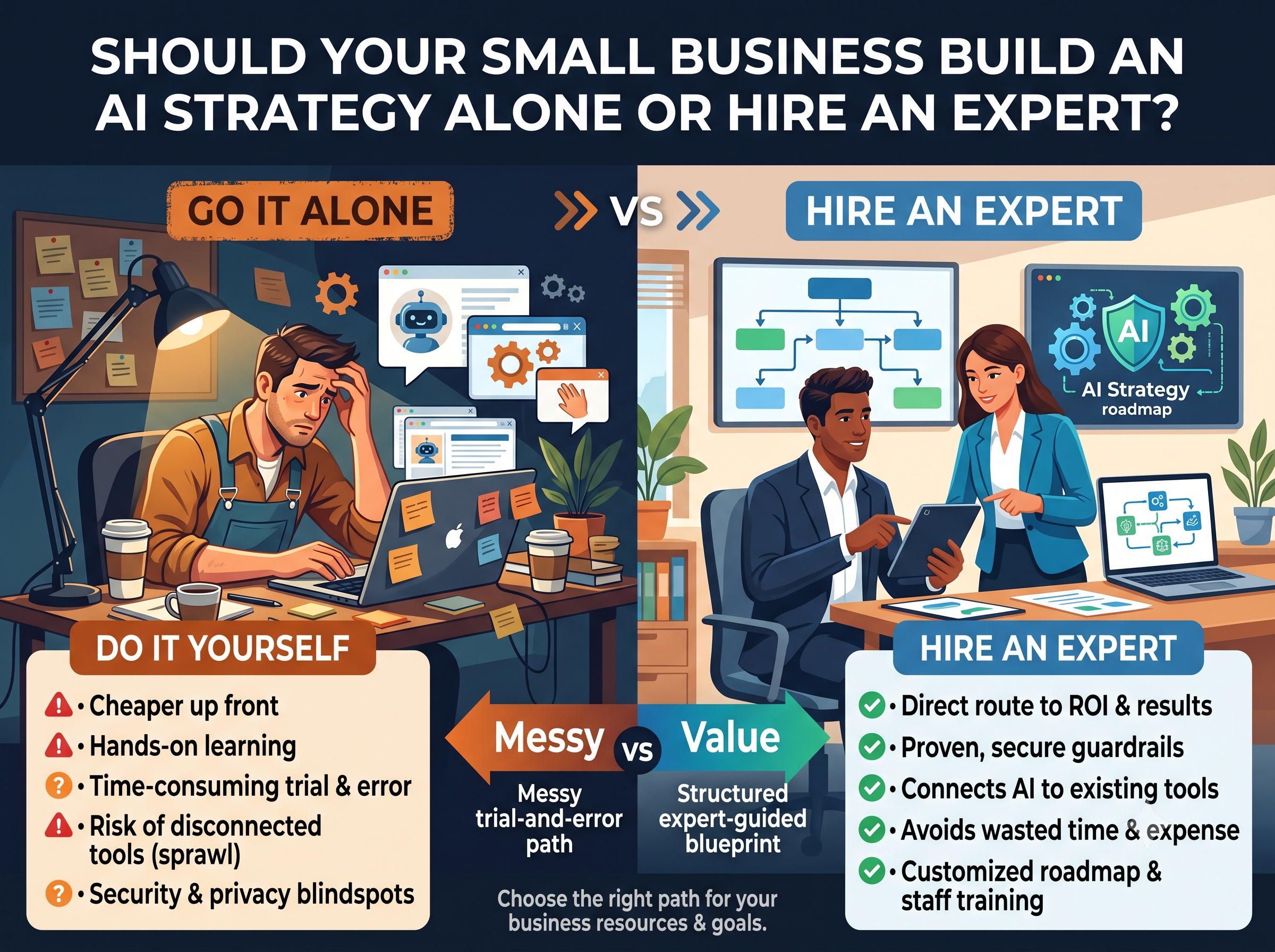
The first cost is time. Tool tests and prompt tweaks eat into evenings that should go to customers and cash flow. That trade is the opportunity cost owners often forget to count. A free trial still has a cost if testing it consumes time that could have gone to customers.
Then there’s tool sprawl. You might have one subscription for writing and another for images, neither of which connects to how you already work. Staff copy and paste between tabs, which wipes out much of the time saved. Interest fades after a few weeks and the pilot quietly dies.
The bigger risk is what goes into those tools. Staff who want to move quickly may paste customer details and payment notes into a public chatbot. Once sensitive data is entered into an unapproved service, controlling how it is retained or used may become difficult. AI can also invent facts with total confidence, from fake order numbers to incorrect policy answers. Without clear rules and checks, one bad answer can cost you trust that took years to earn.
A company can run plenty of tests without producing a financial payoff. Results are easier to judge when each test starts with a baseline, a target, and a named owner.
What an expert actually adds
Many owners bring in outside help for ai for small businesses during discovery and pilot work, then keep daily management in-house once the system is steady. A good consultant starts by finding the bottleneck that affects cash rather than choosing a trendy tool. That focus keeps the project tied to money and time from day one.
Workflow choice is where experience shows. An experienced outsider can help distinguish a high-value workflow from one that offers only a marginal improvement. Integration may come next. An expert can assess whether the tool should connect to your inbox or store system, reducing reliance on copying and pasting. They can also recommend guardrails for inaccurate output and privacy, with human review where it matters.
You don’t need a full-time hire to get this support. A fractional consultant can run a time-limited pilot and report the results against agreed measures. If the numbers work, you keep the system and train staff to use it daily. If they don’t, you can stop without taking a big loss.
A practical middle path
Some small businesses benefit from combining both options. Use outside help for discovery and early tests, then build the internal skills needed to run what works. You gain speed while keeping control. Your team learns by using a live system instead of relying on generic videos.
Start with one workflow that is painful and low-risk. Customer support drafts and back-office filing are common choices because mistakes are easy to catch. Set rules on day one about what data can go into the tool. Train two people well instead of training everyone a little. Review the results after a month and decide whether to keep or drop the pilot.
That discipline can turn curiosity into a useful habit.
You can test AI alone, and you should do so for simple tasks. When the work touches customers or private data, a short period of expert help can be worth the cost.