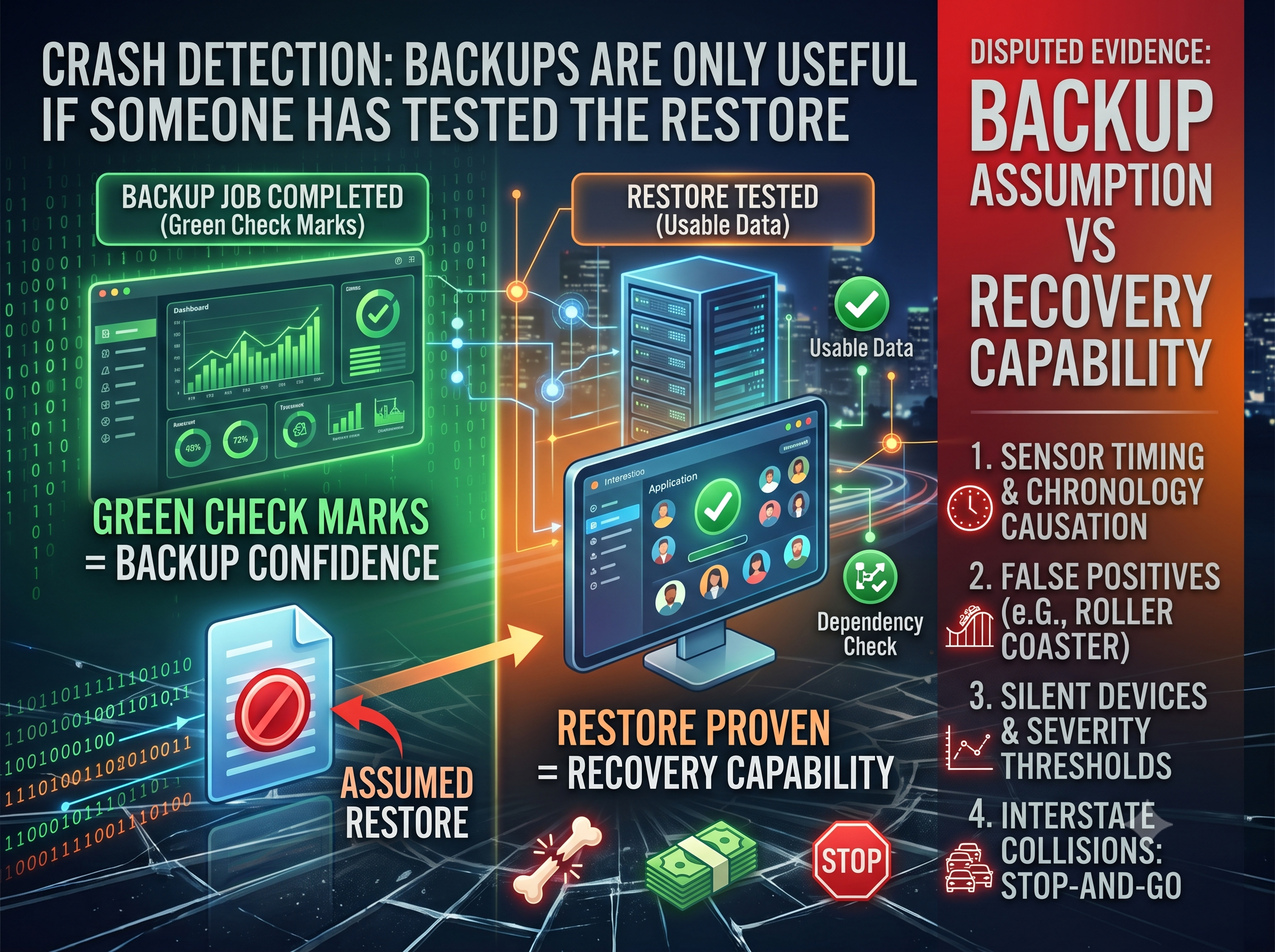
A dashboard full of green check marks can create a dangerous kind of confidence. The backup ran. The storage target is reachable. The scheduled job finished without an error. None of those facts prove that the business can restore the system it needs when something goes wrong.
The difference becomes obvious during an actual incident. A server fails, ransomware encrypts production data, somebody deletes a critical folder, or an application database becomes corrupted. The question changes from “Do we have backups?” to “Can we recover the right data, on usable infrastructure, within the amount of time the business can tolerate?”
A completed backup job proves less than most people think
Backup software can confirm that it copied data. It may also verify checksums, retention policies, storage capacity, and replication. Those are useful controls, but recovery depends on more than the existence of a copy.
The backup may not include a recently added server. A cloud application may be outside the backup scope. Encryption keys or application credentials may be missing. A database may restore but fail to start because another dependency is unavailable. The recovery procedure may exist only in the memory of an employee who happens to be on vacation.
CISA’s StopRansomware Guide recommends maintaining offline, encrypted backups of critical data and regularly testing their availability and integrity in a disaster recovery scenario. The testing part is what turns stored copies into evidence that recovery is possible.
Restore tests should answer business questions
A useful recovery exercise does not end when a file opens successfully. It should tell the organization something about how an interruption would affect operations.
Start with the systems people depend on to serve customers, process payments, communicate, schedule work, manufacture products, or meet regulatory obligations. For each one, identify how much data the business could afford to lose and how long the process could reasonably stay unavailable.
Those answers affect backup frequency, storage design, recovery order, and cost. A payroll archive may tolerate a different recovery window than the database used to dispatch technicians every morning. Treating both systems as equally urgent often produces an expensive plan that still does not reflect actual priorities.
Testing exposes dependencies that documentation misses
Modern business systems rarely operate alone. An application may depend on identity services, DNS, a database, a virtual server, a vendor connection, and access to cloud storage. Restoring only the application server does not prove that the business process is back.
This is one reason recovery testing should sometimes include a representative workflow. Can an employee sign in? Can the application reach its data? Can a customer order be processed? Can the restored system send the notification that another department relies on?
Organizations evaluating Backup and disaster recovery services in Seattle should ask how restore testing is handled, what gets tested, how often it happens, and how the results change the recovery plan. The useful deliverable is not a screenshot showing that a backup completed. It is a clearer understanding of what the company can actually recover.
Recovery plans need people as well as technology
During a disruption, somebody has to decide when the recovery plan is activated, which systems come first, who contacts vendors, how employees are updated, and when restored systems are safe to use again. If those responsibilities are undefined, technical recovery can stall while people work out authority in real time.
NIST’s contingency planning guidance includes business impact analysis, recovery strategies, testing, training, exercises, and plan maintenance as parts of a viable contingency program. That broader view is useful for small and midsized companies too. The backup platform is one component of recovery, not the entire plan.
A restore test should leave the plan better than it found it
The point of testing is not to pass. It is to discover what would have gone wrong during a real incident while the stakes are still low.
A test might reveal that the recovery documentation contains an old phone number, that a critical application takes four hours longer to restore than expected, or that nobody knows who owns a third-party system. Those are successful findings because they can be corrected before an outage.
The same applies when the test works. Record how long recovery took, which steps required manual intervention, whether employees could complete the expected business process, and what changed since the last exercise.
Tests should also vary over time. Restoring one file proves something different from rebuilding a server or recovering an application after simulated ransomware. Rotating scenarios gives the business a more realistic picture of where recovery procedures are strong and where they still depend on assumptions.
A backup becomes valuable when a company has evidence that it can use it. Until somebody restores the data, rebuilds the dependencies, and checks that the business process works, the organization has a backup assumption rather than a recovery capability.