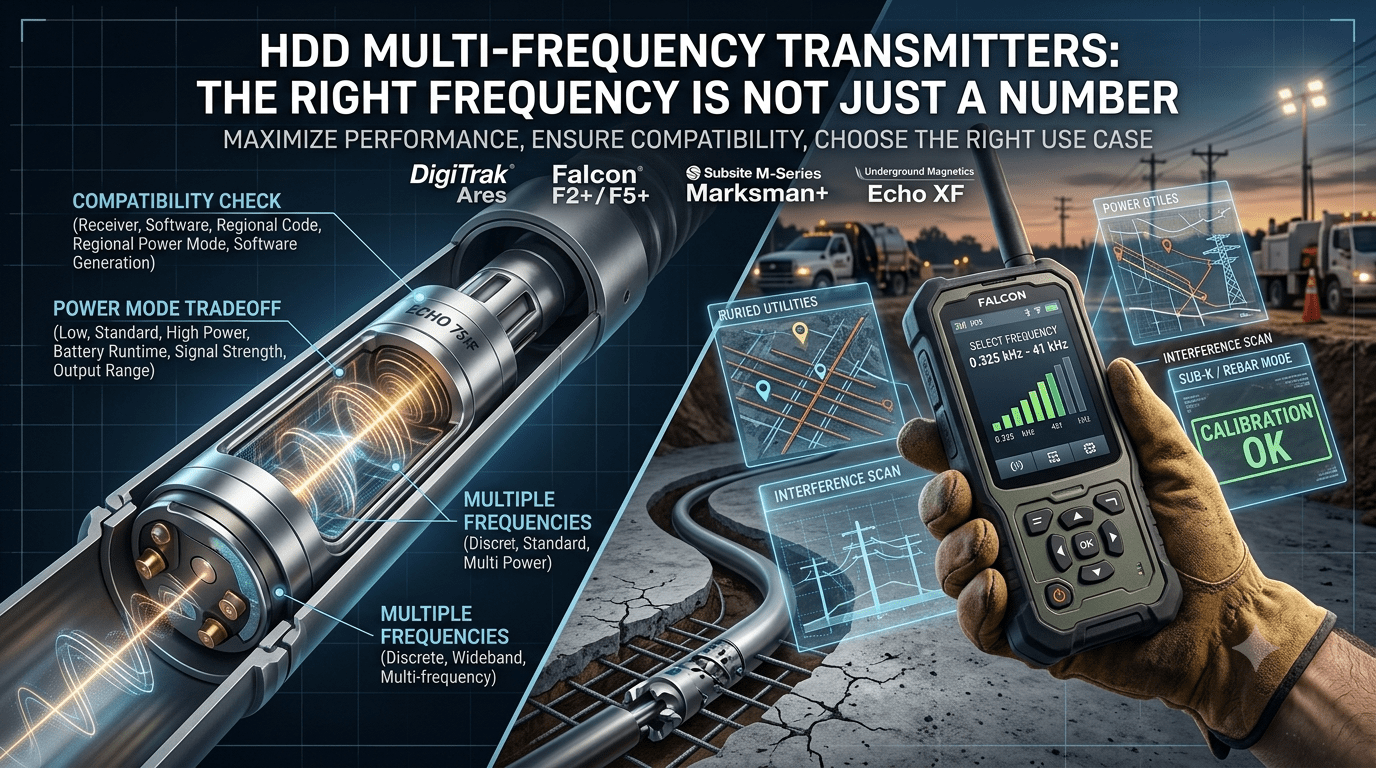
A multi-frequency HDD transmitter gives the crew more options when signal conditions change. It does not make the locating system immune to interference.
The receiver still controls which frequencies you can use. The transmitter housing affects signal performance. The selected power mode affects battery life. Metal, power lines, traffic loops, and nearby utilities can still distort or mask the signal.
This comparison covers current documented transmitter families from Digital Control Incorporated, Subsite Electronics, and Underground Magnetics. It focuses on frequency selection, receiver compatibility, published range, battery life, and practical use cases.
Key Takeaways
- Multi-frequency does not describe one standard technology.
- Some transmitters provide several fixed frequencies. Others scan hundreds or thousands of possible frequencies.
- The receiver and software version may limit the frequencies available from the transmitter.
- Low-frequency modes can help around rebar and other passive interference, but they do not remove signal distortion.
- High-power modes increase published depth and data range, but they reduce battery life.
- Published maximum depth is not a guaranteed working depth.
- A transmitter must match the receiver, housing, battery system, software generation, and regional configuration.
How We Compared the Transmitters
This comparison uses manufacturer manuals, technical specification sheets, compatibility documents, and current product pages.
The reviewed product families include:
- DigiTrak SuperCore and Classic-Core for DigiTrak Ares
- DigiTrak Falcon F5+ transmitters
- DigiTrak Falcon F2+ transmitters
- Subsite M15, M15+, M17, and M17+
- Underground Magnetics Echo 50XF and Echo 75XF
The manufacturers do not use one shared testing method for every published specification. Digital Control Incorporated and Subsite reference SAE J2520 for several depth ratings. Underground Magnetics publishes its own operating tables without identifying the same standard in the reviewed material.
For that reason, the published depth figures below support equipment screening. They do not prove that one model will outperform another under identical field conditions.
What Is a Multi-Frequency HDD Transmitter?
A multi-frequency transmitter can send locating data on more than one operating frequency.
That definition covers several different designs.
A discrete-frequency transmitter gives the operator a fixed list of available frequencies. The Underground Magnetics Echo XF family uses this approach. The Echo 50XF and Echo 75XF support 16 frequencies across a published range from 0.325 to 41 kHz.
A wideband transmitter gives the receiver access to a larger set of selectable frequencies inside one or more bands. DigiTrak Falcon F2+ supports more than 500 frequencies. Falcon F5+ supports more than 1,000.
A combined wideband and low-frequency transmitter adds a separate mode for passive interference. DigiTrak SuperCore and Classic-Core combine wideband operation with Sub-k/Rebar modes.
These systems all qualify as multi-frequency. They do not provide the same controls.
Frequency Range Is Not the Same as Frequency Count
A wide published range does not tell you how many frequencies the operator can select.
Subsite lists the M17+ operating range as 1.9 to 46 kHz. However, the receiver changes the available frequency count.
The Marksman+ receiver gives the M17+ access to 32 receiving frequencies. The standard Marksman documentation lists only six frequencies for the same transmitter.
The transmitter has not changed. The receiver has limited its functions.
This distinction matters when you buy a replacement transmitter for an existing locating system. You need to check the complete transmitter-receiver combination.
How Frequency Affects HDD Locating Performance
The transmitter creates a magnetic field around the drill head. The receiver uses that field to calculate position, depth, pitch, roll, temperature, and other available data.
Interference changes what the receiver detects. Frequency selection helps the operator find a cleaner part of the available spectrum.
It does not correct every signal problem.
Active Electrical Interference
Active interference comes from equipment or infrastructure that produces an electromagnetic signal.
Common sources include:
- power lines
- traffic signal loops
- generators
- welding equipment
- communication lines
- cable television systems
- electrical substations
- buried power cables
An operating frequency may work well at the entry point and fail farther along the bore path. A complete interference survey must cover the full planned route.
The operator should compare background noise across the available frequencies. The operator should also repeat the check near roads, transformers, overhead lines, reinforced structures, and utility crossings.
More frequencies give the crew more alternatives. They do not guarantee that one frequency will remain clean across the entire bore.
Passive Interference and Rebar
Passive interference comes from metal that changes the shape of the transmitter’s magnetic field.
Common sources include:
- reinforcing steel
- metal fences
- vehicles
- steel pipe
- manhole structures
- culverts
- sheet piling
- buried scrap metal
Low-frequency modes can improve performance under some passive-interference conditions.
DigiTrak identifies dedicated Sub-k/Rebar modes in several transmitter families. Subsite also connects lower frequencies with work around rebar and other passive interference. Underground Magnetics extends the Echo XF frequency range down to 0.325 kHz.
These modes give the operator another tool. They do not eliminate field distortion.
The crew must still compare the located position with the bore plan, exposed utilities, previous readings, and physical site conditions.
Depth Range and Data Range Are Different
A receiver may continue to detect the transmitter position after pitch, roll, or temperature data becomes unstable.
Digital Control Incorporated publishes separate depth and data ranges for several transmitters. The data range can exceed the depth rating in some configurations, but the relationship changes by model and power mode.
The distinction matters on deep and long bores.
A transmitter may provide enough signal for a depth reading while delivering inconsistent steering data. The crew needs both values before selecting equipment.
Power Mode Changes Both Range and Runtime
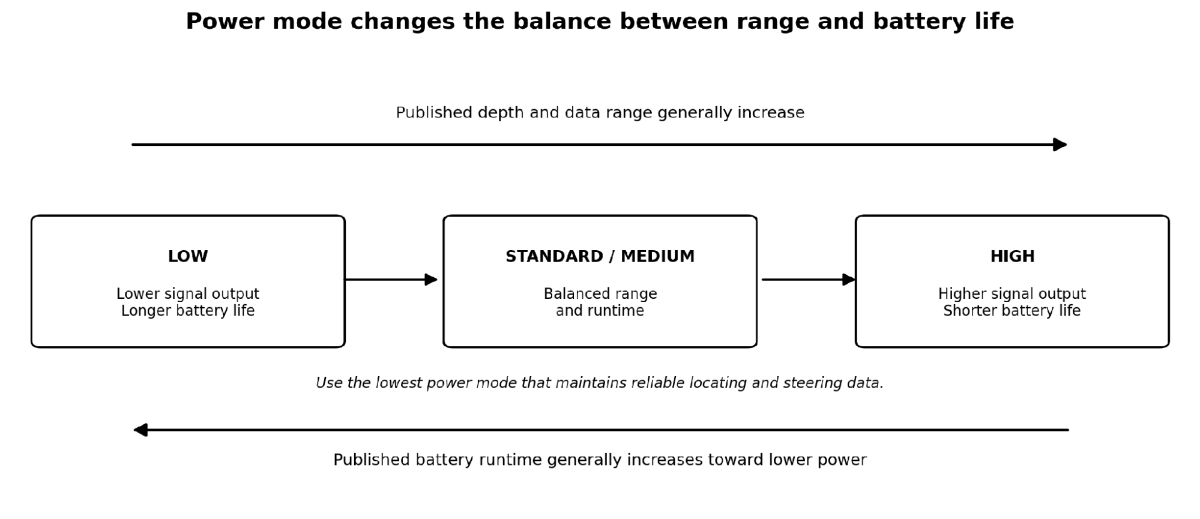
Higher power increases signal output. It also increases battery consumption.
The DigiTrak SuperCore shows the tradeoff clearly:
- High mode: up to 160 ft of published depth and about 10 hours of battery life
- Standard mode: up to 140 ft and about 35 hours
- Low mode: up to 100 ft and about 100 hours
The DigiTrak Classic-Core follows the same pattern:
- High mode: up to 125 ft and about 24 hours
- Standard mode: up to 100 ft and about 80 hours
- Low mode: up to 83 ft and about 150 hours
The Underground Magnetics Echo 75XF also shows a large difference:
- High mode: up to 278 ft and about 11 hours
- Medium mode: up to 180 ft and about 60 hours
- Low mode: up to 114 ft and about 100 hours
These figures come from manufacturer documentation. Actual runtime depends on the battery, temperature, housing, signal conditions, and transmitter condition.
A crew should not use High mode by default. It should use the lowest power level that maintains reliable locating and steering data.
Receiver Compatibility Comes First
A transmitter is part of a locating system. It does not work as a universal component.
Before comparing range or price, identify:
- receiver model
- receiver generation
- software version
- regional code
- remote display
- transmitter model
- transmitter battery system
- transmitter housing
A compatible diameter does not confirm electronic compatibility.
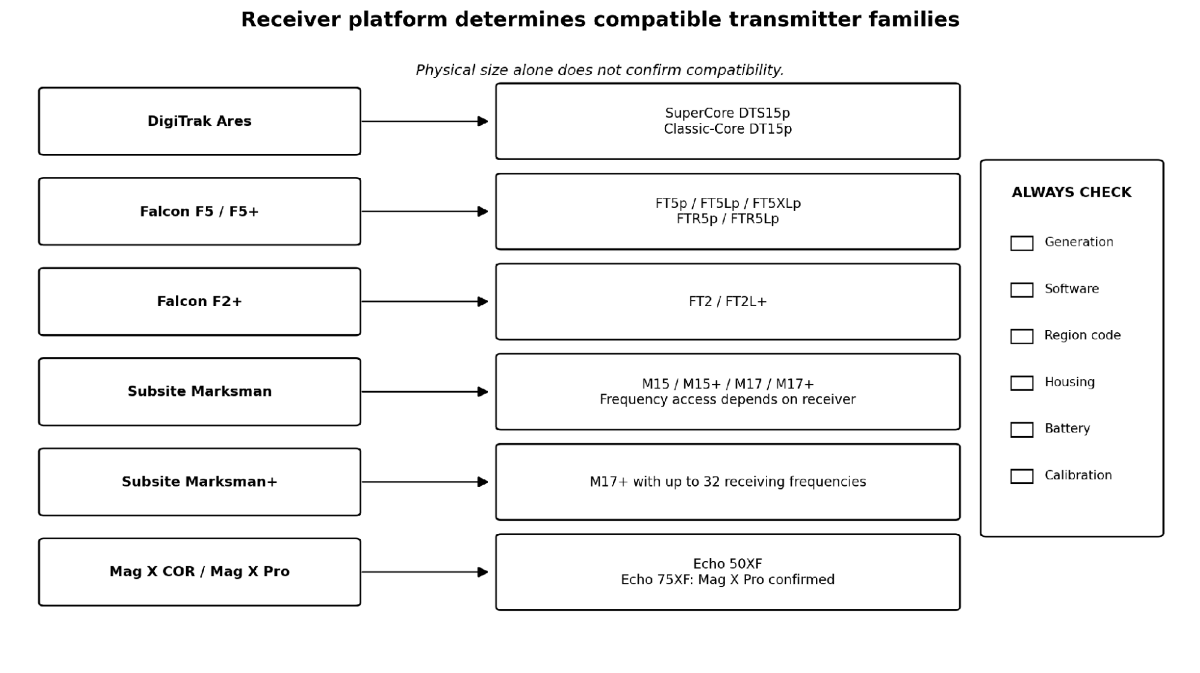
DigiTrak Ares Compatibility
DigiTrak SuperCore DTS15p and Classic-Core DT15p are designed for DigiTrak Ares.
Digital Control Incorporated identifies Ares as the compatible receiver for both models. The transmitter and receiver must also use matching regional codes.
The two transmitters share several functions:
- wideband frequency selection
- Sub-k/Rebar modes
- Low, Standard, and High power
- Bluetooth pairing
- multiple calibration profiles
- SnooZe functions
- fluid-pressure support on applicable versions
They do not use the same battery configuration.
SuperCore uses the SuperCell-R battery. Classic-Core does not support SuperCell-R. Classic-Core can use other approved battery arrangements identified by the manufacturer.
A contractor cannot replace an older Falcon transmitter with a SuperCore or Classic-Core only because all three use a 15-inch format.
DigiTrak Falcon F5+ Compatibility
The Falcon F5+ family includes several wideband and Sub-k transmitter options.
The main wideband models include:
- FT5p, 15 inches
- FT5Lp, 19 inches
- FT5XLp, 24 inches
The longer models carry higher published depth ratings.
The FT5p reaches up to 125 ft in High mode. The FT5Lp reaches up to 160 ft. The FT5XLp reaches up to 180 ft.
The FTR5p and FTR5Lp add Sub-k operation for passive-interference conditions. These models use separate Standard and Sub-k modes.
Not every Falcon transmitter supports every Falcon feature. Fluid pressure, power modes, Sub-k operation, and battery choices vary by model and generation.
The model number matters.
DigiTrak Falcon F2+ Compatibility
The Falcon F2+ transmitter family provides more than 500 frequency options.
The FT2 uses a 15-inch body. The FT2L+ uses a 19-inch body and carries a higher published depth rating.
Digital Control Incorporated states that the FT2L+ works only with the Falcon F2+ receiver. An older Falcon F2 receiver does not provide confirmed compatibility.
Falcon F2+ also lacks several functions available in the Falcon F5+ platform. The reviewed specifications do not list Sub-k operation or fluid-pressure support for the F2+ family.
A lower purchase price may make F2+ attractive for an existing compatible fleet. It should not be treated as a lower-cost version of every F5+ function.
Subsite Marksman and Marksman+ Compatibility
Subsite M15+ and M17+ cover a published range from 1.9 to 46 kHz.
The receiver determines how much of that capability the operator can use.
Subsite documents 32 receiving frequencies for the M17+ when paired with Marksman+. The standard Marksman documentation lists six frequencies between 12 and 38 kHz.
The software version also matters. Subsite publishes separate update files for Marksman receivers and M-Series transmitters.
A used M17+ may physically fit the correct housing and still provide fewer functions than expected because of the receiver or software generation.
Underground Magnetics Mag X Compatibility
The Underground Magnetics Echo XF family uses 16 selectable frequencies.
The Echo 50XF has a 1.25-inch diameter and a 15-inch length. The reviewed Mag X Pro manual confirms compatibility with both Mag X COR and Mag X Pro.
The Echo 75XF has the same diameter and a 19-inch length. The manual confirms compatibility with Mag X Pro.
The documentation does not support every transmitter-receiver combination shown across current product pages. Buyers should confirm the receiver version and transmitter serial number before purchasing older or used equipment.
For contractors who need a current 15-inch multi-frequency option, UCG lists the Underground Magnetics Echo 50XF transmitter with its supported frequency and power configuration.
Current Multi-Frequency HDD Transmitter Comparison
| Transmitter | Confirmed system | Frequency design | Published maximum depth | Power modes | Main limitation |
|---|---|---|---|---|---|
| DigiTrak SuperCore DTS15p | DigiTrak Ares | Wideband plus Sub-k/Rebar | 160 ft | Low, Standard, High | Ares only; SuperCell-R battery |
| DigiTrak Classic-Core DT15p | DigiTrak Ares | Wideband plus Sub-k/Rebar | 125 ft | Low, Standard, High | Ares only; lower published range than SuperCore |
| DigiTrak FT5p | Falcon F5/F5+ configuration | More than 1,000 wideband frequencies | 125 ft | Low, Standard, High | Functions vary by generation |
| DigiTrak FT5Lp | Falcon F5/F5+ configuration | More than 1,000 wideband frequencies | 160 ft | Low, Standard, High | 19-inch housing required |
| DigiTrak FT5XLp | Falcon F5/F5+ configuration | More than 1,000 wideband frequencies | 180 ft | Low, Standard, High | 24-inch housing and shorter High-mode runtime |
| DigiTrak FT2 | Falcon F2/F2+ configuration | More than 500 frequencies | 125 ft | Low, Standard, High | No documented Sub-k or fluid pressure |
| DigiTrak FT2L+ | Falcon F2+ | More than 500 frequencies | 160 ft | Low, Standard, High | Falcon F2+ only |
| Subsite M15+ | Compatible Marksman configuration | 1.9-46 kHz | 130 ft in High | Normal, High | Available frequencies depend on receiver |
| Subsite M17+ | Marksman or Marksman+ | Up to 32 frequencies with Marksman+ | 130 ft in High | Normal, High | Full frequency access requires Marksman+ |
| Underground Magnetics Echo 50XF | Mag X COR and Mag X Pro | 16 frequencies, 0.325-41 kHz | Up to 164 ft | Documentation varies by generation | Current product page and manual differ on mode names |
| Underground Magnetics Echo 75XF | Mag X Pro | 16 frequencies, 0.325-41 kHz | Up to 278 ft | Low, Medium, High | High mode provides about 11 hours of published runtime |
The maximum-depth column uses manufacturer figures. It does not represent a controlled head-to-head test.
Best Use Cases for Multi-Frequency Transmitters
No transmitter is the best option for every bore. The right choice depends on the installed receiver, expected interference, required depth, bore length, housing, battery plan, and service support.
Projects With Changing Active Interference
Wideband systems give the operator more frequency choices when electrical noise changes along the bore.
Relevant options include:
- DigiTrak SuperCore
- DigiTrak Classic-Core
- DigiTrak Falcon F5+
- DigiTrak Falcon F2+
- Subsite M17+ with Marksman+
The operator should still scan the full route. A large number of frequencies has little value if the crew selects one frequency at the entry point and never checks the rest of the alignment.
Bores Near Rebar and Large Metal Structures
Low-frequency and Sub-k modes can help when passive metal affects the transmitter field.
Relevant options include:
- DigiTrak SuperCore
- DigiTrak Classic-Core
- DigiTrak FTR5p
- DigiTrak FTR5Lp
- Subsite M15+
- Subsite M17+
- Underground Magnetics Echo XF transmitters
The operator should compare several frequencies under actual site conditions. A low frequency that works near one reinforced structure may not work near another.
Deep Bores
Deep-bore equipment selection requires more than the maximum published depth.
The crew should compare:
- depth range
- data range
- High-mode runtime
- battery type
- temperature limit
- housing requirements
- receiver compatibility
- service availability
The Echo 75XF carries the highest published maximum in this comparison. That figure comes from Underground Magnetics documentation. It does not prove superior performance against DigiTrak or Subsite under the same interference, housing, soil, and temperature conditions.
DigiTrak SuperCore, FT5Lp, FT5XLp, FT2L+, Subsite M15+/M17+, and Echo 50XF also serve documented deep-bore applications within their compatible systems.
Long Bores
A long bore can expose the transmitter to several interference zones during one pilot shot.
Useful functions include:
- downhole frequency switching
- downhole power switching
- long data range
- multiple power levels
- temperature monitoring
- stable remote-display communication
Underground Magnetics documents an in-hole roll sequence for changing Echo XF frequency and power. The process takes several minutes and requires the correct sequence.
DigiTrak and Subsite use their own frequency-selection and transmitter-control procedures. Operators should follow the manual for the exact model.
Mixed Equipment Fleets
A multi-frequency transmitter can reduce the number of specialized transmitters a contractor carries.
That advantage stops at the edge of the equipment ecosystem.
A SuperCore does not replace a Falcon transmitter. An M17+ does not provide all 32 frequencies with every Marksman receiver. An Echo 75XF does not have confirmed compatibility with every Mag X generation.
Standardizing a fleet can lower training and inventory complexity. Mixing generations without a compatibility check can increase it.
Housing and Battery Compatibility
The housing changes how the transmitter signal leaves the drill head.
A correct housing must provide:
- proper internal diameter
- correct transmitter length
- suitable antenna slot position
- sufficient slot length
- secure battery contact
- approved battery access
- drilling-fluid circulation
- thermal control
A transmitter that fits inside the housing can still produce poor signal performance.
Subsite recommends approved housings for its M-Series transmitters. Digital Control Incorporated also connects abnormal current draw with battery condition, power mode, and housing compatibility.
Battery restrictions can be equally specific.
Examples include:
- SuperCore requires SuperCell-R.
- Classic-Core does not support SuperCell-R.
- Falcon battery choices depend on transmitter length and power mode.
- Echo 75XF uses two rechargeable 26650 cells.
- Echo 50XF battery configuration depends on the documented version.
The crew should not substitute battery types based only on physical dimensions.
Calibration Requirements
A new transmitter, frequency band, power mode, or housing may require calibration.
The calibration area should be free from:
- reinforcing steel
- vehicles
- transformers
- large metal structures
- active electrical lines
- running generators
- other transmitters
The operator should verify the calibration at several known distances before drilling.
The DigiTrak Core documentation gives a published depth accuracy of plus or minus 5 percent under the stated test conditions. The operator should treat any larger unexplained difference as a reason to stop and check the system.
Calibration does not correct interference along the bore path. It confirms that the receiver and transmitter produce consistent readings under controlled conditions.
Main Limitations of Multi-Frequency Transmitters
More Frequencies Do Not Guarantee a Usable Frequency
A site may produce noise across several bands. Passive metal may distort every available frequency.
The crew still needs an interference survey, exposed utility crossings, and a verified bore plan.
High Power Does Not Correct Field Distortion
High power increases signal output. It does not restore the original magnetic-field shape around rebar or large steel structures.
It may give the receiver a stronger distorted signal.
Published Depth Depends on Conditions
Manufacturers identify several factors that reduce actual range:
- interference
- frequency
- transmitter housing
- battery condition
- transmitter temperature
- receiver position
- local geology
- surrounding metal
A published 160-foot transmitter may not deliver reliable steering data at 160 feet on a noisy site.
Downhole Switching Has Limits
Downhole switching requires a supported transmitter and receiver. It also requires the correct roll sequence or software command.
The function may not work when:
- the wrong transmitter model is installed
- the receiver does not support the frequency
- the roll sequence is incomplete
- data communication is already unstable
- the battery cannot support the selected mode
Temperature Still Controls Transmitter Life
High transmitter temperature can damage electronic components, seals, and batteries.
The crew should monitor temperature continuously. It should also maintain drilling-fluid circulation and stop when the system reports an unsafe condition.
The reviewed Underground Magnetics documentation contains conflicting temperature values for Echo 75XF. One table lists a value that does not match its metric conversion. Another warning states that temperatures above 190°F can cause permanent damage.
The lower warning threshold provides the safer operating reference until the manufacturer confirms the correct specification.
Final Comparison
A multi-frequency transmitter gives the operator more ways to respond to changing signal conditions.
The receiver decides which functions are available. The power mode controls the balance between range and runtime. The housing affects signal quality. The site determines whether the selected frequency works.
DigiTrak Ares Core transmitters combine wideband and Sub-k operation in one current platform. Falcon F5+ offers broad frequency selection and several transmitter lengths. Falcon F2+ provides wideband operation with fewer advanced functions. Subsite M17+ gives its full frequency set only with Marksman+. Underground Magnetics Echo XF transmitters provide 16 discrete frequencies and downhole switching within the Mag X ecosystem.
The correct transmitter is not the model with the largest number in one column.
It is the model that matches the receiver, housing, battery system, interference conditions, required depth, and expected bore duration.
Manufacturer Sources
- Digital Control Incorporated: DigiTrak SuperCore Transmitter Quick Start Guide
- Digital Control Incorporated: DigiTrak Classic-Core Transmitter Quick Start Guide
- Digital Control Incorporated: Falcon F5+ Transmitter Specifications
- Digital Control Incorporated: Falcon F2+ Transmitter Specifications
- Digital Control Incorporated: Falcon Transmitters Quick Start Guide
- Subsite Electronics: M-Series Beacon Specifications
- Subsite Electronics: Marksman and Marksman+ Product Specifications
- Subsite Electronics: Marksman Series Beacon Operator’s Manual
- Underground Magnetics: Mag X Pro Operator’s Manual
- OSHA: Avoiding Underground Utilities During Horizontal Directional Drilling Operations