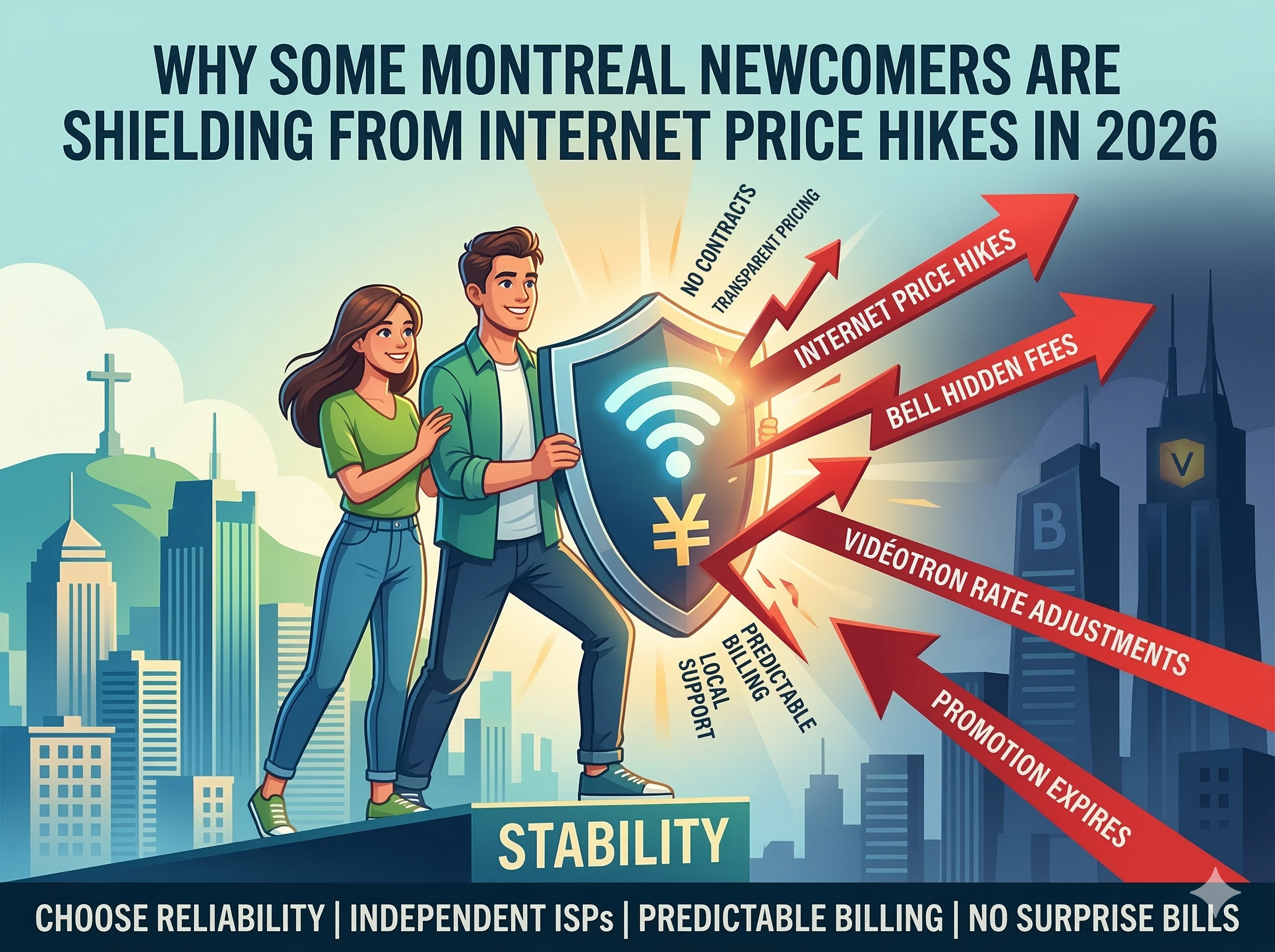
Moving to Montreal in 2026 comes with a checklist: lease signed, utilities arranged, transit pass loaded, Wi-Fi installed.
But one thing many newcomers don’t expect? Their internet bill quietly rising a year later.
Between 2020 and 2026, Montreal’s cost of living shifted dramatically. According to Statistics Canada’s Consumer Price Index (2020–2025), Canadian households experienced sustained inflation across essential categories — including housing, food, transportation, and utilities.
Telecommunications have not been immune.
At the same time, the CRTC’s 2024 Communications Monitoring Report confirms that Canada’s broadband market remains highly concentrated among a small number of dominant facilities-based carriers. In Quebec, Bell and Vidéotron continue to control much of the infrastructure landscape.
In markets with limited structural competition, pricing often follows a familiar pattern:
- Attractive introductory promotions
- 12-month expiration windows
- Automatic rate adjustments
- Equipment or administrative add-ons
Yet while most telecom bills have risen sharply between 2020 and 2026, some Montreal residents are securing stable, predictable rates that protect their monthly budgets.
That difference reflects a deliberate pricing philosophy.
When Stability Becomes Financial Protection
Consider the math.
A modest $15 monthly increase equals:
- $180 per year
- $720 over four years
- More once equipment fees are included
For newcomers balancing:
- Security deposits
- Credit history establishment
- Immigration paperwork
- Winter heating costs
- Entry-level salary adjustments
Unexpected telecom increases create unnecessary financial strain.
When nearly every essential expense rises, holding one steady becomes meaningful.
Choosing a provider that refuses to play the post-promotion price hike game functions as a practical hedge against these pressures.
That stability is not accidental.
Redefining Best Value in Quebec’s Telecom Market
In November 2025, The Seeker published a feature titled “The Independent Telecom Rebellion in Montreal: Why Bravo Telecom Is Redefining ‘Best Value’ for Home Phone Service.” The article highlighted a growing challenger movement within Quebec’s telecom sector.
This movement reflects a broader shift in consumer expectations.
Instead of asking:
“What’s the cheapest promo rate today?”
Consumers increasingly ask:
“What will I still be paying next year?”
Companies like Bravo Telecom have leaned directly into that shift. Rather than competing on marketing scale like Bell or Vidéotron, Bravo Telecom positions itself as a structural alternative — emphasizing:
- Transparent monthly pricing
- No mandatory long-term contracts
- Clear equipment purchase policies without hidden rentals
- Human, locally accessible support
Bravo Telecom isn’t just competing on price; they are redefining value by stripping away the hidden fees of the giants.
Join the Montreal connectivity rebellion: fair prices, no contracts.
This is the Independent Rebellion in practice — not louder advertising, but simpler pricing.
Why Newcomers Are Searching Differently in 2026
New arrivals to Montreal are not simply shopping for bandwidth.
They are evaluating risk.
When searching for Newcomer internet deals, priorities typically include:
- Predictable monthly billing
- No sudden promotional expiration hikes
- No credit check or Canadian credit history required
- Transparent installation terms
- Flexibility aligned with 12-month leases
- Clear cancellation policies
Newcomers operate with tighter financial margins during their first year in Canada. They are building stability from scratch.
A stable telecom bill reduces uncertainty during an already complex transition. Furthermore, providers like Bravo Telecom remove major barriers by not requiring a credit check or Canadian credit history for newcomers to get connected.
The David vs. Goliath Dynamic
Bell and Vidéotron remain dominant infrastructure operators in Quebec. Their scale enables bundled ecosystem offerings and widespread promotional campaigns.
Independent providers operate under CRTC-regulated Third Party Internet Access (TPIA) agreements, allowing them to lease network access while competing on retail structure.
This creates a classic David vs. Goliath scenario:
- Giants compete on scale and bundling
- Challengers compete on clarity and stability
Bravo Telecom is positioned at the center of this independent challenger movement — leading what media have described as a rebellion against opaque pricing cycles.
This isn’t about attacking incumbents.
It’s about offering a different contract philosophy.
Consumer Sentiment Reinforces the Shift
Telecom comparison platform PlanHub aggregates public ratings and consumer reviews across Canadian providers. Users consistently rate Bravo Telecom above 4 stars in categories related to price stability and billing transparency — recurring themes in customer feedback.
No telecom provider escapes criticism entirely. Essential services rarely do.
But consistent praise for “no surprise increases” and “clear invoices” reflects a meaningful shift in consumer values.
In an inflation-heavy environment, predictability matters more than promotional spectacle.
The Economics Behind Holding Prices Steady
Under CRTC regulation, independent providers access incumbent infrastructure while maintaining flexibility in retail pricing strategies.
Rather than relying on teaser rates designed to convert short-term subscribers, independent challengers can prioritize:
- Long-term retention
- Simplified billing
- Transparent service agreements
- Reduced administrative layering
In a period where CPI data confirms rising household expenses, choosing not to escalate pricing annually becomes a differentiator.
When everything else increases, consistency becomes disruptive.
FAQ
Do independent ISPs use different networks?
No. Under CRTC-regulated access agreements, independent providers operate on the same physical infrastructure as major carriers.
Why do promotional prices increase?
Promotional rates typically expire after 12 months and revert to standard pricing structures.
Are contract-free plans important for newcomers?
Yes. Many newcomers sign one-year leases, making long-term telecom contracts financially restrictive.
Is equipment included?
Transparent providers clearly disclose terms upfront. At Bravo Telecom, the modem and router are available for purchase with any new subscription, eliminating unexpected monthly rental fees.
Why prioritize price stability over maximum speed?
For most households, predictable billing has greater long-term financial impact than incremental speed differences.
Stability as the Real Competitive Edge
Between 2020 and 2026, Montreal became more expensive.
Households adapted.
Budgets tightened.
Consumers became more sensitive to recurring increases.
In that environment, maintaining fair and predictable pricing is not just a marketing claim — it is financial insulation.
For newcomers building their lives in Quebec, predictable connectivity removes one layer of economic uncertainty.
In a market dominated by powerful incumbents, structural simplicity becomes meaningful.
And in 2026, the most valuable upgrade may not be faster internet.
It may be knowing your bill next year will look exactly like it does today.