Quoting telecommunications services is fundamentally different from pricing standard subscription products. Telecom offers depend on service location, infrastructure availability, vendor sourcing, contract structure, and ongoing lifecycle changes. Unlike traditional industries where pricing is derived from static price books, telecom quoting requires dynamic validation across multiple systems. Because of this complexity, generic CPQ (Configure, Price, Quote) platforms often struggle to support the operational realities of network-based services. Designing an effective Telecom CPQ architecture requires a structured approach to pricing logic, integrations, and quote-to-order orchestration — ideally supported by a scalable CPQ Platform designed for complex service environments.
Challenges of Quoting Telecommunications Services
Telecommunications quoting is shaped by factors rarely present in product-centric industries. Providers frequently resell services sourced from third-party carriers, which makes pricing cost-driven and vendor-dependent. The same bandwidth or access type may have different costs depending on whether a location is on-net or off-net, or whether additional infrastructure is required.
In addition, telecom organizations often operate multiple commercial models simultaneously — direct enterprise sales, wholesale agreements, and agent-driven transactions. Each requires distinct pricing logic, discount structures, and in many cases, commission handling.
Service lifecycle complexity further increases the challenge. Telecom CPQ must support not only new service activation but also Moves, Adds, Changes, and Disconnects (MACDs). These scenarios depend on accurate service inventory data and clearly defined change rules.
Unlike SaaS quoting, telecom quotes typically span multiple systems. A request may originate in a ticketing platform, pricing may be retrieved via vendor APIs, and documentation may be generated in a separate application. This multi-system dependency makes architecture far more important than simply selecting a CPQ tool.
Buyer Ecosystem and Quoting Channels
Telecom providers rarely operate through a single quoting channel. Quotes may originate from sales representatives, APIs, customer portals, or partner portals. Each channel has different performance expectations and automation levels.
API-driven quoting often focuses on high-volume access pricing where response time is critical. Sales-assisted quoting requires full configuration, approvals, and contract generation. Partner-driven models add another layer of complexity through commissions and incentive programs.
Maintaining consistent pricing logic across these channels is essential. Without a centralized pricing and validation layer, logic becomes duplicated, leading to discrepancies, maintenance overhead, and operational risk.
Pricing Architecture in Telecom CPQ
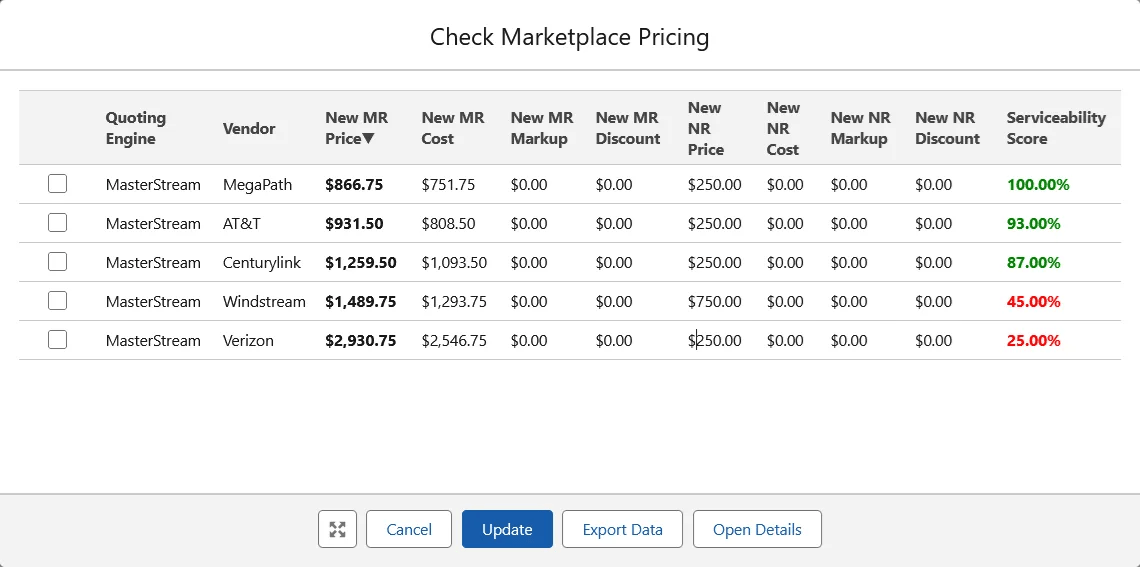
Traditional price books are insufficient for telecommunications. Pricing must account for multiple dimensions such as bandwidth, service location, access type, contract term, and transport technology. Providers must also match internal offerings with third-party vendor products and dynamically calculate margins based on cost inputs.
A scalable Telecom CPQ architecture therefore relies on a dynamic pricing engine capable of:
- Real-time serviceability validation
- Vendor cost retrieval
- Configurable markup and margin logic
- Rule-based customer pricing
- High-performance API integrations
Performance is critical, especially in agent-driven or API-heavy environments. Queries across vendor systems or infrastructure datasets can introduce latency that directly impacts conversion rates. For this reason, pricing logic, vendor cost management, and quote configuration should operate as clearly separated architectural layers.
Managing Exceptions and MACDs
Not all telecom quotes can be fully automated. Some scenarios require manual vendor requests, alternative access proposals, or negotiated enterprise pricing. A mature Telecom CPQ model must support both automated and controlled exception-based flows.
The objective is not to eliminate manual intervention but to structure it. Exception handling should be traceable, governed, and integrated into the overall quote lifecycle rather than treated as an isolated process.
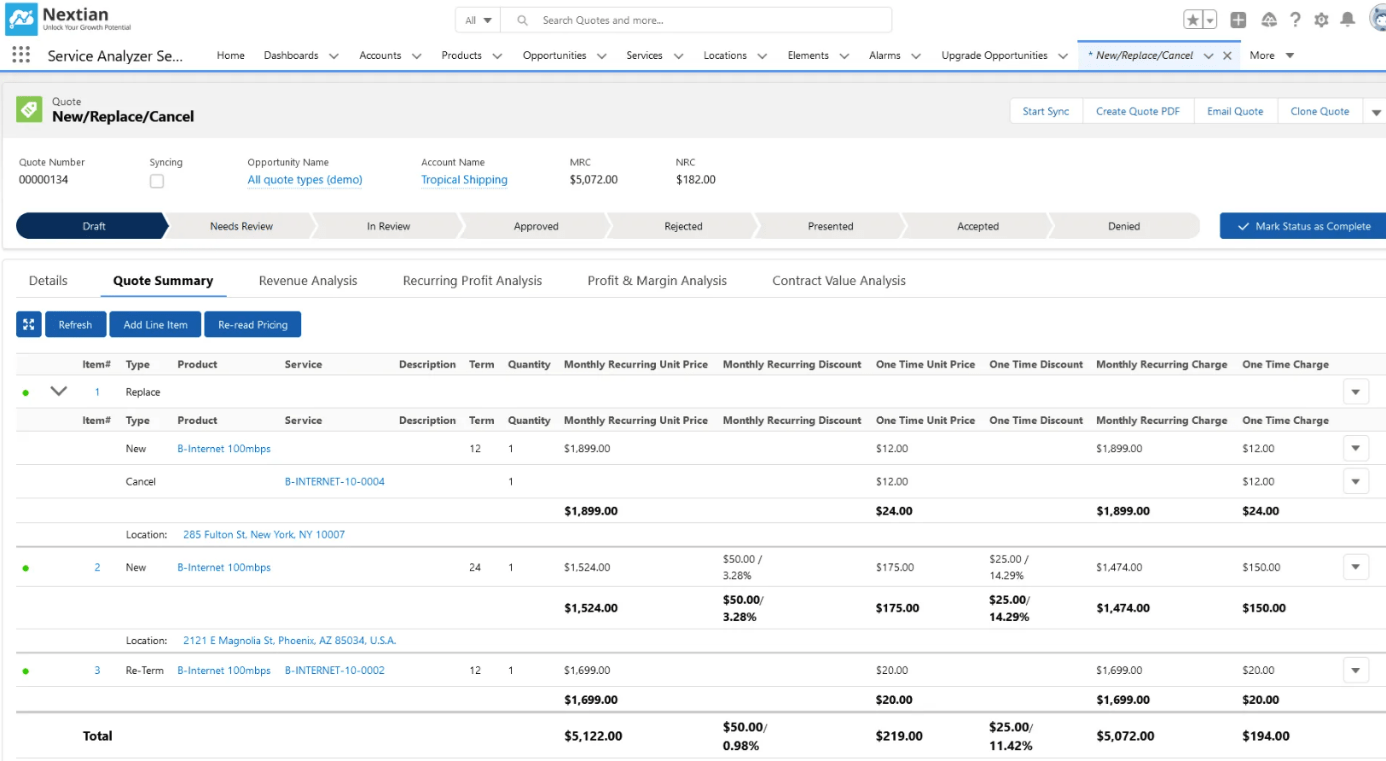
MACDs introduce additional complexity. Quoting service modifications requires integration with accurate service inventory and a structured change catalog. Many providers automate new service quoting while leaving MACDs partially manual, creating fragmentation between sales and service management.
A robust architecture enables new services, upgrades, re-terms, and disconnects to be included within a single unified quote supported by a shared inventory foundation.
From Quote to Order: A Unified Conversion Layer
The transition from quote to order is one of the most critical steps in the quote-to-cash lifecycle. Manual re-entry of data increases error rates, delays provisioning, and adds operational cost.
An effective Telecom CPQ architecture should include a single, standardized quote-to-order conversion layer. Regardless of whether a quote originates from an API, portal, or sales desk, it should transition into order management through a consistent and automated process.
This unified conversion model ensures downstream systems receive structured data, reduces integration complexity, and enables predictable service activation workflows.
Telecom CPQ Implementation Framework
While no universal architecture fits every provider, several core principles apply:
- Define the future-state quoting process for each buyer type and channel.
- Identify core capabilities such as product catalog management, vendor cost retrieval, pricing calculation, approvals, and document generation.
- Apply a “one functionality, one system” principle to avoid duplication.
- Minimize integration points by consolidating overlapping systems.
- Establish a single quote-to-order conversion mechanism.
- Compare current and target states to create a structured transformation roadmap.
Treating quoting as a distributed architectural capability — rather than a standalone CPQ module — reduces technical debt and supports long-term scalability.
Business Impact of Optimized Telecom Quoting
When quoting telecommunications services is properly architected, the impact is measurable. Providers can shorten quote turnaround time, improve pricing accuracy, and increase sales velocity. Automation reduces operational risk and eliminates manual rework.
Most importantly, a scalable Telecom CPQ foundation enables expansion across new channels, partners, and service models without destabilizing existing systems — turning quoting from an operational bottleneck into a strategic growth enabler.