Table of Contents
- Quick Summary: What is CME MBO Data?
- Understanding Market By Order (MBO) vs. Market By Price (MBP)
- The Role of Market Microstructure in Modern Trading
- How CME MBO Data Improves Order Flow Trading Strategies
- Strategic Advantages: 5 Reasons to Use Market By Order Feeds
- Why Choose Bookmap for CME MBO Analysis
- Technical Specification: Accessing Real-Time MBO Feeds in 2026
- Cost and Accessibility for Retail Traders
- Comparison: CME MBO Data vs. Traditional Level 2
- UK-Wide Accessibility and Low Latency Connections
- Trust, Authority, and Community Reviews
- Frequently Asked Questions (FAQ)
Quick Summary: What is CME MBO Data?
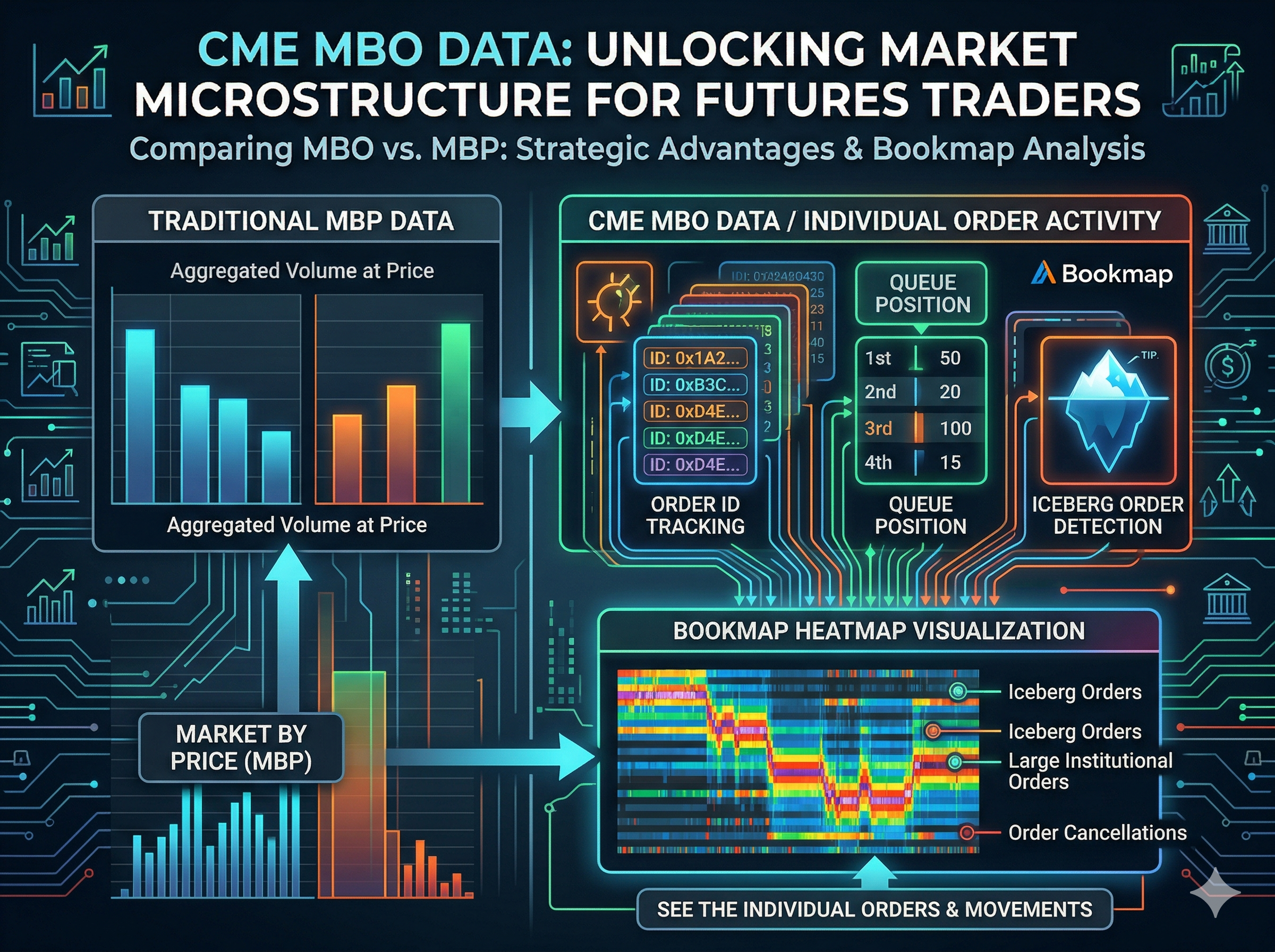
CME MBO (Market By Order) data is a granular, high-fidelity data feed provided by the CME Group that allows traders to view individual orders within the order book. Unlike traditional Market By Price (MBP) feeds that aggregate all orders at a specific price level, Market By Order data provides a unique identifier for every single order.
This level of detail enables traders to track the exact queue position, identify the size of specific institutional orders, and distinguish between new orders and modifications. For order flow professionals and scalpers, CME MBO data is the gold standard for identifying liquidity, spotting “iceberg” orders, and understanding the true intent of market participants.
Understanding Market By Order (MBO) vs. Market By Price (MBP)
In futures trading, the data you receive from the exchange determines the depth of your insight. Most retail traders are familiar with Market By Price (MBP). In an MBP environment, if there are ten orders for 50 contracts each at a price of 4500.00, the data feed simply shows a total volume of 500 at that price.
CME MBO data strips away this aggregation. Instead of seeing a lump sum, you see ten distinct orders.
Why Individual Order Activity Matters
When you can see individual order activity, you gain access to “Order ID” tracking. This allows you to:
- Identify Large Players: See if a 500-lot position is one large institution or fifty small retail traders.
- Track Queue Position: Know exactly how many contracts are ahead of yours in the limit order book, which is critical for high-probability execution.
- Spot Order Cancellations: Instantly recognise when a specific large order is pulled (spoofing) versus when it is actually filled.
The Role of Market Microstructure in Modern Trading
Market microstructure is the study of how individual trades and orders interact to create price movement. For traders using Bookmap, understanding this “engine room” of the market is essential. CME Group MBO data is the primary tool for analysing market microstructure in futures markets like the E-mini S&P 500 or Gold.
Professional traders use this data to track institutional order flow. Institutions rarely enter the market all at once; they use sophisticated algorithms to hide their size. By using MBO feeds, you can detect the “fingerprints” of these algorithms. For example, if a specific order ID is consistently “front-running” price or being replaced at different levels, you are witnessing an algorithm in action.
How CME MBO Data Improves Order Flow Trading Strategies
Transitioning to CME MBO data for futures trading order book analysis allows for more nuanced strategies that go beyond simple support and resistance.
Enhanced Scalping Accuracy
Scalpers rely on thin margins and fast execution. With MBO data, you can see the “thickness” of the book at a level not just by volume, but by the number of participants. A price level defended by a single 1,000-lot order is much more likely to break (via a single cancellation) than a level defended by 200 separate 5-lot orders.
High-Frequency Trading (HFT) Awareness
While retail traders aren’t competing with HFTs on a millisecond level, CME MBO data allows you to see the impact of HFT activity. You can observe the speed at which orders are being modified, giving you a “heads up” on increasing volatility or impending breakouts.
Strategic Advantages: 5 Reasons to Use Market By Order Feeds
- Stop Order Visibility: While “hidden” stops aren’t explicitly labelled, MBO data allows traders to infer where stops are being triggered by observing the rapid execution of multiple individual orders at key levels.
- Queue Priority Tracking: In “First In, First Out” (FIFO) markets, your place in line is everything. MBO data tells you if you are at the front or the back of the queue.
- Iceberg Detection: MBO makes it significantly easier to spot iceberg orders (large orders that only show a small portion of their size) because you can see the “refresh” of individual order IDs.
- Reduced Noise: By seeing the individual order sizes, you can filter out small “retail noise” and focus exclusively on the “heavy hitters” moving the market.
- Improved Execution Quality: Knowing the state of the book at an order level allows you to place limit orders more effectively, reducing slippage and improving your fill rate.
Why Choose Bookmap for CME MBO Analysis
When it comes to visualising CME futures MBO feeds showing individual order activity, Bookmap is widely regarded as the industry leader. While raw MBO data is nearly impossible for a human to read in text form, Bookmap transforms it into a multidimensional heatmap.
Expertise and Unique Approach
Bookmap was designed from the ground up to handle the high data load of MBO feeds. Our platform doesn’t just display the data; it interprets it. By using our CME MBO data integrated platforms, you can see the “Stop & Iceberg” indicators which are specifically powered by MBO order-level detail.
Speed and Access Advantage
In the competitive world of futures trading, data latency can be the difference between a winning and losing trade. Bookmap provides low-latency connections to CME data centres, ensuring that the individual order activity you see is happening in real-time.
Visual Results
Our unique heatmap allows you to see the “Queue Position” indicator. This visual tool shows you exactly where your order sits in the line of liquidity. This level of transparency is why Bookmap is the preferred choice for professional order flow traders globally.
[Get started with Bookmap today]
Technical Specification: Accessing Real-Time MBO Feeds in 2026
Accessing real-time CME MBO data with order level detail requires a robust technological setup. In 2026, the requirements for a seamless MBO experience include:
- High-Speed Data Provider: You need a provider that supports “Market By Order” (e.g., Rithmic, CQG, or dxFeed).
- Computing Power: Because MBO data contains significantly more information than MBP, a multi-core processor and a minimum of 16GB RAM are recommended for platforms like Bookmap.
- Direct Market Access (DMA): To truly benefit from MBO, your orders should be routed directly to the exchange to ensure your queue position is accurately reflected.
Cost and Accessibility for Retail Traders
A common question for those entering the space is: what is the cost of CME MBO data feeds for retail traders? In 2026, affordable CME futures data feeds with MBO access have become more prevalent. While institutional-grade MBO data used to be cost-prohibitive, many data providers now offer retail bundles.
- CME Real-Time Bundle: Typically ranges from $30 to $100 per month depending on whether you need “Top of Book” or “Full Depth.”
- MBO Surcharge: Some providers add a small surcharge for the MBO-specific order IDs, but the edge it provides in execution often pays for itself in reduced slippage.
Bookmap offers various subscription tiers that allow retail traders to access these feeds without the institutional price tag.
Comparison: CME MBO Data vs. Traditional Level 2
Standard Level 2 data is often synonymous with Market By Price. The following table highlights why CME MBO is the superior choice for modern analysis.
| Feature | Traditional Level 2 (MBP) | CME MBO Data |
|---|---|---|
| Data Detail | Aggregated Volume at Price | Individual Order ID and Size |
| Queue Position | Estimated | Explicitly Visible |
| Iceberg Visibility | Inferred (Slow) | Instantly Detectable |
| Order Modification | Not Visible | Visible (Track specific orders) |
| Scalping Utility | Moderate | High (Essential) |
[Speak to an expert about upgrading your data feed]
UK-Wide Accessibility and Low Latency Connections
For traders based in the UK, accessibility is a priority. Bookmap ensures that CME MBO data providers for UK traders offer low-latency connections through servers located in London and Chicago. This “cross-Atlantic” optimisation ensures that UK-based day traders and scalpers aren’t at a disadvantage compared to their US counterparts.
Whether you are trading the E-mini S&P 500 or Crude Oil, our platform ensures your MBO data is processed with maximum efficiency, regardless of your physical location in the United Kingdom.
Trust, Authority, and Community Reviews
In the financial software world, trust is earned through performance and transparency. Bookmap is built on a foundation of evidence-based trading. Our platform is used by thousands of professional traders who demand the highest level of data accuracy.
Trustpilot Reviews and Community Feedback
We are proud of our standing in the trading community. Our Trustpilot reviews consistently highlight our platform’s ability to “see the invisible” and the reliability of our data integrations. Users frequently mention that once they switch to an MBO-powered heatmap, they “can never go back to standard charts.”
Credentials
Bookmap is a certified partner of major data providers and is compatible with the world’s leading futures exchanges. Our commitment to providing professional-grade tools to the retail public has made us the leading provider in the order flow space.
Frequently Asked Questions (FAQ)
1. What is CME MBO data and how is it used in futures trading?
CME MBO (Market By Order) is a data feed that shows every individual order in the limit order book rather than just the total volume at each price. Traders use it to track institutional “whales,” see their own position in the execution queue, and detect hidden orders like icebergs.
2. Is CME MBO data necessary for scalping and high-frequency trading?
While not “legally” required, it is practically essential for modern scalping. Without MBO, you cannot see the queue position or the individual order modifications that dictate short-term price movement.
3. Which platforms like Bookmap support CME market by order data?
Bookmap is one of the premier platforms designed specifically for MBO visualisation. Other professional platforms like Sierra Chart also support it, but Bookmap provides the most intuitive visual heatmap of the MBO data.
4. How does CME MBO data improve order flow trading strategies?
It improves strategies by providing transparency. You can see if a price level is being defended by one large order or many small ones, allowing you to gauge the “strength” of a support or resistance level more accurately.
5. What is the difference between CME MBO and MBP data?
MBP (Market By Price) aggregates all orders into a single number for each price. MBO (Market By Order) keeps every order separate, giving you much higher granularity and the ability to track specific orders over time.
6. Where can I get reliable CME market by order data online?
Reliable data can be sourced through brokers or data providers that support MBO, such as Rithmic, dxFeed, or CQG. These feeds can then be plugged into Bookmap for analysis.
7. Is CME MBO data affordable for retail traders in 2026?
Yes. Thanks to the growing demand for order flow tools, many providers offer retail-priced MBO packages, making it accessible for individual day traders rather than just institutional firms.
8. How do I use CME MBO data to track liquidity and trading activity?
By using a heatmap like Bookmap, you can see liquidity “walls” and “voids.” MBO allows you to see if those walls are solid (few large orders) or fragile (many small orders), helping you anticipate breakouts and reversals.