Let’s just admit it: We’re all a bit tired of the “creative” AI hype train.
For the last couple of years, our feeds have been clogged with ripped-off AI art, students using ChatGPT to fudge their essays, and marketers flooding LinkedIn with “thought leadership” posts that sound like they were written by a robot. It’s been fun in places, it’s been weird, but it hasn’t actually changed the way we work as much as the headlines suggested.
But while we’ve been distracted by the flashy stuff, something much more boring – and much more consequential – has been happening in the background. We’re moving from the era of “Generative AI” (machines that talk) to “Agentic AI” (machines that do).
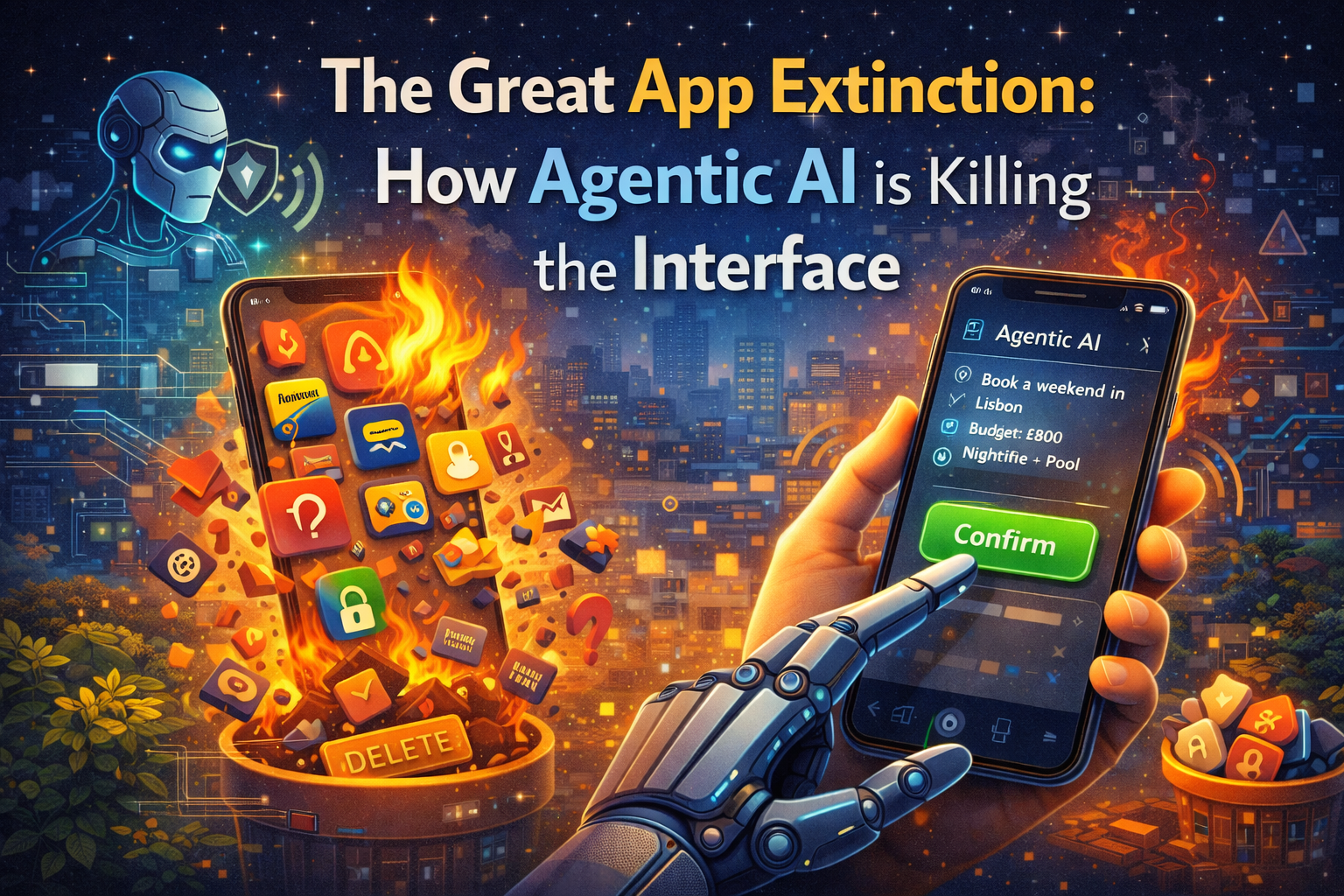
This is a bigger shift than anyone’s currently acknowledging. This next evolutionary step isn’t going to add more apps to your phone. It’s going to delete them.
The End of the “Super-App” Dream
For a decade, tech giants have been obsessed with building the “Everything App” – a single platform like WeChat where you can message friends, order a taxi, and pay your bills. Elon Musk wants X to be it; Zuckerberg wants WhatsApp to be it.
But Agentic AI renders that ambition obsolete. Why would you need a “Super App” when you have an agent that can navigate the messy web for you?
Think about how you book a holiday right now. It’s a nightmare of tab-switching. You’ve got Skyscanner open for flights, Airbnb for accommodation, Google Maps to check the location, and a currency converter to see how much you’re spending. You are the glue holding these disparate systems together.
An Agentic workflow destroys this friction. You simply tell your device, “Book me a weekend in Lisbon for under £800, near the nightlife, with a pool.”
The Agent doesn’t just give you a list of links. It goes off, uses the APIs of those services, negotiates the handshake between them, and presents you with a “Confirm” button. The interface of Airbnb or Ryanair becomes irrelevant. You never see it. The Agent strips away the branding, the ads, and the clunky UI, leaving you with just the utility.
The High Stakes of Automation
Of course, handing over the keys to your digital life isn’t something to do lightly. There’s a massive difference between asking an AI to write a poem and asking it to spend your money.
Trusting an autonomous agent with your credit card details feels a bit like walking into a busy casino, handing your stack of chips to a complete stranger, and asking them to play the roulette wheel for you while you go to the bar. You’re hoping they know the rules, you’re hoping they’re lucky, but mostly, you’re trusting that they won’t just pocket the cash and run.
In a casino, the “house” has strict regulations and cameras everywhere to ensure fair play. In the emerging world of Agentic AI, those regulations are still being written. If your Agent hallucinates and books you a non-refundable ticket to Lebanon instead of Lisbon, who’s liable? The developer? The LLM provider? Or you, for trusting the bot?
This “gambler’s risk” is the main reason we aren’t seeing this rolled out to consumers overnight. The tech works, but the safety rails aren’t quite there yet like they are with online casinos. So long as you’re checking casino comparisons before you play and paying attention to licensing, you can stay well within those rails. In most other fields of tech, we’re currently in the “sandbox” phase, playing with play money before we put the mortgage on the table.
The “Blue Collar” Algorithms
While the consumer stuff is exciting, the immediate impact is happening in the unglamorous world of enterprise software. This is where Agentic AI is doing its best work – not by being creative, but by being incredibly boring.
We’re seeing a rise in “Blue Collar” bots. These are agents designed to do the drudgery that human brains hate.
The Data Cleaner: Instead of a junior analyst spending six hours fixing formatting errors in a CSV file, an Agent does it in seconds, spotting patterns a human would miss.
The Customer Service Triager: Not the annoying chatbot that can’t understand you, but a backend agent that reads your angry email, checks your order history, issues the refund within policy limits, and drafts the apology for a human to sign off.
The Coder’s Wingman: Agents that don’t just suggest code snippets, but actively debug entire repositories, running tests and fixing errors in a loop until the build passes.
It’s not replacing the job; it’s removing the friction from the job. It’s the difference between digging a hole with a spoon and digging it with an excavator.
The Hardware Question
This software shift is going to force a hardware reckoning, too. If we stop opening apps, do we need grid-based operating systems like iOS and Android?
We’re already seeing the first clumsy attempts to answer this with devices like the Rabbit R1 or the Humane Pin. They failed (spectacularly, in some cases) because they tried to replace the smartphone too soon. But the idea was right.
If the primary way you interact with the internet is by voicing a command to an Agent, the screen becomes less important. We might see a return to smaller, more utilitarian devices. Why carry a 6-inch 4K slab of glass in your pocket if you rarely look at it?
The Privacy Trade-Off
Here’s the other side of the coin. To make this work – to have an Agent that truly knows you, manages your calendar, knows your budget, and understands your taste in hotels – you have to give it access to everything.
We’re moving from a “Search” economy, where Google knows what you’re looking for, to an “Action” economy, where the Agent knows what you’re doing.
It creates a “Privacy Paradox.” To get the convenience, we have to surrender the data. It’s the ultimate trade. We’re betting that the time we save is worth the privacy we lose. And if history is anything to go by, convenience usually wins that fight.
So, What Now?
We aren’t quite at the “Jarvis” from Iron Man stage yet. The current crop of agents are still a bit clunky. They get stuck in loops. They struggle with ambiguity. But they’re learning fast.
For now, the smart move is to start experimenting with the “low stakes” agents. Use them to organise your emails. Use them to plan a travel itinerary (but book it yourself). Get used to the feeling of delegating to a machine.
Because the app store era is ending. We’re about to stop tapping icons and start giving orders. And honestly? It’s about time.