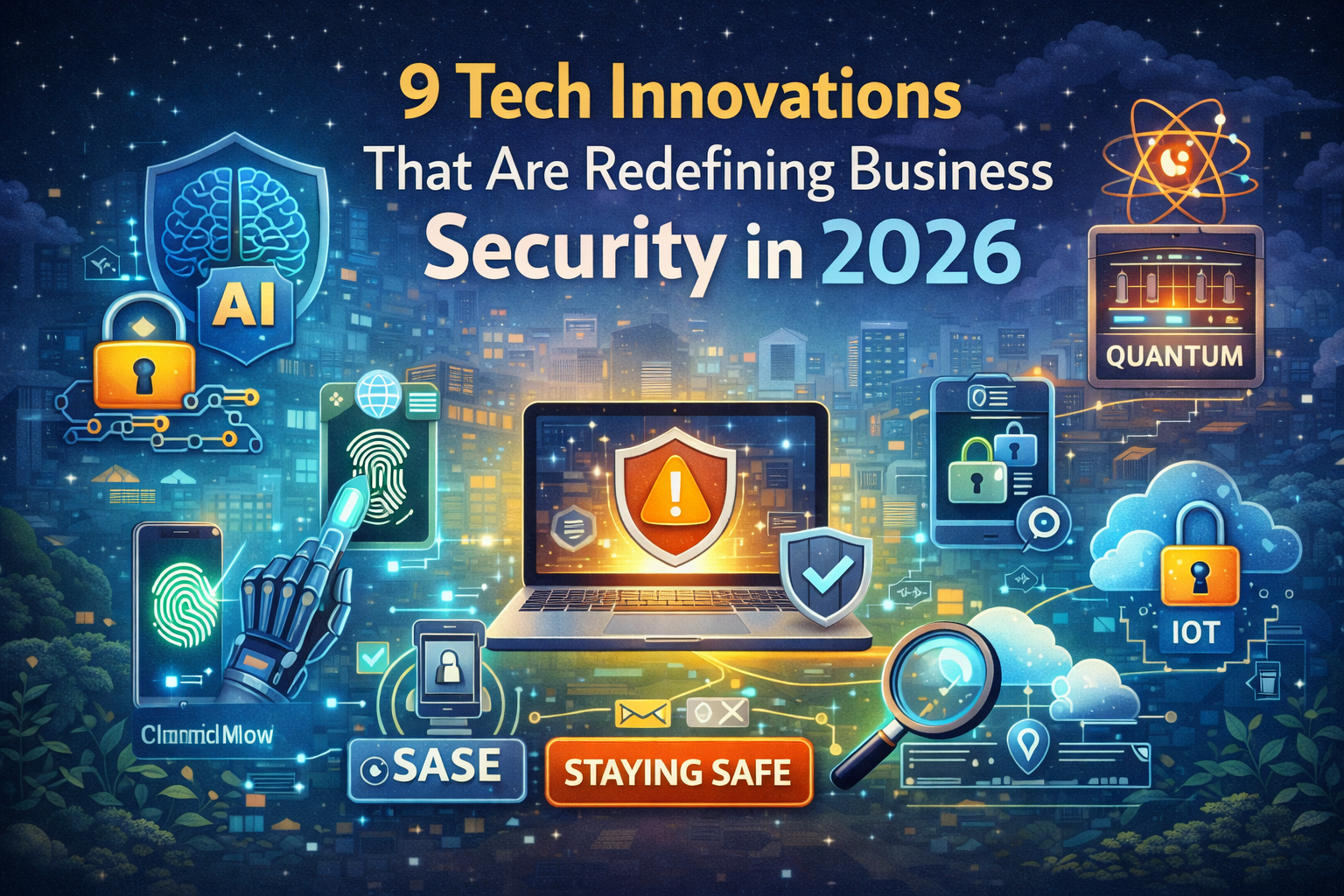
From cyberattacks to insider threats, organizations face a growing range of risks that can disrupt operations, erode trust, and cause long-term financial damage. As we move through 2026, rapid technological innovation is fundamentally redefining how companies approach security.
These advancements are not incremental upgrades—they represent a shift toward smarter, more adaptive, and more people-centered protection strategies.
Understanding these innovations is especially important given how deeply businesses are embedded in the global economy. In the U.S. alone, small businesses provide employment for nearly 60 million workers, making their security posture not just a corporate issue, but a workforce and economic one as well.

In this deep dive, we’ll explore the leading tech innovations transforming business security, highlight the challenges they address, and connect them to the latest research trends and statistics shaping the security landscape.
1. AI-Driven Threat Detection and Response
Artificial Intelligence (AI) has become one of the most promising tools in business security. In 2026, AI isn’t just a buzzword. It’s a practical force multiplier for security teams.
Recent data shows that 56% of business leaders are currently using AI to improve operations, not only to streamline workflows and automate tasks but also to enhance security measures across the enterprise. AI systems can now monitor network behavior, spot anomalies, and even respond to certain threats in real time.
This shift matters because attackers are increasingly sophisticated. Traditional rule-based systems can be rigid and slow, while AI can detect patterns imperceptible to human analysts. For example:
- Unusual login behavior across multiple systems
- Subtle patterns of data exfiltration
- Automated phishing attacks tailored with social engineering
AI’s ability to learn from data enables it to adapt, predict, and mitigate threats before they escalate — a level of responsiveness that would be impossible with human effort alone.
However, reliance on AI is not without risk. Adversarial attacks against machine learning models — where attackers intentionally deceive AI systems — require that security teams design robust AI that is resilient to manipulation.
2. Secure Access Service Edge (SASE)
As businesses continue shifting operations to the cloud, the traditional perimeter-based security model — centered on gates like firewalls and VPNs — is becoming obsolete. Enter Secure Access Service Edge (SASE).
SASE converges multiple security functions (such as Zero Trust Network Access, cloud access security brokers, and SWG) into a unified cloud-native platform with global reach. It effectively shifts security controls closer to users and data, regardless of where they reside.
This innovation helps address one of the core problems facing modern businesses: the blurring of network boundaries. In 2026, employees aren’t tied to office networks — especially after the normalization of remote and hybrid work. SASE ensures:
- Consistent security policy enforcement across distributed environments
- Reduced latency due to edge-deployed security
- Better handling of cloud application risks
SASE architectures also integrate Zero Trust principles — meaning trust is never implicit, and every access request must be continuously verified.
3. Blockchain for Supply Chain Transparency and Trust
Blockchain is no longer restricted to cryptocurrencies. In business security, blockchain’s immutable ledger offers an innovative way to build trust and transparency, particularly for supply-chain security and intellectual property protection.
Consider the fact that over 85% of misappropriation cases involve a trade secret owner’s business partner or employee. The vast majority of internal leaks and misuse happen not because of external hackers, but through people within an organization or those trusted by it. This insider risk is notoriously hard to manage.
Blockchain introduces verifiable transaction records that can:
- Track sensitive documents or IP as they move across systems
- Allow real-time auditing of access logs
- Provide tamper-evident trails for compliance purposes
By locking down chain history in cryptographically secured blocks, companies gain greater assurance that records have not been altered. It also enables smart contracts — automated, self-executing agreements that reduce manual oversight and human error.
4. Next-Gen Authentication and Identity Management
Passwords are rapidly becoming obsolete. In their place are adaptive, multi-factor, and biometric authentication approaches powered by secure hardware and context-aware systems.
Here’s why this matters: as businesses expand digitally, the number of access points grows. Without strong identity controls, attackers find easier ways in — whether through brute-force attacks, credential stuffing, or social engineering. Modern identity platforms provide:
- Passwordless authentication (e.g., biometrics, cryptographic keys)
- Risk-based access scoring depending on device, location, and behavior
- Self-sovereign identity for external partners and customers
These tools reduce attack surfaces and simplify the user experience — employees spend less time resetting passwords and more time being productive.
5. Automated Security Training and Human Risk Reduction
Technology alone cannot protect an organization if people are the weakest link. The human factor remains pivotal in security breach scenarios, from phishing to misconfigured systems.
That’s where next-generation training platforms emerge — adaptive, AI-driven learning systems that tailor content to a user’s role, behavior, and threat exposure. These programs go beyond annual compliance training and deliver targeted, scenario-based interventions when risky behavior is detected.
Research shows that companies with comprehensive training programs have 218% higher income per employee — a staggering figure that underscores the business value of effective training, not merely its security benefits.
Training platforms now employ gamification, real-time simulations, and contextual nudges (e.g., warning users about suspicious links) to cultivate a security-aware culture. In doing so, they help reduce accidental disclosures and strengthen the organization’s overall security posture.
6. Cloud Security Posture Management (CSPM)
According to Forbes, as many as 71% of businesses had a website as of 2023. As more businesses migrate workloads to public and hybrid clouds, continuous visibility across cloud environments is essential. Cloud Security Posture Management (CSPM) tools automate discovery, monitoring, and remediation of cloud misconfigurations — a leading cause of cloud data breaches.
CSPM platforms scan infrastructure, identify risks, and provide automated enforcement to ensure compliance with policies and standards. They are especially critical as businesses adopt Infrastructure as Code (IaC), which accelerates deployment but also increases the potential for oversight.
Cloud environments are dynamic — resources scale up and down automatically. CSPM tools keep pace by continuously assessing risk and enabling DevSecOps practices that bake security into the development lifecycle.
7. Protection Against Injection Attacks
One of the oldest yet still persistent security threats is the injection attack. In such an attack, a malicious actor manipulates user-supplied input to alter backend SQL statements, compromise databases, or escalate privileges.
Understanding injection attacks — such as SQL injection — remains fundamental because they exploit poor input validation and can lead to:
- Unauthorized database access
- Data leakage or corruption
- Full system compromise
In 2026, modern web application firewalls (WAFs), runtime application self-protection (RASP), and secure coding frameworks are essential tools to detect and block injection attempts in real time. Together with DevSecOps, these tools help shift security left — meaning vulnerabilities are addressed earlier in development rather than after deployment.
8. Quantum-Resistant Cryptography
Looking beyond today’s threats, future risk vectors include quantum computing — which threatens to break widely used encryption algorithms. Organizations are beginning to adopt quantum-resistant cryptography, also known as post-quantum cryptography, preparing for a time when quantum computers are powerful enough to undermine traditional security.
While quantum-safe systems are still emerging, standards bodies and tech leaders are already integrating new algorithms that can withstand quantum attacks. Preparing now mitigates future risk to long-lived data and preserves trust in encrypted systems.
9. Security in the Era of IoT and Edge Computing
The proliferation of Internet-of-Things (IoT) devices and edge computing has expanded the attack surface. From sensors on manufacturing floors to smart devices in retail environments, these connected endpoints can become gateways for attackers.
Innovations such as microsegmentation, device identity attestation, and secure element chips help ensure that only authorized devices communicate on the network, and that their interactions are monitored and controlled efficiently.
Staying Safe and Secure in 2026
In 2026, business security is not just about firewalls and antivirus software; it’s a holistic ecosystem powered by AI, cloud-native platforms, adaptive identity systems, and human-centric training. These innovations are shaping a world where security is intelligent, continuous, and aligned with business strategy.
Yet technology is only part of the equation. Security must be integrated with people, processes, and culture. With threats evolving daily, organizations that embrace these innovations — rooted in data, powered by automation, and guided by human insight — will be best positioned to protect what matters most: their people, their data, and their mission.