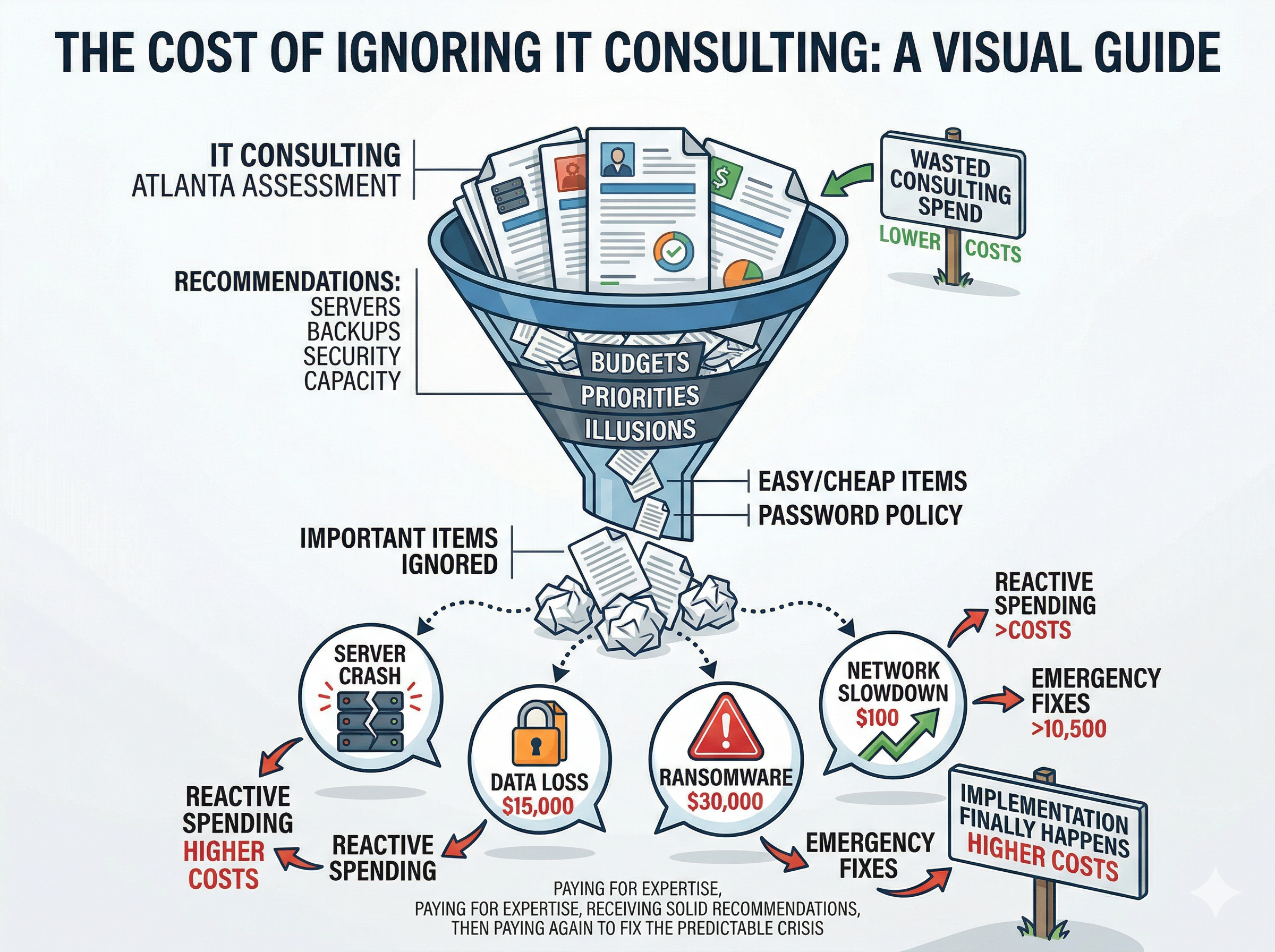
The IT consulting Atlanta firm delivered their assessment three months ago. Comprehensive document, executive summary, prioritized recommendations. Your leadership team nodded along during the presentation. Everyone agreed the findings made sense. The invoice got paid.
Then nothing happened. The 50-page report sits in someone’s email folder. The recommendations about upgrading aging servers, implementing better backup systems, and addressing security gaps didn’t get budgeted. Work continued exactly as it had before the assessment.
Now your file server just crashed, taking down access to everything your team needs to work. The consultant’s report specifically identified this server as end-of-life and recommended replacement within 90 days. That was four months ago. The emergency replacement is costing twice what the planned upgrade would have, and you’re losing a day of productivity while it gets configured.
This cycle plays out constantly across Atlanta businesses: pay for expertise, receive solid recommendations, implement nothing, then pay again to fix the predictable crisis that results.
Why businesses commission assessments they won’t act on
It’s not that leadership doesn’t believe the IT consulting Atlanta recommendations. Most assessments are pretty accurate about identifying risks and needs. The problem is competing priorities and the illusion that nothing urgent is happening.
Budget timing mismatch – The assessment happens in Q3. Budget planning for next year is already finalized. The recommendations get filed under “maybe next budget cycle” and forgotten by the time that actually arrives.
No immediate pain – The servers are old and slow, but they’re still running. The backups are inconsistent, but you haven’t needed them. The security gaps exist, but you haven’t been breached. When nothing’s actively broken, spending money to prevent future problems loses out to current needs.
Sticker shock – The consultant recommends $75,000 in infrastructure improvements. Leadership was expecting maybe $20,000. Rather than have a conversation about phasing or prioritizing, the whole thing gets shelved as “we can’t afford that right now.”
Lack of technical understanding – The CEO doesn’t really grasp why the 8-year-old server is a problem if it’s still working. The CFO doesn’t understand why you can’t just add more storage instead of replacing the whole system. Without understanding the technical reasoning, the recommendations feel optional.
The selective implementation problem
Sometimes businesses implement the easy, cheap recommendations and ignore the important ones. They’ll update the password policy (free) but skip the multi-factor authentication implementation (requires work and user training). They’ll document their systems (takes time) but won’t budget for the hardware refresh (costs money).
This creates the illusion of acting on IT consulting Atlanta advice while sidestepping the recommendations that would actually reduce risk. Six months later when something fails, they’re confused why they still had problems despite “following the consultant’s advice.”
The consultant recommended ten things in priority order. You implemented numbers 8, 9, and 10 because they were cheap and easy. Items 1-3 that would have prevented your current crisis didn’t get done because they required real investment.
When “it’s been working fine” stops being true
Every business that defers IT consulting Atlanta recommendations eventually hits the moment where luck runs out:
The aging server finally fails – It’s been running for seven years, which the consultant said was past expected lifespan. You gambled on it lasting another year. It didn’t. Now you’re paying emergency rates for replacement and recovery.
The backup system you never tested doesn’t work – The consultant recommended backup testing and documented procedures. You skipped it because backups were “running.” When you actually need to restore something, you discover the backups are corrupted and useless.
The security gap gets exploited – The assessment identified missing patches and weak access controls. You planned to address it eventually. Then ransomware hits and you’re offline for a week while you scramble to recover and pay the attackers.
The network capacity limit gets hit – Growth projections showed you’d outgrow current network capacity within 18 months. You’re at month 20 and everything’s slow. Adding employees now means degrading performance for everyone.
The problems consultants predict aren’t hypothetical—they’re pattern recognition from seeing the same issues across hundreds of businesses.
The cost math that doesn’t get done
Atlanta businesses will pay $15,000 for an IT consulting assessment, then refuse to spend $40,000 implementing the recommendations. Then six months later they’ll spend $60,000 fixing the crisis that could have been prevented.
The calculation that doesn’t happen:
- Planned server upgrade: $35,000
- Emergency server replacement after failure: $50,000
- Lost productivity during two-day outage: $20,000
- Overtime to get back to normal operations: $5,000
- Total cost of deferring the recommendation: $75,000
You saved $35,000 by not implementing the recommendation, then spent $75,000 dealing with the predictable consequence. But because these expenses happen separately and the crisis cost isn’t labeled “cost of ignoring consulting advice,” the connection doesn’t get made.
The consulting report as insurance policy
Some businesses commission IT consulting Atlanta assessments not to improve their technology, but to document that they knew about risks. If something goes wrong, they can point to the report and say “we were aware of the issue.”
This is consulting as liability protection rather than actual guidance. The report becomes evidence they were informed about risks, even though they chose not to mitigate them. In some cases this matters for insurance claims or board oversight, but it’s an expensive way to document awareness while not actually addressing problems.
When implementation finally happens
Most recommendations eventually get implemented, just under worse circumstances:
During crisis recovery – The server crashed, so now you’re replacing it. Under time pressure, paying premium rates, without the luxury of planning the implementation properly.
After an incident – Security breach forces implementation of the authentication and access controls that should have been done preemptively.
When growth forces it – You’ve added enough employees that the network literally can’t handle more. Now you’re upgrading while dealing with performance complaints.
New leadership changes priorities – A new CTO or CFO reviews the old consulting report and asks why nothing was done. Suddenly recommendations that were “too expensive” last year are getting budgeted.
The work gets done eventually. It just gets done reactively, expensively, and disruptively rather than proactively during planned maintenance windows.
The consultant relationship cycle
IT consulting Atlanta firms see this pattern enough that they can predict which clients will implement recommendations:
Clients who implement readily:
- Have experienced a major IT failure recently
- Have technical leadership who understands the risks
- Budget based on operational needs rather than just responding to crises
- View IT as business infrastructure, not overhead
Clients who won’t implement until forced:
- Haven’t experienced major IT problems yet
- Leadership sees IT as expense to minimize
- Budget process is reactive rather than strategic
- No internal technical expertise to advocate for recommendations
Consultants can often tell during the initial engagement which category a client falls into. Some still take the work, deliver the assessment, and know it’ll sit ignored until crisis drives implementation.
What actually drives action
The honest answer to what makes Atlanta businesses implement IT consulting recommendations: pain.
Not predicted pain or theoretical risk—actual experienced problems. The server that crashed. The breach that happened. The outage that cost revenue. The employee frustration that led to turnover.
Consulting reports that highlight risks before they materialize rarely drive action unless leadership already has a mindset of proactive management. Most businesses operate reactively, and no amount of professional assessment changes that until the culture shifts.
The businesses that get value from IT consulting Atlanta engagements aren’t smarter or more technical—they’re usually just burned enough by past incidents that they take prevention seriously.
Making the investment worthwhile
If you’re going to pay for IT consulting, either commit to implementing the recommendations or save the money. An assessment that sits ignored is pure waste.
Before commissioning the work:
- Make sure budget exists or can be created for implementation
- Get executive buy-in that this isn’t just documentation exercise
- Understand that recommendations will likely require investment
- Commit to at least addressing high-priority items within the recommended timeframe
Otherwise you’re paying someone to create a detailed document of everything that will eventually go wrong, then filing it away until those predictions come true. The consultant gets paid either way, but you’ve wasted money on advice you weren’t prepared to follow.
The pattern of commissioning IT consulting Atlanta assessments then ignoring them until crisis forces action is so common that consultants build it into their business models. They know you’ll be back—either for crisis recovery that costs more than prevention would have, or for another assessment two years from now that will identify many of the same problems still unaddressed.